The Charleston in American Mah Jongg: Rules and Passing Strategies
In American Mah Jongg, the Charleston is a term for the tile-passing phase that happens right after the deal. Before play begins, players exchange tiles in a set pattern around the table to improve their hands and start committing to a combination from the National Mah Jongg League (NMJL) card.
The goal of American Mah Jongg is to be the first player to build a 14-tile winning hand and go out by declaring Mahjong (or Mahj). But the hands on the NMJL card are very specific, so the Charleston is an important strategic moment. The choices you make during these passes often determine how competitive your hand will be when you play Mah Jongg.
The Basics of the Charleston Tile Exchange
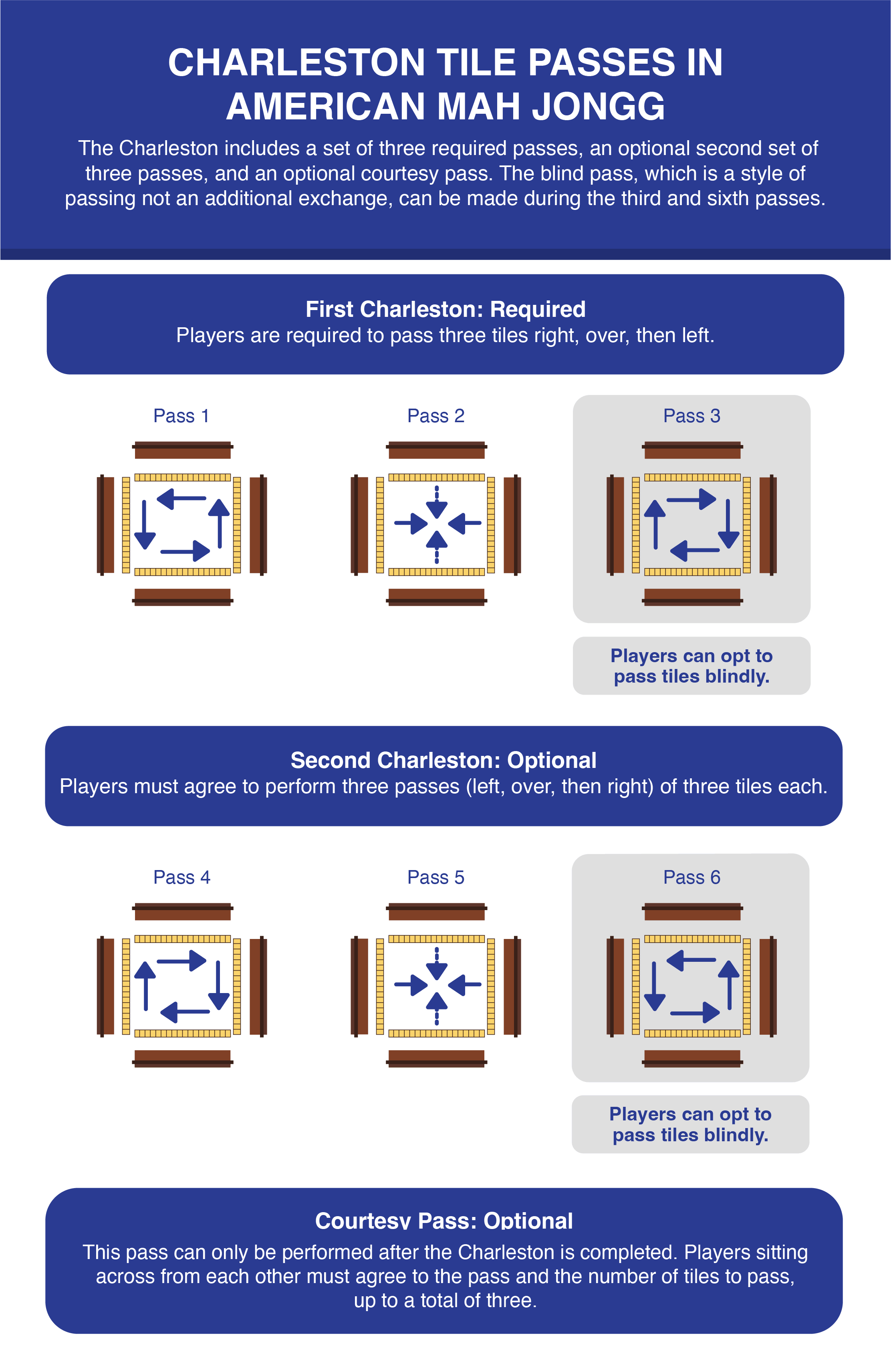
Although it may seem confusing at first to Mah Jongg beginners, passing tiles during the Charleston is very straightforward. You simply exchange three tiles at a time in a pattern that follows the mnemonic ROLLOR (right, over, left, left, over, right). The first three passes are required (the "first Charleston"), and the last three are optional (the "second Charleston"):
- First Charleston (required)
- Pass 1: Right
- Pass 2: Over
- Pass 3: Left
- Second Charleston (optional)
- Pass 1: Left
- Pass 2: Over
- Pass 3: Right
What makes the Charleston confusing for some are particular moves that happen within or after the tile exchanges, such as the blind pass and courtesy pass.
Blind Pass
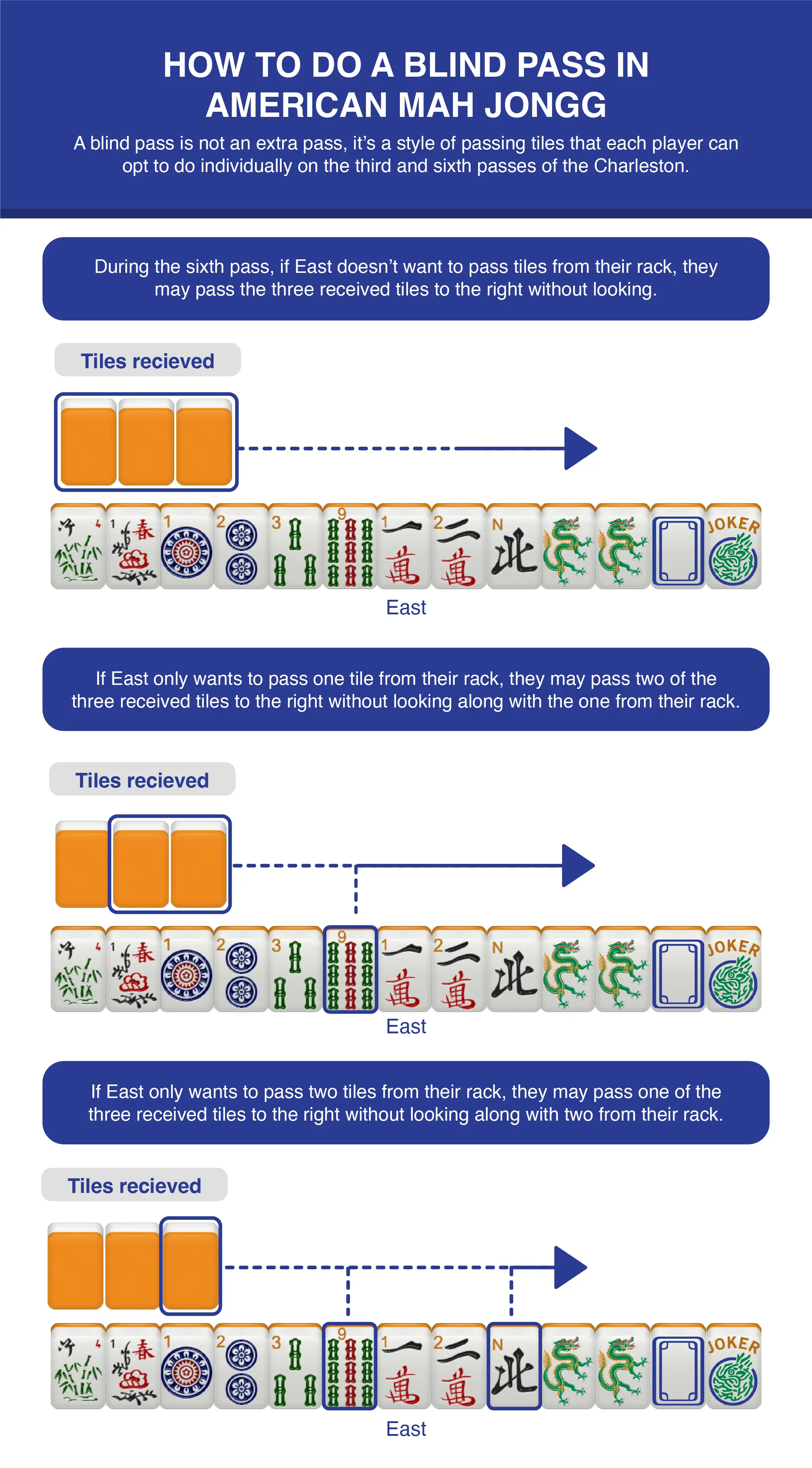
A blind pass means you don't look at the tiles that were passed to you before passing them along. If you have a strong hand and want to pass just a few or no tiles from your rack or you don't want to reveal any hints about your strategy, you might consider performing a blind pass. To do a blind pass, follow these rules:
- A blind pass can only occur during the third and sixth passes (the last pass of each Charleston round).
- A blind pass is optional—the pass itself isn't optional, just the decision of whether to look at the tiles being passed to you.
- Each individual player decides whether to pass blindly, and it doesn't matter if any other player does.
- To make a blind pass in person, don't look at the three tiles passed to you (received tiles). You can blindly pass one, two, or all three of them. Just keep them all facedown and slide over the number of tiles needed to pass on to the next player so that you pass a total of three. If you have one tile from your rack you're passing, you'd slide two of the facedown received tiles over with your one tile to the next player. If you had two tiles from your rack, you'd slide just one of the passed tiles over with those two, or you can blindly pass all three of the received tiles.
- To make a blind pass online with Mahjong 4 Friends, you add however many tiles you want to pass from your rack (up to three) to the dotted rectangles. Then the tiles to be passed to you will automatically pass to the appropriate player. So if you add one tile from your rack to a dotted rectangle and click "Proceed," two tiles will pass blindly, and a new tile will be passed to you. If you add two tiles, one will pass blindly, and you'll receive two new tiles. If you add zero tiles, three tiles will pass blindly, and you'll receive none.
Courtesy Pass
A courtesy pass is an optional agreed-upon tile exchange between two players sitting across from each other that occurs only after the Charleston has been completed. Just follow these rules:
- A courtesy pass happens only after the Charleston has come to an end, so it can only happen once. The Charleston ends either after the first Charleston is done and the second Charleston is skipped or after the second Charleston when all six passes of the Charleston exchange occur.
- Only players sitting across from each other can agree to perform the courtesy pass. No one can be forced to do the pass.
- Players must agree to exchange a specific amount of tiles, up to three.
Mah Jongg Charleston Rules
To understand how to perform each part of the Charleston, follow these steps:
- Begin the Charleston after the Mahjong tiles have been dealt. A Mah Jongg game cannot start until at least the first Charleston (first three passes) has occurred. Players should organize their tiles into sets after the deal to prepare for the Charleston.
- Choose a hand from the NMJL card. Choose a hand or two that's closest to the tiles you have. If you play online with Mahjong 4 Friends, you can consult a helpful list of suggested hands that reveal how many tiles away you are from a winning hand.
- Pass three tiles facedown in each of the three required Charleston passes, performed as follows:
- First pass (right): Select three tiles you want to pass. Place them facedown on the table and pass them to the player on your right.
- Second pass (over): Examine the new tiles passed to you. From all the tiles you now have, select three tiles to pass, place them facedown on the table, and pass them to the player across from you.
- Third pass (left): This optional blind pass lets you choose whether to look at the tiles from the second pass, but you must pass three tiles facedown to the player on your left. You can choose all three after looking, use one or two from your rack and complete the pass with unseen tiles, or pass all three incoming tiles blindly.
- Decide whether to do the second Charleston. This optional set of three passes (left, over, right) must be agreed on by all players, otherwise it's skipped and play begins. If performed, it follows the same procedure as the first Charleston but in reverse order:
- First pass (left): Select three tiles to pass facedown to the player on your left.
- Second pass (over): Select three tiles to pass facedown to the player across from you.
- Third pass (right): Like the first Charleston, this pass is an optional blind pass. Decide whether to look at the tiles passed to you and then select three tiles to pass facedown to the player on your right.
- Perform an optional courtesy pass. This tile exchange is an optional pass that can only occur when the Charleston ends. During this pass, two players sitting across from each other can agree to exchange up to three tiles. Both players must agree to do the exchange, and they have to pass the same amount of tiles, with three tiles being the maximum.
Charleston Strategies for American Mah Jongg
The Charleston may seem like a flurry of passing tiles, but it offers you a strategic opportunity to better your hand (use our comprehensive guide on Mah Jongg hands to better understand how to build your hand) while also picking up subtle clues about your opponents' hands. To gain an advantage, use these Mah Jongg strategies:
- Take your time. If you're playing with experienced players, you may feel rushed to pass tiles, but you can take time to consider your options. Look for winning hands on the NMJL card that require the fewest tiles to complete, and then consider how the tiles passed to you fit those hands.
- Stay flexible early. During the first few passes, avoid locking into a single hand too quickly. It's often best to keep two or three possible hands in mind until you see how the tiles develop.
- Keep pairs. Pairs are key to many winning hands and give you flexibility as your hand develops. You can't call tiles to complete a pair unless it's the final tile to go Mah Jongg, so you have to rely on drawing the right tiles to build a pair if it's not already in your hand. Keeping pairs in the Charleston can put you ahead.
- Prioritize tiles that complete any singles or pairs. Because you can't call tiles for singles or pairs unless you're declaring Mah Jongg, keep those top of mind when looking at the tiles passed to you and when deciding which tiles to pass on yourself.
- Avoid passing Jokers. Because they’re so valuable, Mah Jongg Joker rules forbid you from passing these on to other players in the Charleston. If you do pass one, it should be returned, but some house rules may apply penalties for doing so.
- Pass mismatched tiles. Don't just avoid breaking obvious sets like pairs or pungs, also watch for tiles that fit common NMJL patterns such as single tiles in ascending order (2–3–4 in one suit) or grouped numbers (like a pung of 3 Bams, a pung of 5 Dots, and a pung of 7 Craks). Pass tiles that don't work together in these patterns.
- Watch patterns of incoming tiles. The tiles you receive may hint at what your opponents are not collecting. For example, receiving several Bam tiles could mean nearby players are focusing on Dots or Craks, making hands centered on Bams easier to complete. Although they could pass a 3 Dot because they only needed a pair, you can still gather a sense of what your opponents may not be using to build their hand.
- Don't overthink the Charleston. The Charleston improves your odds, but it does not determine the entire game. Even a modestly improved hand can still develop into a winning one when the game gets going.
A Different Kind of Dance: Do the Charleston with Mahjong 4 Friends
The Charleston is an important part of gameplay, and after you learn how to play American Mah Jongg, you realize how the Charleston is a great spot to gain an advantage. And you can practice these strategies to hone your Charleston-passing skills by playing Mah Jongg online.