Mahjong Tile Names Explained for American Mah Jongg
Mahjong tile sets share a similar foundation, but the total number of tiles and how they’re used can vary depending on the version of the game. Chinese Mahjong sets include 144 tiles, and American Mah Jongg sets include 152 tiles because this variation adds eight Jokers.
While many of the tiles themselves are the same across both versions, the naming conventions and gameplay differ, especially in American Mah Jongg where the NMJL card defines how tiles are used in each hand. Understanding these differences is key if you want to play Mah Jongg with confidence, whether online or in person. The table below offers a snapshot of these differences.
| Tile Group | American Mah Jongg Name | Chinese Mahjong Name | Key Difference |
|---|---|---|---|
| Suit Tiles | Dots, Bam, Craks | Circles (Dots), Bamboo, Characters (Wan) | Chinese Mahjong uses suit tiles in traditional runs; American Mah Jongg uses combinations defined on the NMJL card, which never include runs. |
| Winds | East, South, West, North | East, South, West, North | Chinese Mahjong ties Winds to seat position and scoring; American uses them only as defined by the card. |
| Dragons | Red, Green, White (Soap) | Red (Zhong), Green (Fa), White (Bai) | In American Mah Jongg, Dragons can be independent or correspond to suits; in Chinese Mahjong, they function independently. |
| Flowers | Flowers (all equal) | Flowers and Seasons | American treats all Flowers, including Season tiles, as interchangeable; Chinese assigns specific meaning and scoring to them. |
| Jokers | Used | Not used | Jokers are a core mechanic in American Mah Jongg, but they aren’t used in Chinese Mahjong |
In American Mah Jongg, tile names are the language of the game and the foundation of every hand (learn about Mahjong terminology here). Without a clear understanding of them, gameplay can feel confusing and harder to follow. Tile names help you track the action, call what you need, and read the NMJL card, where every hand depends on quickly recognizing suits, numbers, and tile groupings. This guide breaks down each tile and explains how it’s used in American Mah Jongg gameplay.
American Mah Jongg Tile Names by Group
American Mah Jongg tiles are grouped into three main categories: Suits, Honor Tiles, and Special Tiles, with subgroups in each. Although each group plays a different role, together they form the full set of tiles you’ll use in every game.
Note: Mahjong sets often come with extra tiles and blank tiles. You can use them to replace lost tiles, so store them separately from the tiles you play with.
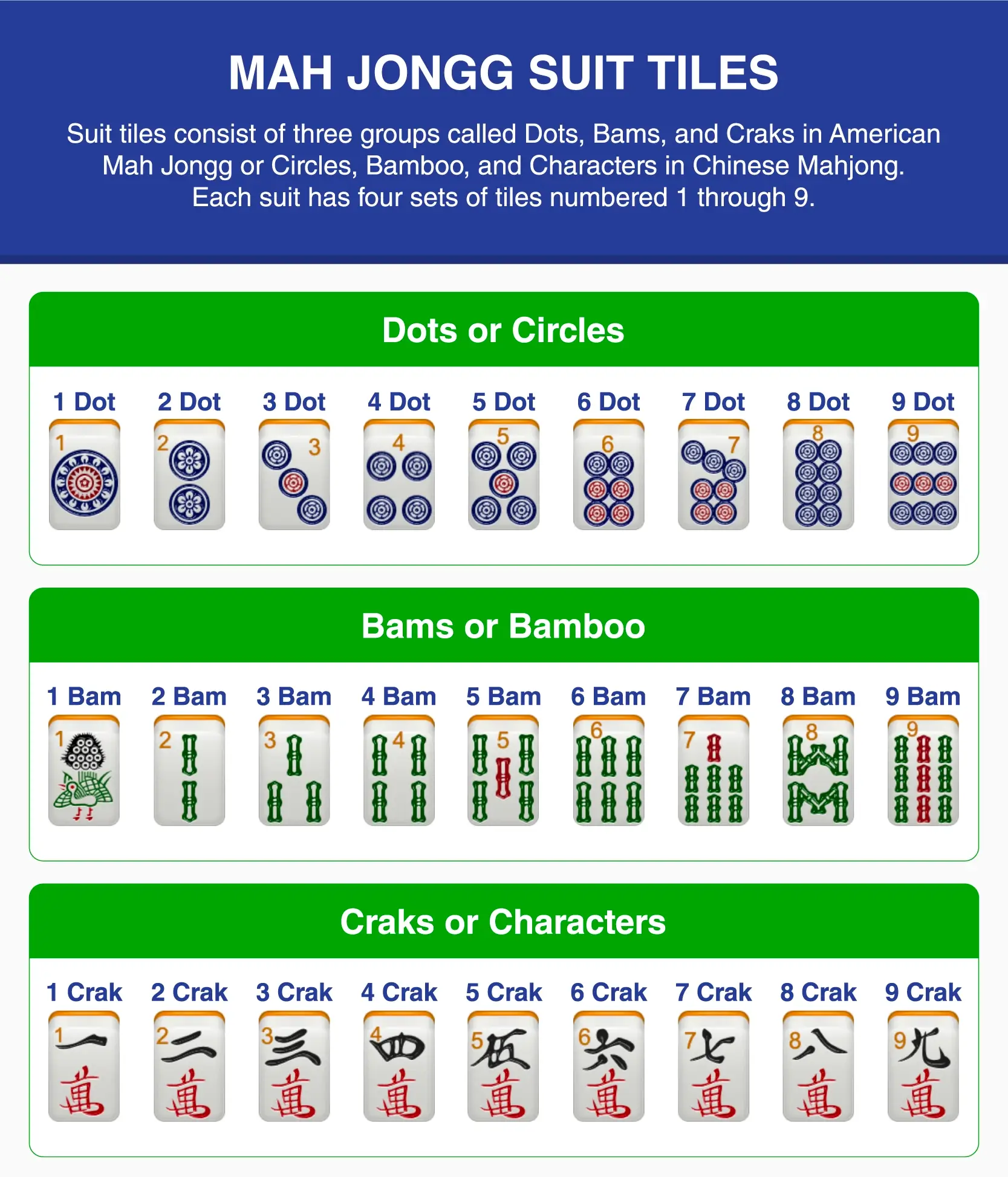
Suit Tiles
Suit tiles consist of three groups:
- Dots: These tiles are typically marked with circular shapes, often resembling dots or wheels.
- Bams: Short for bamboo, these tiles usually feature bamboo sticks or similar linear designs.
- Craks: Short for characters, these tiles are typically marked with Chinese characters, even in American Mah Jongg sets.
Each suit contains numbered tiles from 1 through 9, with four of each tile. When calling a Suit tile, you say the number followed by the suit name, such as “3 Dot.”
On the NMJL card, Suit tiles are not written by name. Instead, they are represented by numbers and organized using color to indicate how suits should be used.
Honor Tiles
Honor tiles include Winds and Dragons. Unlike Suit tiles, they are not numbered.
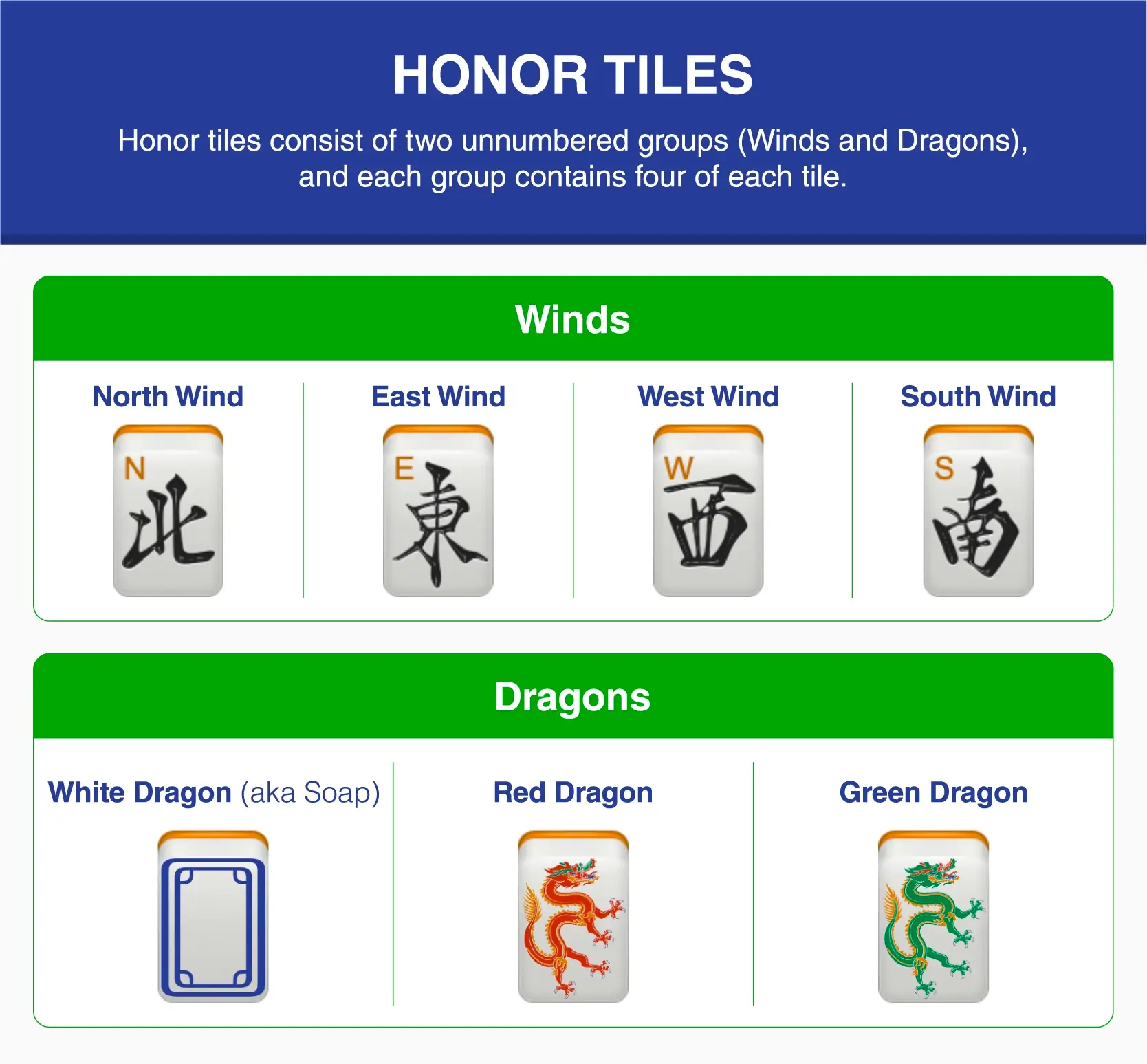
Winds
The Wind tiles include four tiles each of the following:
- North Wind
- East Wind
- West Wind
- South Wind
These tiles are typically called by their cardinal direction name, “North,” instead of “North Wind.” On the NMJL card, these tiles are indicated by a one-letter abbreviation (N, E, W, or S).
Dragons
The Dragon tiles include four tiles each of the following:
- Red Dragon
- Green Dragon
- White Dragon
Call these tiles by their full name, such as “Red Dragon,” but the White Dragon is commonly referred to “Soap.”
Special Tiles
Special tiles include Flowers and Jokers. What makes them special is how they function differently from Suits or Honor tiles in hands.
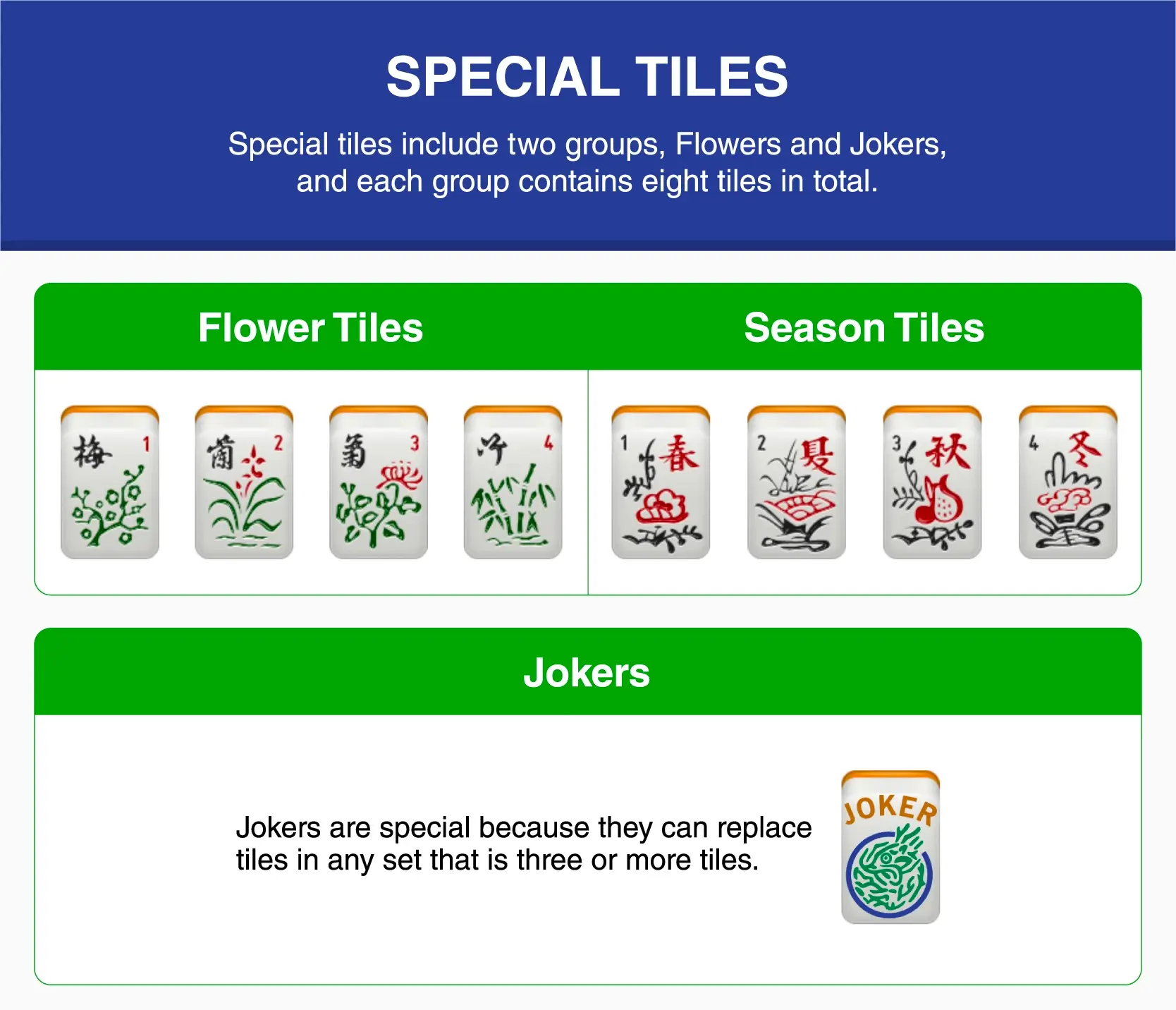
Flowers
Flower tiles (eight in total) are all considered equal, regardless of their design or numbering. While sets often include multiple Flower tiles with different images or numbers, they are interchangeable in play.
Season tiles play a role in other Mahjong variations and often come in American Mah Jongg tile sets, but they aren’t a separate category. If you see tiles that represent the four seasons, they are still considered interchangeable Flower tiles. Just be sure you’re only playing with a total of eight Flower tiles of any design (many sets contain extras).
Flower tiles are simply called “Flower.”
Jokers
Jokers act as wild cards, replacing tiles in pungs, kongs, and quints only, and you play with a total of eight. They cannot be used to replace a single tile or a tile in a pair. You won’t see Jokers listed on the NMJL card because their special feature is that of substituting for other tiles.
Jokers come into play through normal draws or by using the Joker swap rule. When a pung, kong, or quint is exposed with a Joker, you can exchange a matching tile from your rack to claim that Joker on your turn. This applies to both other players’ exposures and your own.
How Tile Names Are Connected on the NMJL Card
The NMJL card doesn’t use tile names directly. Instead, it shows how to build a hand using letters, numbers, and color patterns. Understanding how these elements relate to tiles is just as important as knowing the tile names themselves because it helps you use the right Mah Jongg strategies to build your hand.
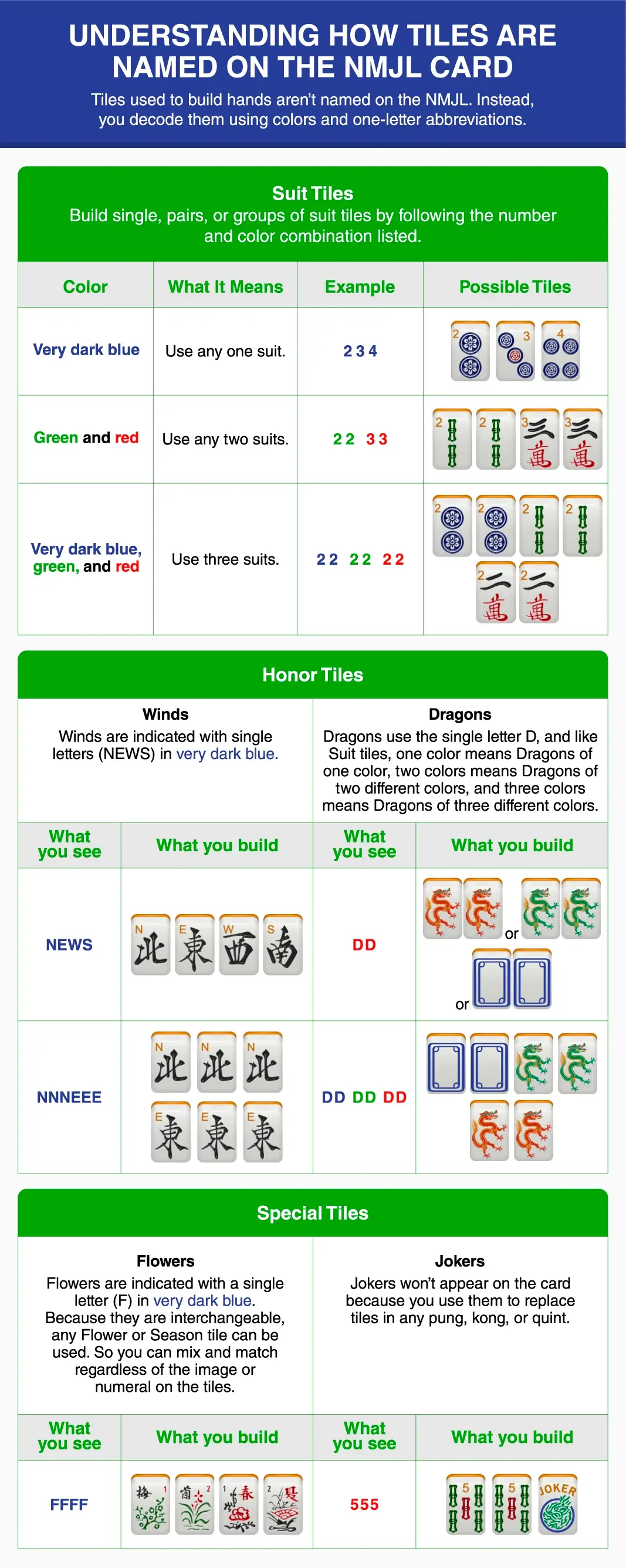
Suit Tiles
Suit tiles are used to build hands in several different ways, depending on how color is applied. The colors do not correspond to specific suits. Instead, they indicate how many suits must be used.
Note that when numbers appear in order, they are not treated as traditional runs, acting as a unit. Each tile is still a separate, single tile requirement. This distinction is key when interpreting the card and deciding what you can and cannot call during play.
One Color (1 Suit)
If a group of numbers appears in one color (very dark blue), it must all be built in the same suit of your choice. In a completed hand, that color always represents a single, consistent suit throughout the entire grouping.
These examples show only how a single numbered grouping is built within one suit. The suit can be any one you choose, as long as all tiles in that grouping match it. They are not complete hands and do not represent full NMJL hand requirements.
Examples:
- 444: 4 Dot, 4 Dot, 4 Dot
- 777: 7 Crak, 7 Crak, 7 Crak
- 123: 1 Bam, 2 Bam, 3 Bam
Two Colors (2 Suits)
If a group of numbers appears in two colors (green and red), it must be built using two different suits of your choice.
Examples:
- 6666: 6 Dot, 6 Dot, 6 Bam, 6 Bam
- 1111: 1 Bam, 1 Bam, 1 Crak, 1 Crak
- 4567: 4 Crak, 5 Crak, 6 Dot, 7 Dot
Three Colors (3 Suits)
If a group of numbers appears in three colors, it must be built using three different suits.
Examples:
- 333: 3 Dot, 3 Bam, 3 Crak
- 789: 7 Bam, 8 Crak, 9 Dot
- 123: 1 Crak, 2 Dot, 3 Bam
Honor Tiles
Honor Tiles are shown on the NMJL card using letters and abbreviations rather than full names. Winds and Dragons are used in specific groupings, and in some cases, Dragons are tied directly to suits through color.
Wind Tiles
When Winds are shown, they must be matched exactly as written. Because their letter differentiates them, you’ll always see them in very dark blue on the card.
Examples:
- EEE: A pung of East tiles
- NEWS: A single North, single East, single West, and single South tile
Unlike Chinese Mahjong, East Wind tiles don’t offer any extra points. They are simply another Wind tile.
Dragon Tiles
Dragon tiles appear with the abbreviation D. When one color is used, you need just one type (color) of Dragon tile; two colors means two different types of Dragon tiles (such as Red Dragon and Green Dragon or White Dragon and Red Dragon), and three colors means you use all three types. White Dragons are also used to build a hand with a 0 (zero) in it.
Examples:
- DDDDDD: A pair of each Dragon tile
- DDD: A pung of Dragons
- DDDD: A kong of Dragons
When a hand is built using suits, the matching dragon is often part of that same color pattern. In many hands, Dragon tiles are connected to suits through color rather than listed explicitly.
- Red Dragon corresponds to Craks
- Green Dragon corresponds to Bams
- White Dragon (Soap) corresponds to Dots
Special Tiles
Flowers have a simple designation on the NMJL card because these tiles are interchangeable, but Jokers won’t appear on the card because they’re used to replace other tiles in your hand.
Flower Tiles
Flowers appear on the card as a one-letter abbreviation, F, in very dark blue. They are the most straightforward tile because any Flower tiles, regardless of number or design, can be used to fulfill the hand requirements.
Examples:
- F: Any single Flower tile
- FFF: A pung of any three Flower tiles
- FFFF: A kong of any four Flower tiles
Joker Tiles
Jokers won’t be listed on the NMJL card because their special function is replacing tiles. Just remember that they can only replace tiles in pungs, kongs, and quints, so you wouldn’t be able to replace a NEWS grouping (a single tile for each wind) or a 123 (single 1, single 2, and single 3 tile).
You’ll encounter a number of tiles when you play Mah Jongg, but understanding their tile names, how they’re grouped, and how they help you build a winning hand will help you build confidence and win when playing Mah Jongg online.