How to Play American Mah Jongg: Rules, Setup, and Strategies
American Mah Jongg is a tile-based strategy game played with four people and a set of 152 tiles. The goal is to be the first player to complete a winning-hand combination so you can declare Mah Jongg (go out). Unlike traditional Mahjong variants that allow more flexible hand-building, American Mah Jongg is built around a yearly card issued by the National Mah Jongg League (NMJL), which lists all valid winning hands as well as hand values, which are essential to Mah Jongg scoring.
Although the game may seem complex to Mah Jongg beginners at first, rounds follow a simple cycle:
- Build and break the wall and then deal.
- Choose a potential hand from the card while exchanging tiles during the Charleston.
- Take turns drawing and discarding tiles while building sets that match the chosen pattern.
Use this guide to learn how to set up Mah Jongg, follow the rules, and discover smart beginner strategies to improve your chances of winning. If you need to practice what you learned, try playing Mahjong online to build confidence in your skills.
Mah Jongg Objective
The goal of American Mah Jongg is to be the first player to complete a 14-tile hand that matches one of the combinations on the NMJL card. Once your tiles match a valid pattern exactly, you declare Mah Jongg, which immediately ends the round.
Mah Jongg Equipment
To start the game, you’ll need just a few pieces of basic equipment.
- Tiles: American Mah Jongg is played with a set of 152 tiles that are used to form the combinations shown on the NMJL card. The tiles fall into three main groups:
- Numbered suit tiles: Bams (bamboo), Craks (characters), and Dots are numbered 1 through 9.
- Honor tiles: Honor tiles include Winds, divided into North, East, West, and South, and Dragons, divided into red, green, and white.
- Special tiles: Flower tiles and Jokers are special tiles. Flower tiles and Season tiles are grouped under the designation of Flower tiles, and because they have no division, all the tiles are interchangeable with each other. So if you see an “F” listed in the hand, you can use any Flower tile. Jokers can substitute for any set consisting of three or more tiles, but they can’t substitute for any tiles in pairs or singles.
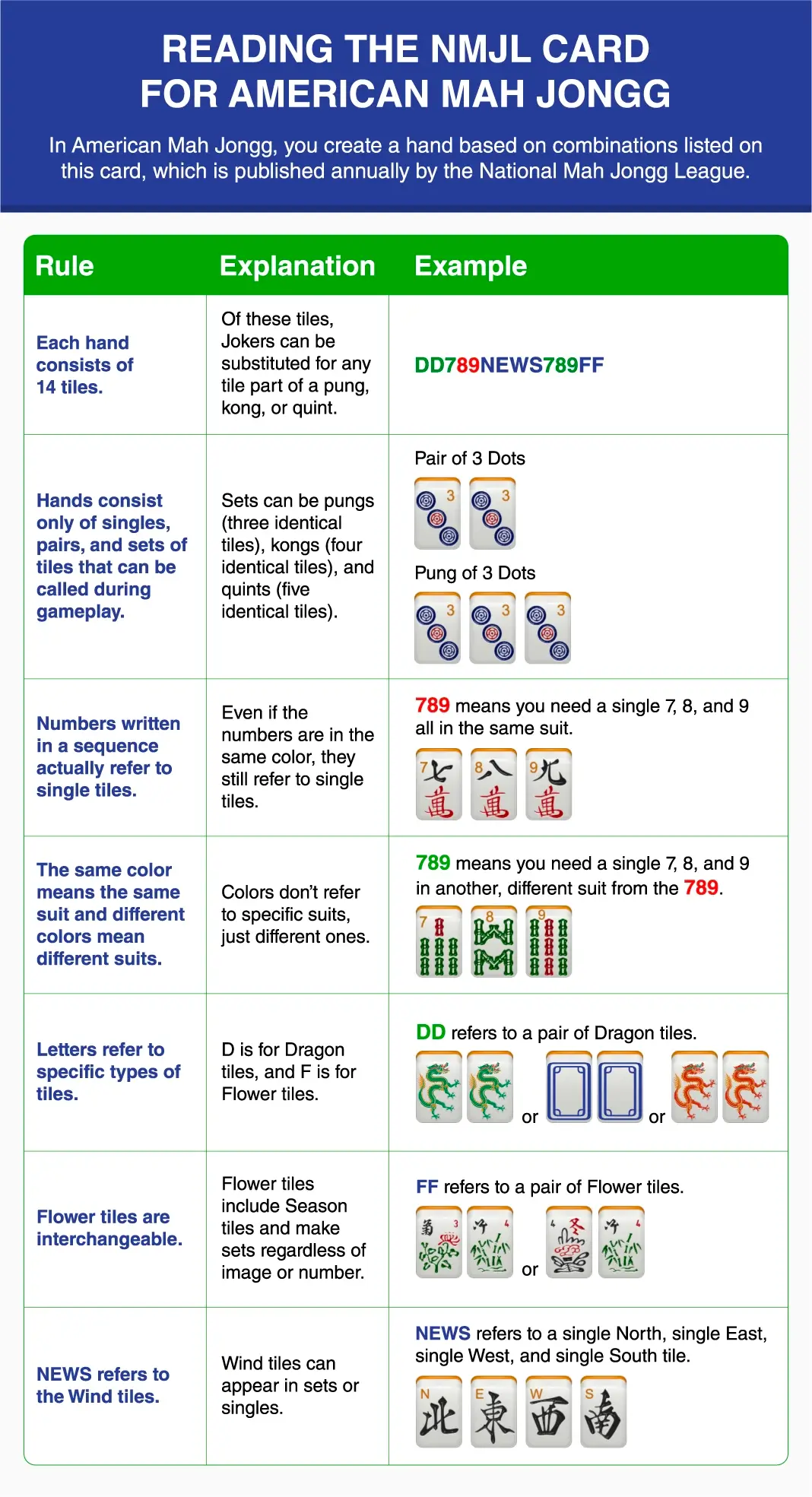
- The NMJL Card: Players must complete exactly one of the combinations on this card, published yearly by the National Mah Jongg League, to win. Each combination shows the tiles required to build the hand, which includes pairs, singles, pungs (three identical tiles), kongs (four identical tiles), and quints (five identical tiles). To read the hands correctly, keep these tips in mind and use our comprehensive guide on Mah Jongg hands.
- Hands never contain consecutive runs or sequences. Although a 2, 3, 4 of a single suit may look like you’re creating a run of consecutive numbers, these are actually single tiles that happen to be in the same suit, so a Joker cannot be used in this case. Similarly, if you see NEWS listed in the hand, this refers to single Wind tiles, one of each direction (North, East, West, and South), so Jokers cannot be used as a substitute.
- Colors on the NMJL card don’t match specific suits. When you see numbers in a specific color in a hand, that means those numbers must belong to the same suit, but it can be any suit. For example, three green 2s (222) on a card can be satisfied by three 2 Bams, three 2 Craks, or three 2 Dots. If the hand also shows three red 2s (222), then you need three 2s from a different suit.
- Racks: A Mahjong set often comes with both a set of tiles and four racks (slanted tile holders) that players can arrange tiles on during the game.
Dealing the Mah Jongg Tiles
Before gameplay begins, players set up the tiles and prepare the table. This is where the action, terminology, and strategy all begin. For a deeper explanation of common terms used in American Mah Jongg, see our full guide to Mah Jongg terms.
To set up your Mah Jongg game, follow these steps:
- Roll dice to determine the first dealer. All players should roll the dice, and the player with the highest total becomes the first dealer, referred to as East. The dealer will break the wall and deal out the tiles. Dealers change each round by taking turns in a counterclockwise direction. So the next round’s dealer is always the player to the current dealer’s right.
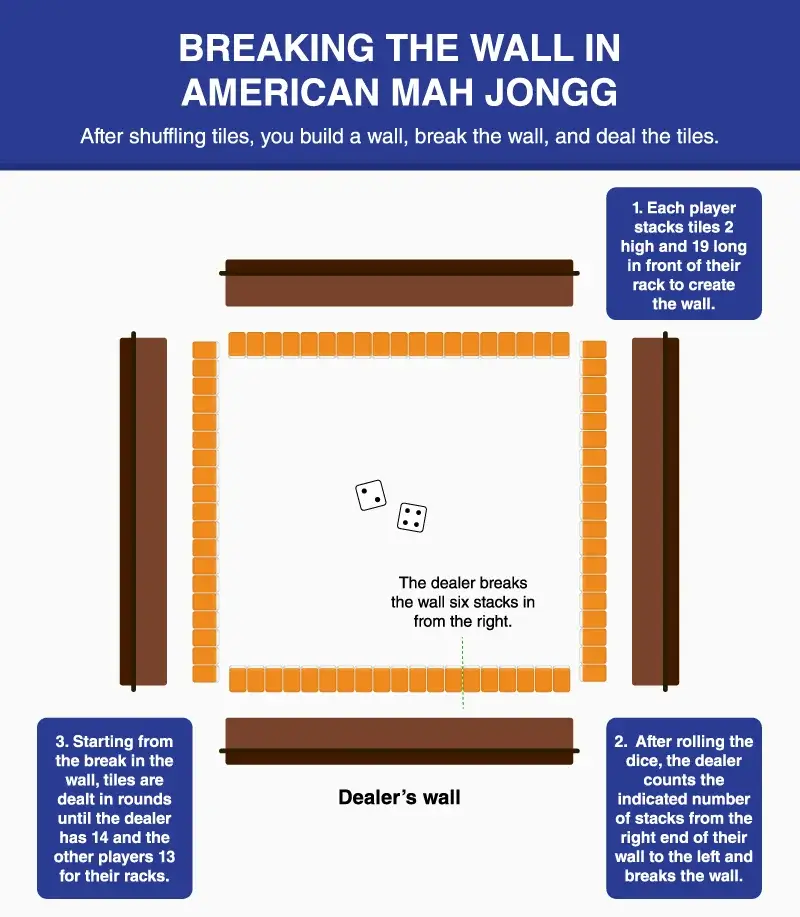
- Build the wall. At the start of a round, players shuffle the tiles facedown and build the wall by each player stacking tiles in a line (wall), 2 high and 19 long, in front of their racks. These four walls are pushed together and form a square.
- Break the wall. After the tiles are shuffled and the wall is built, the dealer rolls two dice to determine where the wall will be broken. Starting with the dealer’s rightmost tile stack and moving counterclockwise around the table, the dealer counts stacks according to the total shown on the dice to determine where they will be breaking the wall. For example, if the dice total is six, the dealer begins at the right side of their wall and counts in six stacks, separating the wall after the sixth stack.
- Deal the tiles. After the wall is complete and broken according to the dice roll, tiles are dealt to the players starting from the opening in the wall. The dealer (East) takes two stacks (4 tiles) and players take two stacks at a time to each player until all players have 12 tiles. Then each player takes 1 more tile for 13 tiles total while the dealer takes 2 more tiles for a total of 14 tiles. After dealing, players arrange their tiles on racks so only they can see them. Because the dealer starts with one extra tile, they will make the first discard once play begins.
Passing Tiles During the Charleston
After the tiles have been dealt, players participate in the Charleston tile exchange, where, in an effort to improve their starting hands, players pass tiles to other players in a specific pattern. During this time, you should choose a hand or two from the NMLJ that’s closest to the tiles you have. When playing online with Mahjong 4 Friends, you are given a list of suggested hands to help you decide!
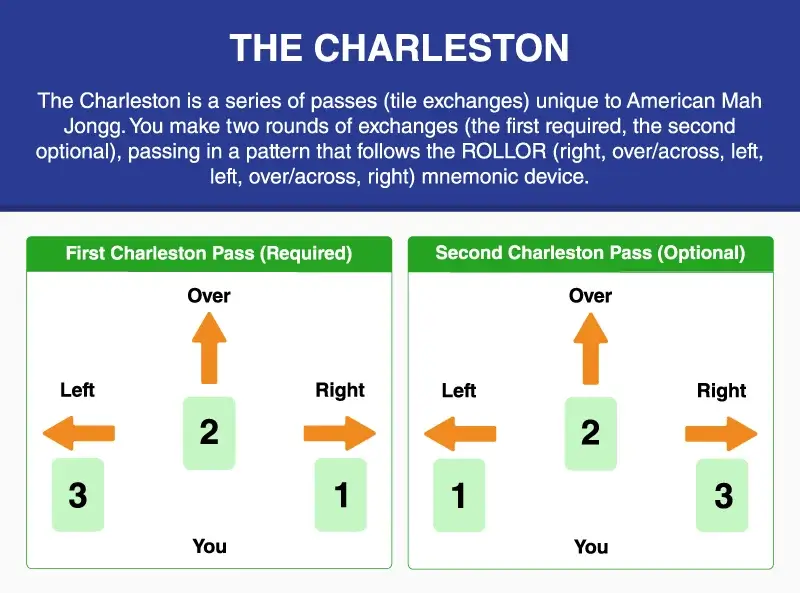
In each exchange, players pass three tiles at a time in a pattern, often remembered by using the mnemonic ROLLOR (right, over, left, left, over, right).
The first three passes are referred to as the first Charleston, which is a required set of exchanges that follow this sequence:
- Pass three tiles to the right.
- Pass three tiles over (across).
- Pass three tiles to the left.
The next three exchanges are called the second Charleston, which is optional if all players agree, and follows this sequence:
- Pass three tiles to the left.
- Pass three tiles over (across).
- Pass three tiles to the right.
A blind pass can only occur on the last pass of each Charleston set of exchanges. It simply means you don’t look at the tiles you’re given when exchanging tiles. For example, if you’re passing left for the last pass of the required Charleston exchange and you have only one tile you’re willing to give up from your tray, you can blindly pass two of the tiles passed to you along with your tray tile to the player to your left.
You can blindly pass as many of the exchanged tiles as you want to as long as you pass three on to the next player. You can also do this type of pass on the third pass (right) of the optional Charleston exchange.
After the Charleston is completed, two players sitting across from each can agree to exchange up to three tiles with each other, which is called a courtesy pass. You must both agree to perform the exchange and must both pass the same number of tiles.
Mah Jongg Rules
Follow these basic rules during play:
- Play begins, after the Charleston, with the dealer discarding the first tile. Then play continues in a counterclockwise sequence around the table, so the player to the right of the dealer takes the next turn.
- Players take turns drawing and discarding tiles. Turns begin by drawing a tile from the wall and end by discarding one face up to the center of the table while saying its tile name (for example, “5 Dot”).
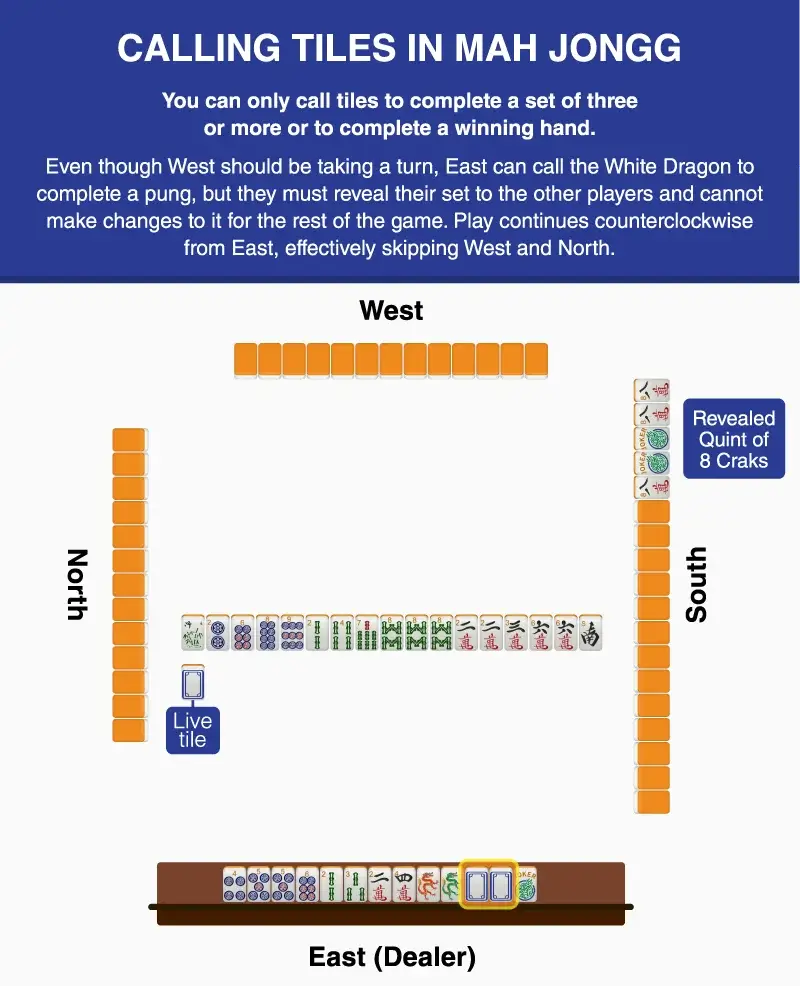
- Even if it’s not their turn, players may call a discarded tile if it completes a valid set of three or more tiles or it completes a winning hand. When a tile is discarded, players can call the tile by saying, “Call,” to complete a pung (three of the same tile), kong (four of the same tile), or quint (five of the same tile). When a player calls a tile, the completed set is exposed on the rack and locked into place (the player can’t add to or make changes to the set). Players may also call the tile for a single or pair if it completes a winning hand, allowing them to declare Mah Jongg. If you call tiles, you must follow these rules:
- If a tile has been called, then play continues counterclockwise from the player who called the tile, even if that means other players have been skipped over.
- If multiple players call the tile, the player with the highest priority gets the tile. Priority, from highest to lowest, is the player completing the last tile of a winning hand and then the player completing a pung/kong/quint who is closest in turn order. So if two players call a tile, with one player needing to complete a pung and one a kong, then the tile is awarded to the player who is closest to going next. If two players call a tile and one is completing a quint and one is ready to declare Mah Jongg, the player needing the tile to win takes priority.
- You must discard after calling a tile. Just like you must discard after drawing a tile, you must also discard when calling a tile to keep your tile count at 13.
- Jokers can be swapped during a turn. If your opponent exposed a set that used Jokers but you have the tile the Joker was substituted for, you can swap your tile for the Joker on your turn. For example, a player played a pung of 4 Craks but used a Joker for one of the tiles. If you have a 4 Crak, you can swap your tile for the Joker during your turn. Simply request the Joker from the player in exchange for your tile. You can also swap for a Joker in your own exposed set, or you can swap for multiple Jokers provided they are in the same set. Use our guide on Mah Jongg Joker rules for a complete explanation of all the rules related to this special tile.
- When a player completes a valid 14-tile combination, they declare Mah Jongg, reveal their hand, and win. The sets you build must match a specific 14-tile hand on the NMJL card. You can’t pick and choose sets from different hands to create a custom hand.
Strategies for Playing American Mah Jongg
Although luck plays a role in which tiles you draw, relying on strong Mah Jongg strategies can significantly improve your chances of winning.
- Choose a hand early. After the Charleston, try to narrow your focus to one or two possible hands. Switching directions too late can make it difficult to complete your hand before another player wins.
- Use the Charleston strategically. The Charleston is your best chance to improve your starting hand. Pass tiles that clearly do not fit your potential hands and keep tiles that give you flexibility.
- Complete pairs and snag singles in the Charleston. Pairs and single tiles are often the hardest part of a hand to complete because they cannot use Jokers unless you’re completing your hand. So use the Charleston to prioritize completing these parts of your hand, and don’t let them go.
- Avoid revealing your hand too early. Calling tiles can speed up your progress, but it also reveals what kind of hand you are building. If you expose too many sets early, other players may avoid discarding the tiles you need. When possible, keep your hand concealed until you are closer to completing it.
- Watch discards carefully. An advanced Mah Jongg strategy, pay attention to what other players discard. If you see many tiles from the same suit being discarded, it may signal that those tiles are safe to release.
Start Playing American Mah Jongg
American Mah Jongg combines strategy, observation, and a bit of luck, making every round different from the last. If you understand the flow of the game—the Charleston, drawing and discarding tiles, and building sets toward a hand on the NMJL card—you’ll find the rhythm of gameplay becomes much easier to follow. The best way to learn the game is to dive in and play Mah Jongg online or download our Mahjong app so you can practice following the rules and using specific strategies..