American Mah Jongg Strategy Tips to Improve Game Play
In American Mah Jongg, you win by completing a specific 14-tile hand from the National Mah Jongg League (NMJL) card before another player declares Mahjong. While luck affects which tiles you draw, strategy affects how you use those tiles to build winning hands and maximize your Mah Jongg score.
A strong set of Mah Jongg strategies can give you the confidence to evaluate every element of the game effectively, from matching your rack tiles to potential hands to decoding player discards and exposures. This guide breaks down practical American Mah Jongg strategies for every stage of the game so you can stay competitive when you play Mahjong online.
Strategies During the Charleston
The Charleston tile exchange is more than swapping tiles. It’s your first opportunity to shape a winning hand, evaluate flexibility, and gather information about the direction of the game. Use the Charleston strategies in this section to improve your hand while also protecting valuable tiles from helping opponents complete sets they need for high-scoring hands.
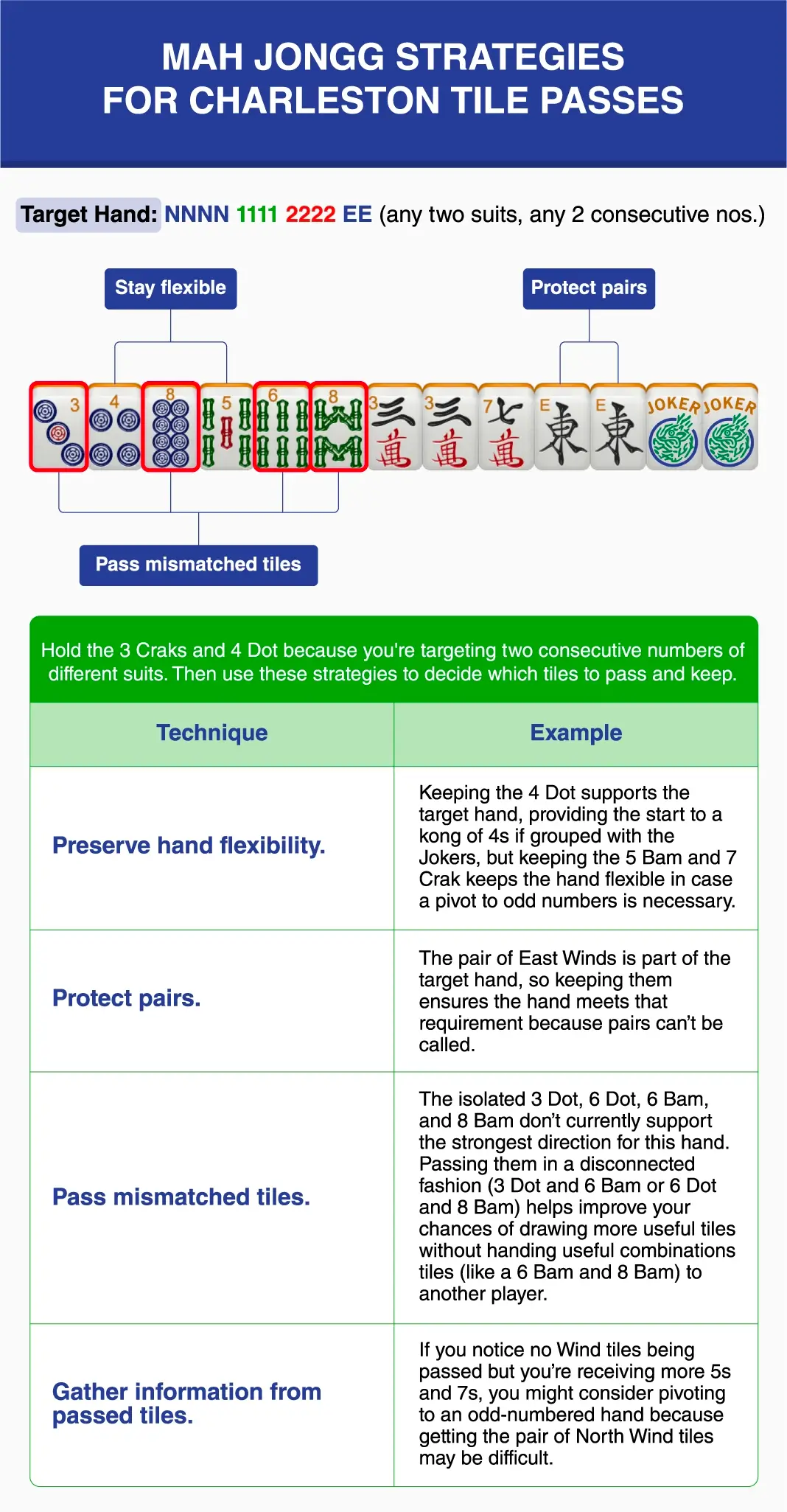
Stay Flexible During the First Passes
One mistake often made by American Mah Jongg beginners is committing to one specific hand too early. During the first few Charleston passes, keep multiple options open instead of forcing one exact pattern from the NMJL card.
For example, if your tiles contain several even numbers, matching tiles, or identical tiles in the same suit, you may have several possible hand options. Staying flexible allows you to adjust if the tiles passed to you strengthen you in one direction over the other. You can use our comprehensive guide on Mah Jongg hands for details on how best to build your hands.
Prioritize Singles and Pairs Early
Although some special hands require singles and pairs almost exclusively, many hands have at least one or two singles or pairs as a requirement. But singles and pairs are some of the hardest parts of a winning hand to complete because Jokers cannot replace them. You also can’t call player discards to complete most singles or pairs unless you’re declaring Mah Jongg.
So focus heavily on protecting useful singles, Wind tiles (because those are often listed as just pairs and singles), and pairs that support your hand choices during the Charleston. If you pass them too early, rebuilding those combinations later in gameplay can become extremely difficult.
Pass Isolated and Mismatched Tiles
During the Charleston, try to pass Mahjong tiles that don’t naturally support the same suit, tiles you’re trying to match, or likely hand patterns you see in your rack. Isolated Mah Jongg tiles are usually less valuable than connected groups of tiles that support multiple hand possibilities. You should also avoid passing obvious combinations, such as partial pungs, pairs, or matching Wind tiles that could easily help another player complete melds.
For example, if your rack contains several even-numbered Dot tiles, a pair of Green Dragons, and matching 6 Bams, an isolated 1 Crak or single West Wind is often a safer pass because it doesn’t naturally connect to your hand. But passing two matching 5 Dots or a pair of North Wind tiles could accidentally help another player complete a pung, kong, or other meld.
Read Information from Incoming Tiles
The Charleston is one of the first chances to gather information about other players’ hands. Repeatedly receiving certain suits, Wind tiles, or unrelated Mahjong tiles may suggest other players are moving away from those patterns.
For example, if multiple players pass you Craks during the Charleston, that may signal those players are not pursuing Crak-heavy hands. Likewise, if you keep receiving isolated Wind tiles or odd-numbered tiles, other players may be prioritizing even-number hands, same-suit patterns, or matching tile combinations instead.
While American Mah Jongg involves luck, you can constantly evaluate what incoming tiles reveal about what other players are planning. This becomes especially important later in the mid-game when discards and exposures narrow the possible hands opponents may be building.
Strategies for Choosing and Building a Hand
In American Mah Jongg, every decision revolves around completing a specific hand from the National Mah Jongg League card. Strong hand selection is one of the biggest differences between beginners and experienced players because the wrong commitment can leave you chasing matching tiles that are no longer realistically available.
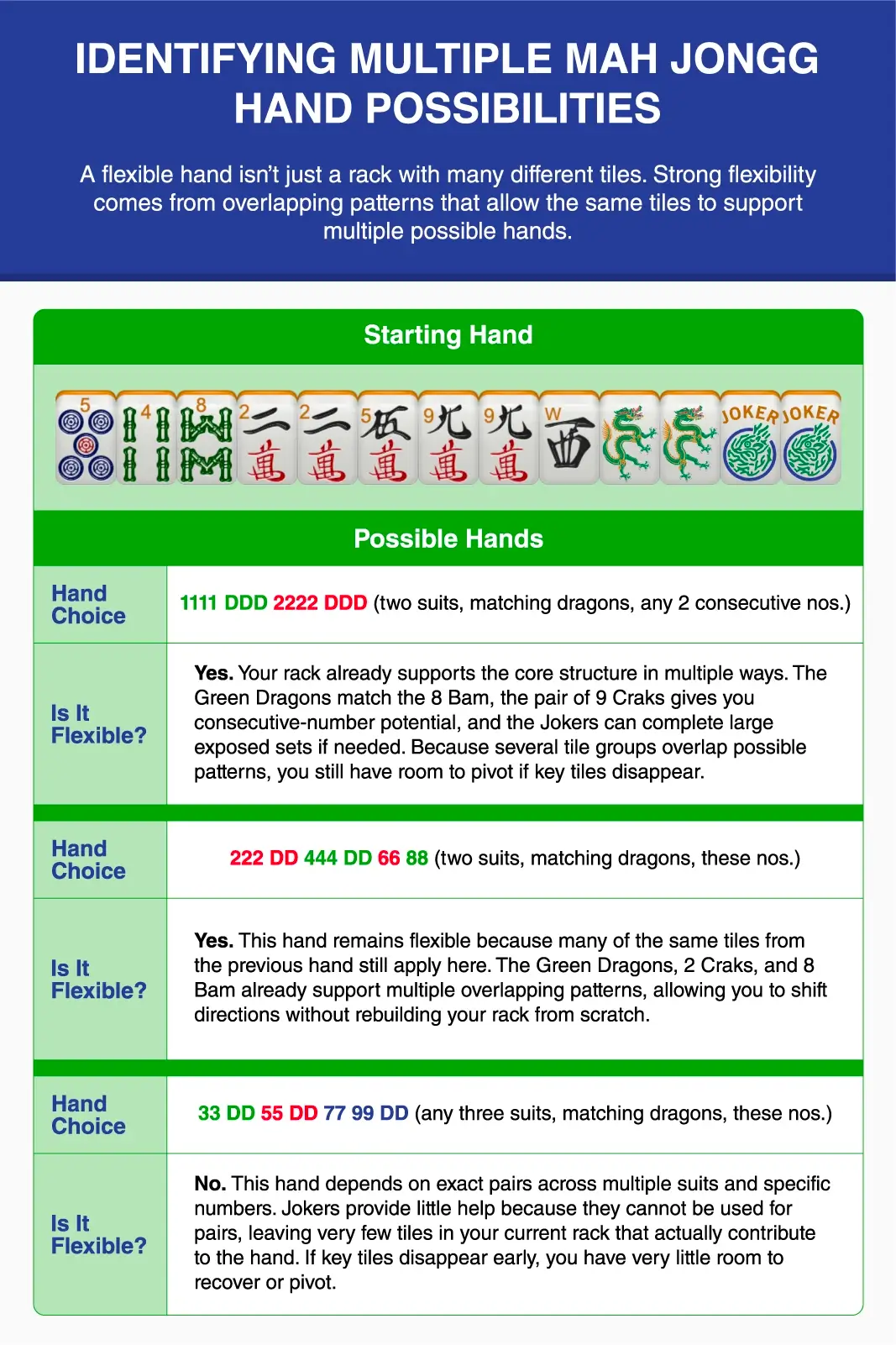
Choose Hands with Flexible Tile Patterns
Many beginners focus immediately on the most exciting or high-scoring hands on the NMJL card. But experienced players often prioritize hands with flexible patterns, overlapping tile usage, or multiple ways to complete the same structure.
For example, a hand that allows several number combinations or works with more than one same-suit arrangement is often safer than a rigid special hand requiring very specific identical tiles or Wind tiles.
Look for Overlapping Possibilities
Strong American Mah Jongg strategy often involves building toward more than one possible hand early in gameplay. If your rack supports several related patterns, you can adjust more easily as Mahjong tiles are discarded or exposed.
For example, pairs, pungs, or matching tiles may support both consecutive-style hands and like-number hands at the same time. Keeping overlapping possibilities alive during the early and mid-game makes it easier to pivot if important tiles disappear.
Avoid Overcommitting to Difficult Hands
Some special hands look appealing because they are high scoring or visually simple, but they can become extremely difficult to complete once key Mahjong tiles are no longer available. Hands built around singles, quints, exact Wind tiles, or difficult matching tile patterns often become dead much faster than beginners realize. You should constantly reevaluate whether a hand is still realistic based on player discards, exposed melds, and visible Jokers.
Reevaluate Your Hand Throughout Gameplay
Hand selection doesn’t end after the Charleston. Continue reevaluating your specific hand throughout the Mahjong game, especially during the mid-game when more information becomes available.
If too many critical tiles have already been discarded, exposed, or locked into another player’s concealed hand, pivoting to a different hand may offer a better chance of completing Mah Jongg before the wall runs out.
Strategies While Drawing and Discarding Tiles
After the Charleston ends, the game becomes a constant balance between improving your own hand and limiting opportunities for other players. Every draw, discard, and exposed set reveals information that can help you adjust your strategy throughout gameplay.
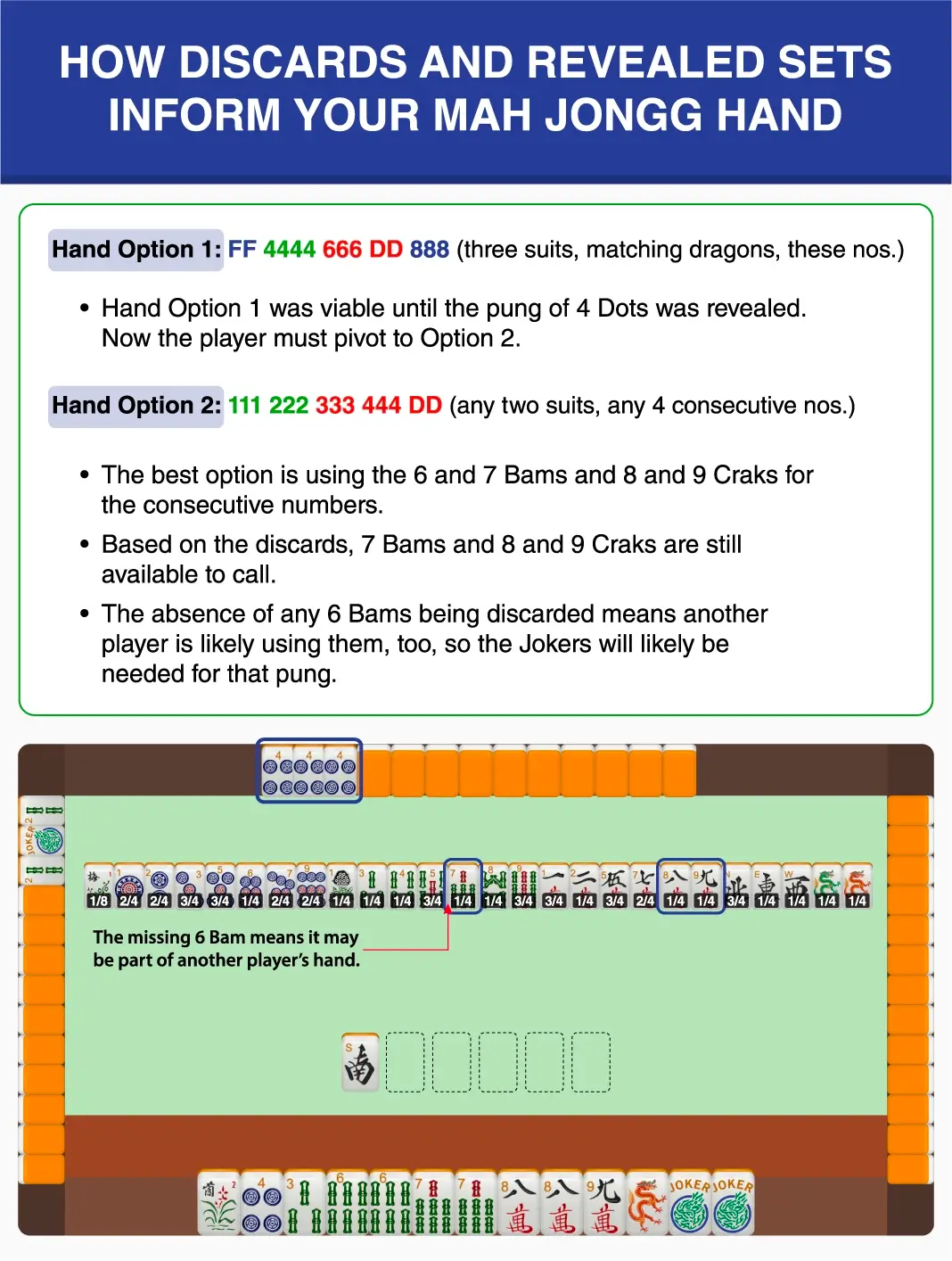
Track Player Discards Carefully
Pay close attention to player discards because they reveal which Mahjong tiles are becoming safer and which hands may still be live. If several copies of the same Mah Jongg tile have already been discarded, hands relying on those matching tiles become much harder to complete.
For example, if three 7 Dots have already appeared in player discards, hands requiring a kong or quint built around that tile becomes much less realistic because only one copy remains unplayed. So you can start eliminating what possible hands other players are pursuing. Discard patterns can also reveal what opponents are avoiding. For example, repeated discards from one same suit may suggest a player has moved away from that suit entirely, and that gives you clues as to what they may be trying to build.
Just as important, especially toward the end of the game, discards can show you what tiles players are not throwing away, which means those tiles are valuable. For example, if no one has tossed a Red Dragon or Flower tile into the discard pile, you can bet someone needs that tile to complete a set or perhaps declare Mahjong. So if you have one of them, keep it in your rack as long as possible until you see someone else discard it.
Avoid Feeding Exposed Hands
After players begin exposing melds like a pung or kong, their specific hand often becomes easier to predict. Keep your eye on exposed sets while watching discards to narrow down possible NMJL patterns and avoid discarding tiles that could complete those hands. This becomes especially important during the mid-game, when a single discard can quickly help another player finish a winning hand.
Reevaluate Every Draw
Many beginners focus only on the Mahjong tiles they need, but you should constantly reevaluate your rack after every draw. A new tile may strengthen a completely different direction or create a more realistic path to Mah Jongg.
For example, you may begin building around an odd-number hand, but drawing several matching even tiles and a Joker during the mid-game may create a faster, more realistic path to a different winning hand on the NMJL card.
You should also watch for when a hand is becoming too dependent on difficult draws, dead tiles, or risky discards. Staying flexible throughout gameplay often leads to more consistent wins than stubbornly chasing one exact pattern.
Don’t Discard Valuable Defensive Tiles Too Early
Not every discard decision should focus solely on improving your own hand. Sometimes holding a potentially dangerous Mahjong tile prevents another player from completing a complete set or calling Mahjong first.
For example, if a player has already exposed several melds with 3s and you’re holding the last visible 3 Bam, discarding it could immediately complete their winning hand. Even if the tile no longer strongly helps your own rack, keeping it out of play may be the safer decision.
To keep valuable game-winning tiles out of the hands of your opponents, keep your potential discards to the side of your rack. Place the safe discards (tiles that match past discards) on the outside, but place ones you believe may be valuable to other players closer to your own sets so you avoid grabbing one by accident.
Strategies for Calling and Exposing Tiles
Calling tiles and exposing melds can speed up your progress toward a winning hand, but exposures also reveal valuable information to the table. As you play, try to carefully balance speed, flexibility, and concealment throughout the game.
Don’t Expose Your Hand Too Early
Keeping a concealed hand longer limits the information available to other players and gives you more flexibility if you need to pivot during the Mahjong game. Many beginners call a pung or kong as soon as possible, but early exposures can make your specific hand much easier to predict. Once opponents recognize your pattern, they may stop discarding matching tiles that help complete your hand.
Call Tiles When Speed Matters
Keeping a concealed hand gives you flexibility and makes your specific hand harder for opponents to predict. But sometimes calling a discarded tile is worth revealing information if it helps you complete an important pung, kong, or other meld before the needed Mahjong tiles disappear from play.
For example, if you already have most of a winning hand completed and another player discards the exact tile needed to finish a kong, calling it immediately may be safer than waiting to draw the tile later. Especially if several copies of that tile are already visible in player discards or exposed sets, you may not get another opportunity.
Key times to be more aggressive include during the mid-game when key matching tiles are disappearing quickly or when another player appears close to declaring Mah Jongg.
Use and Expose Jokers Carefully
Constantly watch exposed melds for potential Joker swaps while also carefully considering whether exposing a Joker is worth revealing information about your hand. Jokers are some of the most valuable Mahjong tiles in American Mah Jongg, but how and when they’re used can dramatically affect gameplay.
A concealed Joker offers flexibility because opponents cannot use it. After a Joker is exposed in a meld, however, it becomes vulnerable to a Joker swap. For example, if a player exposes a kong using a Joker and another player later draws the representative Mah Jongg tile, that player can exchange the tile for the exposed Joker during their turn.
Endgame Mah Jongg Strategies
As the wall gets smaller, American Mah Jongg strategy often shifts from building the strongest possible hand to surviving long enough to avoid feeding another player’s winning hand. This is the time to become far more defensive and even try some advanced strategies, especially because several exposed melds reveal likely NMJL patterns.
Identify Dangerous Discards
Late-game discards carry much more risk than early discards. By this point in the Mahjong game, exposed melds, Wind tiles, matching tiles, and player discards often reveal which specific hand another player may be pursuing.
If an opponent has exposed several sets in the same suit or multiple identical tiles, experienced players avoid discarding tiles that could realistically complete those patterns. For example, if a player has exposed multiple Dot melds and matching Dragons, discarding another Dot tile late in gameplay could help complete a kong, quint, or even a winning hand tied to that same suit pattern.
Recognize When a Hand Is Dead
You should constantly evaluate whether your hand still has a realistic path to winning. One of the hardest skills to build is accepting when a winning hand is no longer realistic. If too many critical Mahjong tiles have already been discarded, exposed, or locked into other players’ melds, continuing to chase the same hand can lead to risky discards and poor decisions.
Shift From Offense to Defense
Not every round should end with aggressive gameplay. Sometimes the strongest Mah Jongg strategy is simply avoiding dangerous discards while waiting for safer opportunities. So as you near the end of the game, become more defensive, especially after another player exposes multiple melds or appears close to completing a winning hand. Protecting the table from an obvious discard can become more important than improving your own rack.
Pay Attention to Tile Availability
Late in gameplay, visible Mahjong tiles become extremely important. Tracking exposed sets and discarded tiles helps players judge whether key matching tiles are still realistically available. This awareness also helps you recognize which special hands or concealed hand patterns are no longer possible as the wall runs down.
Put Mah Jongg Strategies to Work
Your American Mah Jongg strategy should follow one simple rule: Constantly adapt. You need to adjust all throughout the game by reevaluating the NMJL card, tracking player discards, and recognizing when to shift from offense to defense.
The more you play Mah Jongg online or with experienced players, the easier it becomes to recognize the right direction for your tiles, spot dangerous discards, and make smarter decisions during every phase of the Mah Jongg game. With practice, these small strategic adjustments can dramatically improve how consistently you complete Mah Jongg before the rest of the table.