American Mah Jongg Scoring: Hand Values, Doubles & Payouts
American Mah Jongg scoring starts with the hand value printed on the NMJL (National Mah Jongg League), Big, or Marvelous card, and then bonuses and doubles are applied to develop a hand score. That hand score is used to determine the payout between players.
In American Mah Jongg, although each hand has a specific value, that value doesn't become your final score. Instead, it becomes the base value used for calculating payouts. Because each losing player pays the winner, the payout is typically much larger than the winning hand's value, and it's why you may see non-winning players with negative scores.
Whether you play Mahjong online or around a table, the final scores may not be itemized to show how they were calculated, which may be confusing, but we break it all out for you so that you can understand where every point comes from.
This guide focuses primarily on Mahjong 4 Friends' American-style net scoring / payout scoring, where the printed card value is used as the base and eligible self-draw and no-Joker results may double the hand score. Other groups, tournaments, and card publishers may use fixed point bonuses instead, so always confirm the scoring method before play.
How to Calculate American Mah Jongg Scores
Some Mah Jongg terms can make scoring a bit more confusing, so before you learn how to determine scores, this table helps you get familiar with what the scoring terms mean.
| Term | What It Means | Example |
|---|---|---|
| Hand Value | The point value assigned to the winning hand on the card | 25 points |
| Hand Score | The hand value after bonuses and doubles are applied | 25-point hand with a no-Joker double = 50 |
| Payout | The amount exchanged between players based on the hand score and how the hand was won | Three players each pay 50 = 150-point payout |
| Score | The positive or negative value assigned to each player after the payout is applied | Winner: +150; Opponents: -50 each |
Mah Jongg scoring follows three basic steps to calculate scores:
- Confirm the hand value. Every hand in American Mah Jongg has an assigned point value, called the hand value. Whether you use the NMJL card, Big Card, or Marvelous, find the winning hand on the card and note its value. This single value becomes the starting point for calculations. For example, a winning hand had a hand value of 30.
- Apply bonuses and doubles to calculate the hand score. The hand score is the amount used to determine payout. Available bonuses and doubles depend on the hand's composition and how the hand was completed (whether the winning tile was self-picked or called). For example, if the 30-point winning hand qualifies for a no-Joker double, the hand score would be 60.
- Calculate the payout. The payout is the final payment amount, which is determined by how the hand was won. The payout from each losing player is added together for the winner's score, and the payout of each player becomes their final score, which will be negative.
- Discarded: If the winner calls a tile to complete their hand, the player that discarded the tile must pay double the hand score, which in this case would be 120 (60 x 2), and the other two players would each pay the hand score to the winner. So the winner would have 240 points, the player who discarded would have -120, and the other two players would have -60 each.
- Self-drawn: If the winner drew their final tile, then each loser pays the hand score amount. For example, each player must pay the winner 60 points. That means the winner has 180 points, and each loser has -60.
As you continue playing more hands, scores are cumulative. So players with negative scores can dig themselves out of the hole or dig themselves even deeper. How many rounds you play is up to you and the group you're playing with. Remember, too, that while Mahjong 4 Friends doesn't use penalties, some house rules may apply penalties to players for calling discarded tiles by the wrong tile names, building a dead hand, and declaring Mah Jongg in error. So confirm house rules for scoring before you play, and if you need to brush up on the rules of play, use our complete guide to playing American Mah Jongg.
How Bonuses and Doubles Impact Your American Mah Jongg Score
Hand values can have a variety of bonuses and doubles applied, all of which depend on how the hand was won as well as the card you're using. This table breaks down those differences and how they affect the value of the hand, but house rules for the group you're playing with can differ.
| Bonus or Double | Effect on Scoring | Example |
|---|---|---|
| No-Joker Double | Eligible jokerless hands have their hand value doubled. | 25-point hand → 50-point hand score |
| Self-Draw Double | Winning by drawing your own final tile doubles the hand value. | 40-point hand → 80-point hand score |
| Stacking Doubles | Multiple eligible doubles are applied together unless otherwise specified. | 25-point hand with no-Joker and self-draw doubles → 100-point hand score |
| Pure Joker Exception (Marvelous Card) | Required pure Jokers (hands that require a Joker be used as a specific component) do not prevent an otherwise eligible no-Joker double. | 25-point pure-Joker hand still qualifies for a no-Joker double → 50-point hand score |
| No Prior Exposure Bonus (Big Card) | Eligible non-concealed hands with no prior exposures receive a 10-point bonus before any no-Joker doubling is applied. | 25-point hand → 35 points → 70-point hand score after no-Joker double |
American Mah Jongg Scoring Examples
Because seeing the negative scores and watching adjustments as scores accumulate can be confusing, these examples walk you through specific scoring calculations. In the examples below, payout refers to the amount exchanged between players (so it's a positive number), while score refers to the positive or negative value assigned to each player's total.
American Mah Jongg Scoring Example: No-Joker Double
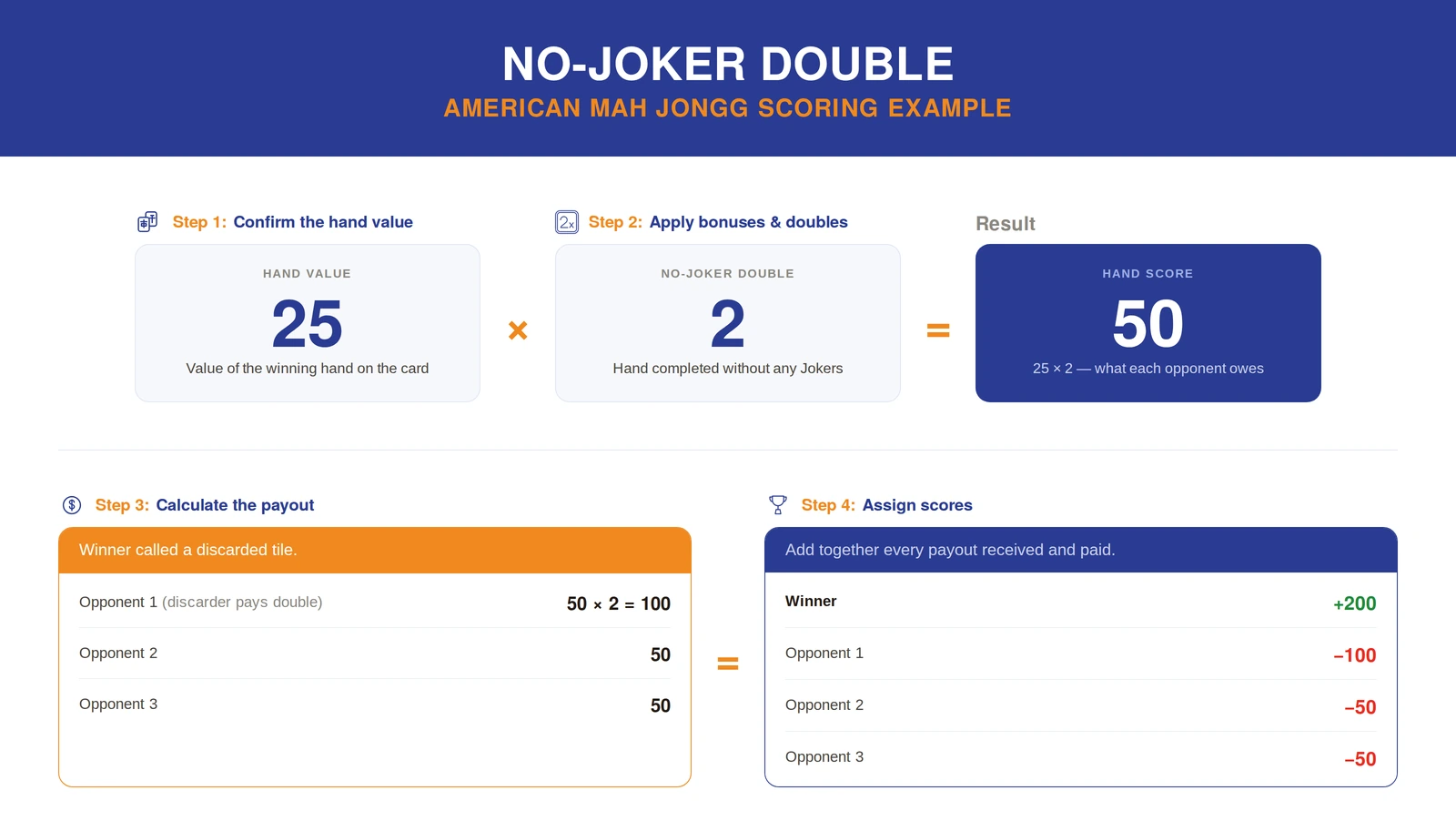
If a winning hand with a hand value of 25 is won with no Jokers and a called tile, scoring for the no-Joker double is calculated as follows:
- Apply bonuses and doubles to calculate the hand score. The no-Joker hand qualifies to be doubled. For example, the 25-point hand would double for a hand score of 50.
- Calculate the payout and assign scores. The payout to the winner needs to account for the discarded tile being called, which means the player who discarded it must pay double the hand score while the other two players pay just the hand score.
- Losing player who discarded: Payout = 100 (50 x 2), for a score of -100
- Two other losing players: Payout = 50 each, for scores of -50 points each
- Winner: 200 points (100+50+50)
American Mah Jongg Scoring Example: Self-Draw Double
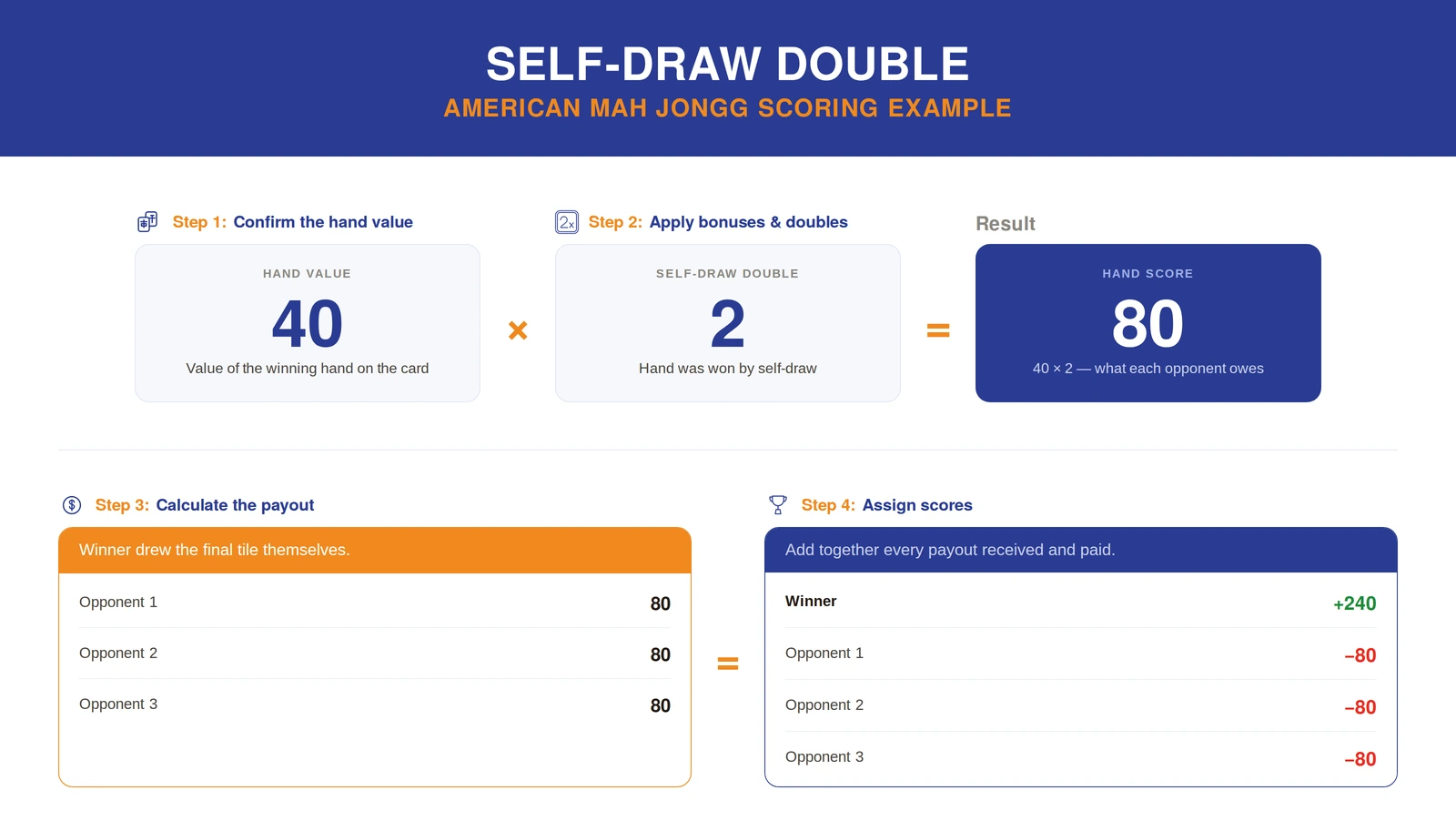
If a winning hand with a hand value of 40 is won by the winner drawing the last tile themselves, scoring for the self-draw double is calculated as follows:
- Apply bonuses and doubles to calculate the hand score. The self-drawn hand qualifies to be doubled. For example, the 40-point hand would double for a hand score of 80.
- Calculate the payout and assign scores. Each losing player must pay points to the winner, which becomes their score.
- Losing players: Payout = 80, for scores of -80 points each
- Winner: 240 points (80 x 3)
American Mah Jongg Scoring Example: Stacking Doubles
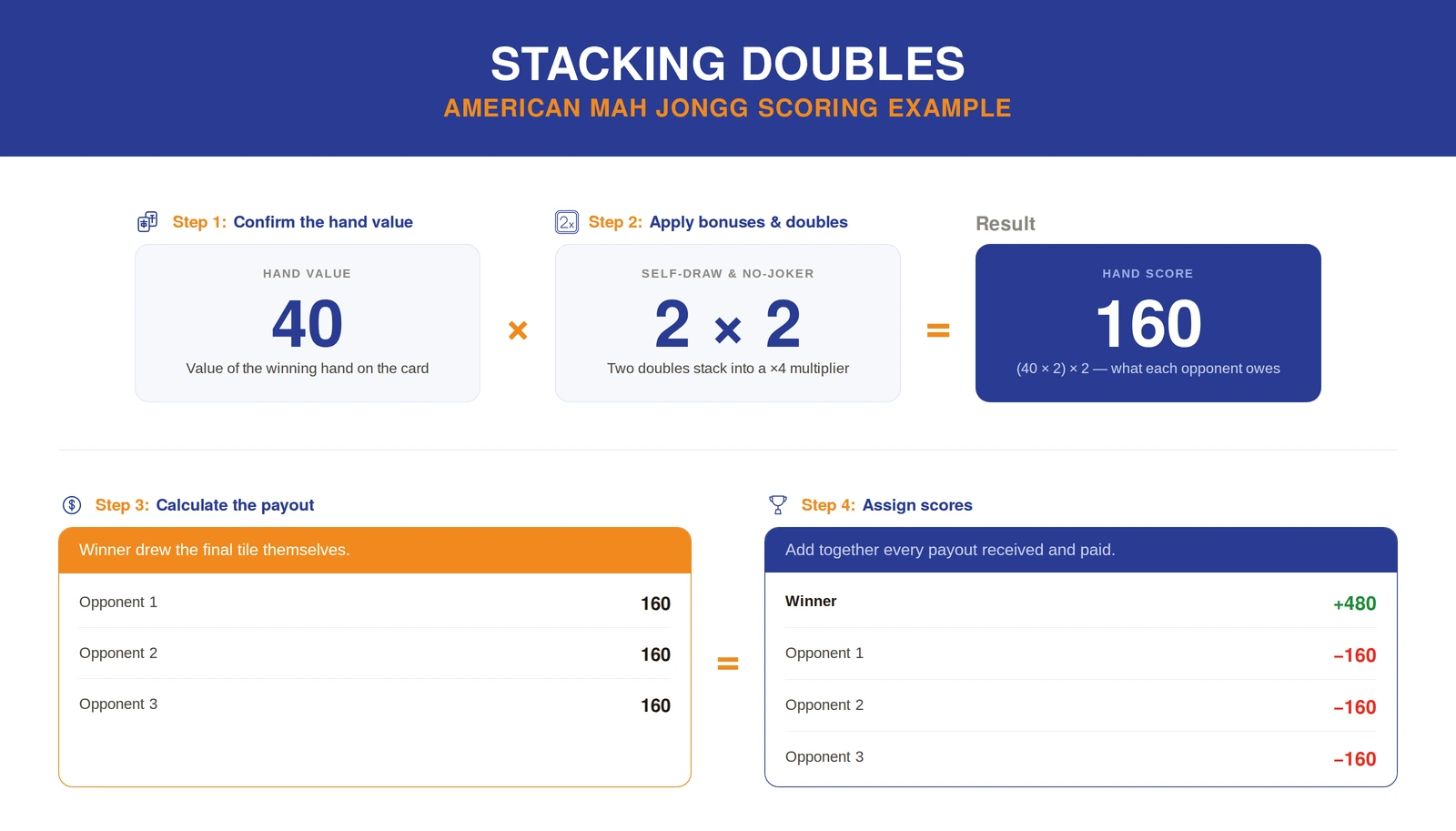
If a winning hand with a hand value of 40 is won by the winner drawing the last tile themselves and their hand qualifies for a no-Joker double, scoring is calculated as follows:
- Apply bonuses and doubles to calculate the hand score. The hand can have both doubles, for the self-drawn tile and the no Jokers, applied to their hand score. For example, the 40-point hand would double once for the no Jokers (80) and then double again for the self-drawn tile for a hand score of 160 (80 x 2).
- Calculate the payout and assign scores. Each losing player must pay points to the winner, which becomes their score.
- Losing players: Payout = 160, for scores of -160 points each
- Winner: 480 points (160 x 3)
American Mah Jongg Scoring Example: Joker Exception (Marvelous Card)
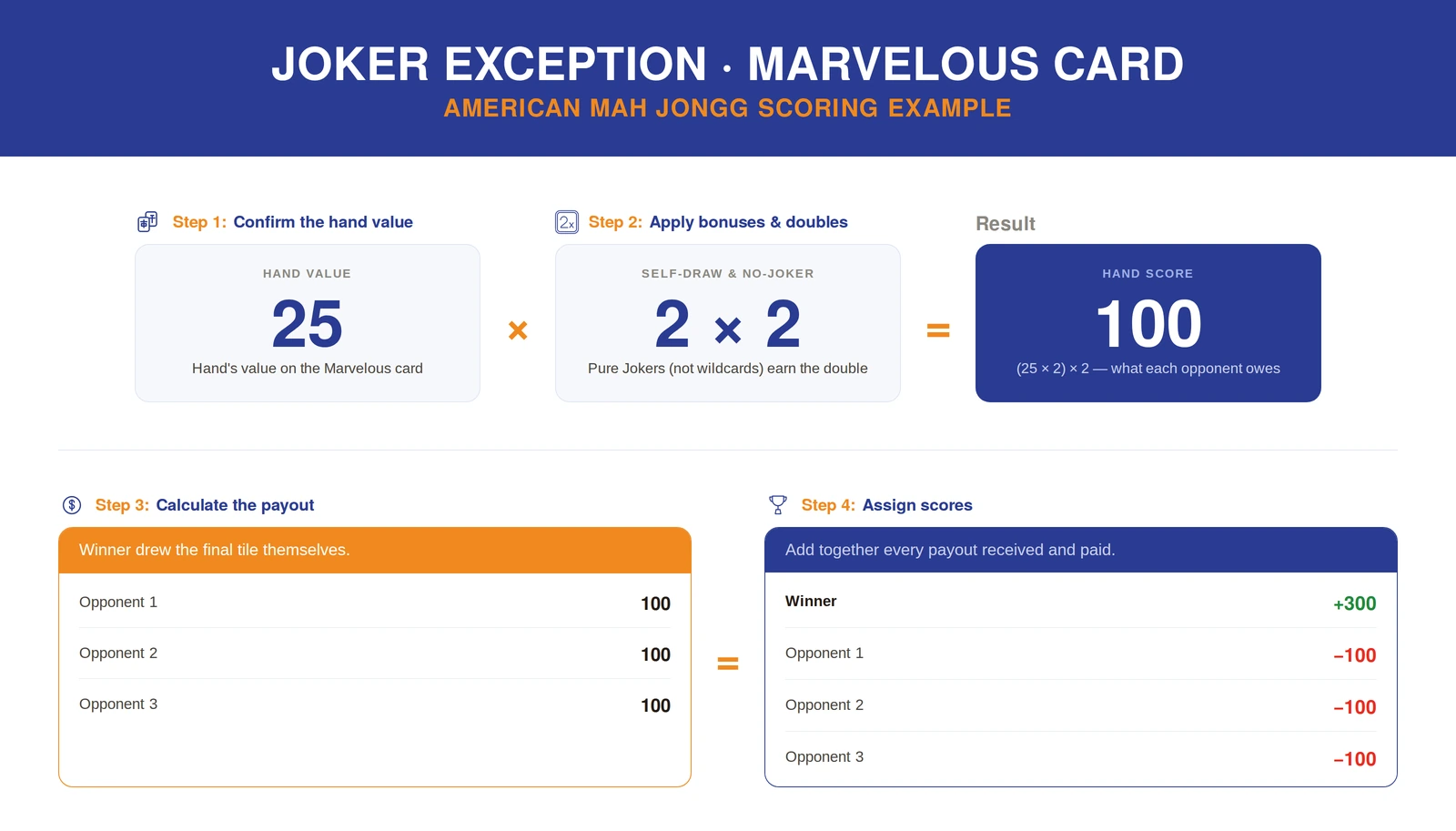
Some Marvelous Card hands, known as pure Joker hands, require a Joker as a literal card component, rather than using it as a wild substitute. When the Joker is required by the hand and is not being used as a wild tile, it typically doesn't disqualify hands from the no-Joker double. So if a player won by drawing the final tile for a 25-point pure-Joker hand from the Marvelous card, scoring is calculated as follows:
- Apply bonuses and doubles to calculate the hand score. The hand can have both doubles, for the self-drawn tile and the no Jokers, applied to their hand score because the Jokers were pure Jokers. For example, the 25-point hand would double once for the no Jokers (50) and then double again for the self-drawn tile for a hand score of 100 (25 x 2 x 2).
- Calculate the payout and assign scores. Each losing player must pay points to the winner, which becomes their score.
- Losing players: Payout = 100, for scores of -100 points each
- Winner: 300 points (100 x 3)
American Mah Jongg Scoring Example: No-Prior-Exposure Bonus (Big Card)
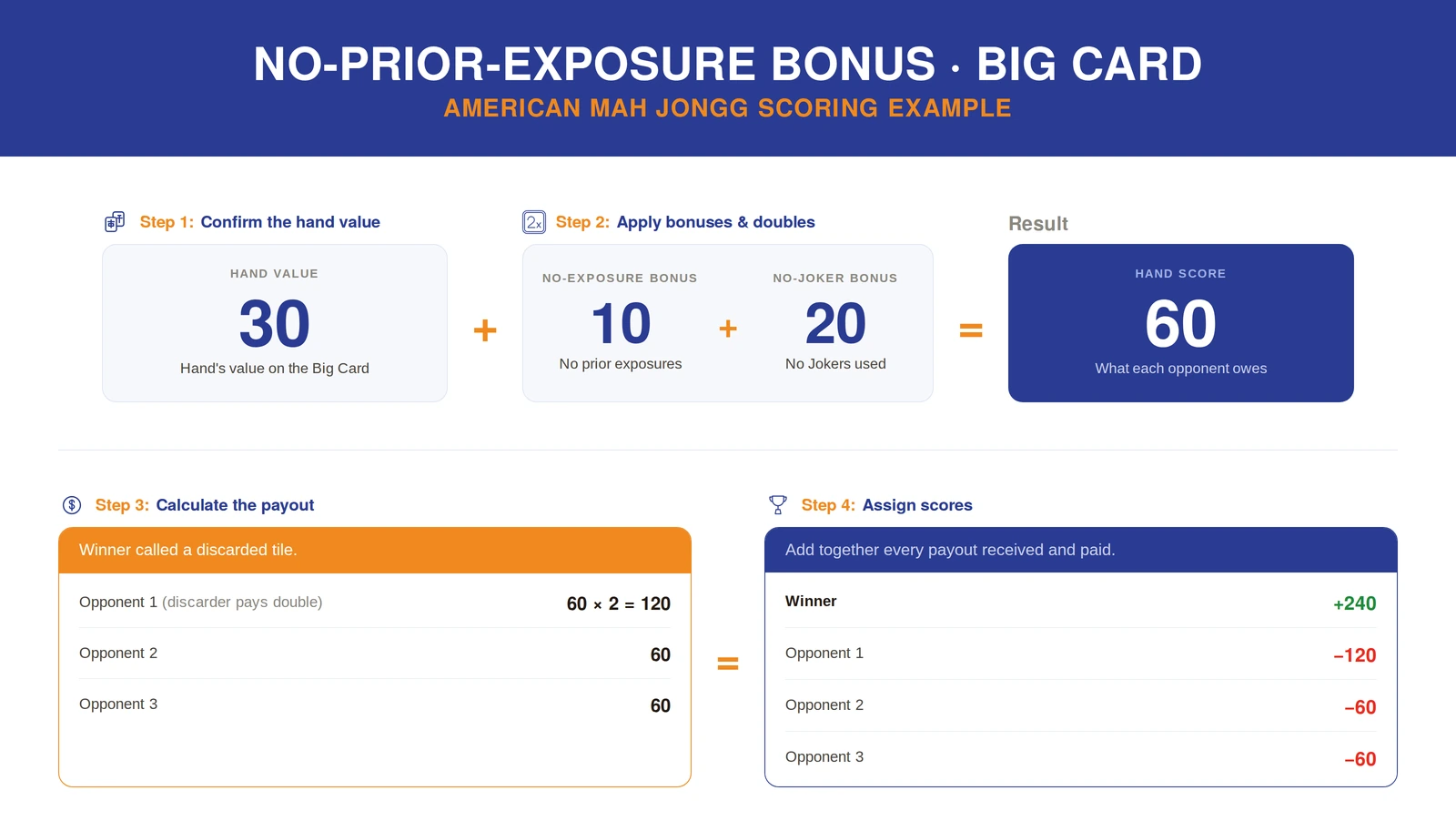
Eligible non-concealed Big Card hands that are completed without prior exposures receive a 10-point no-exposure bonus, and those completed with no Jokers receive a 20-point bonus, provided the hand wasn't singles and doubles. These bonuses don't apply to hands already marked concealed, because their concealed difficulty is already built into the hand value. So if an eligible non-concealed hand used no Jokers, was worth 30 points, and was won by calling a tile, scoring is calculated as follows:
- Apply bonuses and doubles to calculate the hand score. The Big Card hand can have both the no-Joker and no-prior-exposure bonuses applied. For example, the bonuses applied would equal an extra 30 points (10+20), giving them 60 points (30+30).
- Calculate the payout and assign scores. Each losing player must pay points to the winner, which becomes their score, but the player who discarded the tile pays double the hand score.
- Losing player who discarded: Payout = 120 (60 x 2), for a score of -120
- Two other losing players: Payout = 60 each, for scores of -60 points each
- Winner: 240 points (120+60+60)
American Mah Jongg Scoring Tips
Understanding how scores are calculated can help you make better decisions when selecting and pursuing different Mah Jongg Hands.
- Avoid focusing on hand value alone. You'll be tempted to try for high-value hands, but a higher value doesn't always offer the highest payout, especially if it's unattainable. Instead of sticking with a single and pairs hand after receiving only a few matching tiles during the Charleston tile exchange, look for hands that can be flexible so you can adjust, if necessary.
- Consider opportunities for doubling. When choosing between similar hands, pursue the ones that have the potential for doubling your hand value, such as no-Joker doubles. This means choosing hands that commit you to drawing or calling all the tiles you need, and to do so, you may need to focus quickly during the Charleston to fill your rack with necessary tiles for just one hand. While you risk losing pivoting opportunities, you could be rewarded with a double payout!
- Know when to go all in for one hand. If you try to keep two possible hands going, you'll lose the opportunity to capitalize on other bonuses or doubles. Sometimes, players need to stop overthinking their choices and go all in. After all, because bonuses and doubles stack, becoming laser-focused on a specific hand could have you pulling in multiple bonuses and doubles.
- Drop bonus opportunities in favor of winning. Just as important as making your hand choice and sticking to it, you need to know when to quit pursuing something like a no-Joker bonus. While a bonus will increase your payout, if sticking to a no-Joker hand means you can't win, you end up worse off than if you won using Jokers.
Increase Your Chances of Scoring High in American Mah Jongg
Winning a hand is great, but scoring higher than everyone else at the table is even better! Understanding Mah Jongg scoring helps you choose better hands and recognize opportunities for a better payout, and the best way to test your skills is by playing Mah Jongg and tracking your score in real time.