Mahjong Terms Explained: Key Vocabulary for American Mah Jongg Players
The game of Mah Jongg has its own vocabulary, and American Mah Jongg blends traditional Chinese terminology with unique National Mah Jongg League (NMJL) rules and procedures. If you're new to playing the game, terms like “pung,” “Charleston,” or “discarded tile” can feel overwhelming.
This guide organizes essential Mah Jongg terms in the order you’ll encounter them during gameplay—from tile basics to declaring a winning hand—so you can follow along at the table and play Mah Jongg with confidence.
Equipment and Setup Terms
Several equipment and setup-related terms are commonly used in American Mah Jongg. Understanding these terms helps clarify later vocabulary, especially when players refer to the wall, the dealer, or the NMJL card.
- Mahjong set: A Mahjong set is the complete collection of tiles and accessories used to play the game of Mah Jongg. A standard American Mahjong set typically includes suit tiles, honor tiles, Flower tiles, Jokers, racks, dice, and sometimes a wind indicator. Some American Mahjong sets include extra tiles to allow for house rules or replacement pieces.
- Rack: A rack is the slanted tile holder that keeps a player’s tiles upright and hidden from other players. Each player arranges their hand on a rack during gameplay.
- NMJL card: The NMJL card is the official annual card published by the National Mah Jongg League. It lists all valid winning hands for that year, and in American Mah Jongg, a player’s hand must match one of these printed combinations to win.
- Wall: The wall is the stacked formation of facedown tiles placed in the center of the table at the start of a round. Players build the wall by each stacking tiles in a line 2 tiles high and 19 tiles long in front of their racks, and tiles are dealt and drawn from the wall during gameplay.
- Breaking the wall: Breaking the wall refers to the dealer, after the tiles are stacked (wall is built), separating their wall at a point indicated by rolling the dice. This becomes the starting point for tile distribution.
- Dealer (East): The dealer, also called East, is the player designated to begin the round. In American Mah Jongg, the East position rotates counterclockwise among players between rounds.
- Wind indicator: A wind indicator is a marker included in some Mahjong sets that tracks which player is East (dealer) for the current round.
Mah Jongg Tile Categories
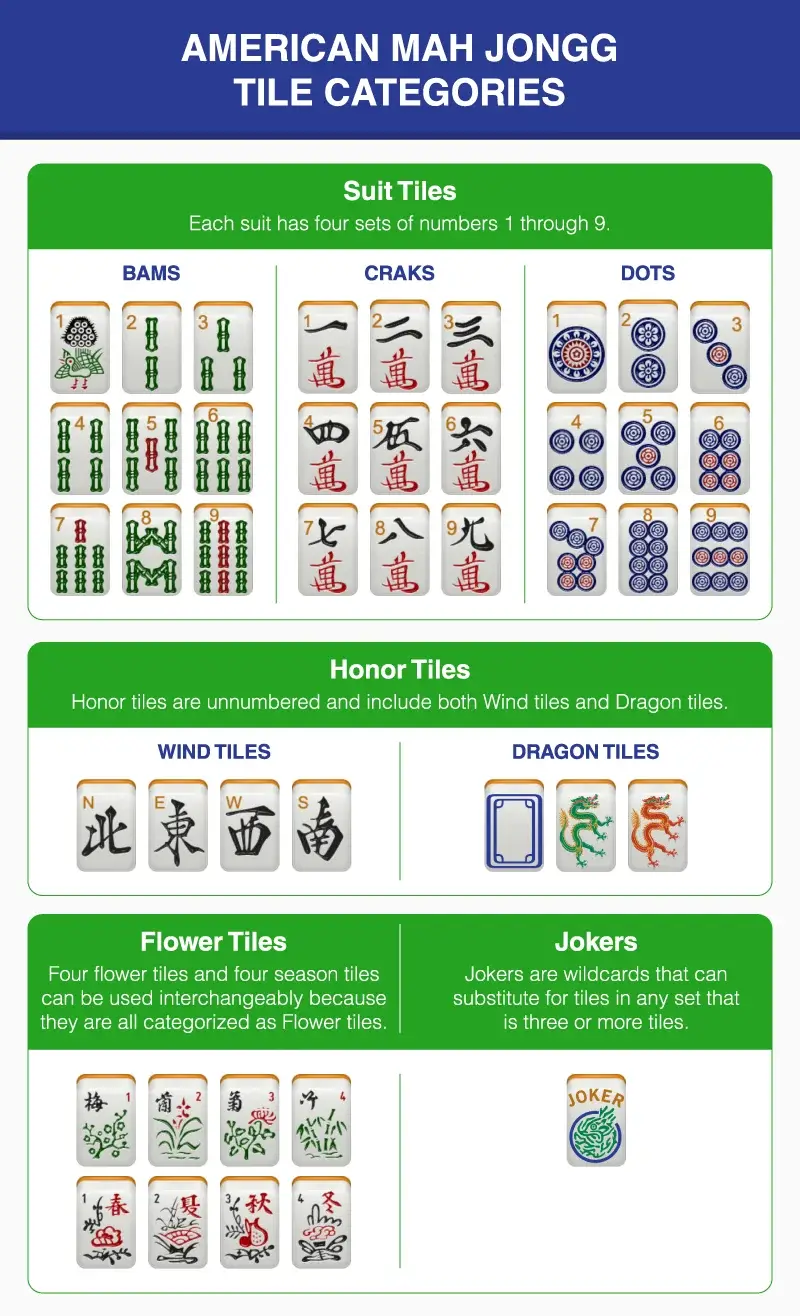
Before you can build a winning hand, you need to understand how Mah Jongg tiles are categorized. In American Mah Jongg, every hand listed on the NMJL card is made from specific combinations of three major tile categories: suit tiles, honor tiles, and Flowers, with Jokers sometimes used as substitutes for tiles in certain sets (pungs, kongs, and quints). Knowing Mah Jongg tile names and which category a tile belongs to helps you recognize what sets you can form and which tiles will never fit together.
Suit Tiles
Each suit contains tiles numbered 1 through 9, with four identical tiles of each number. Because most NMJL hands require matching numbers within the same suit, players typically choose one or two suits to build around when selecting a hand. Suits include:
- Bams (short for bamboo)
- Craks (short for characters)
- Dots (sometimes called circles)
When referring to one specific tile, players typically say the number followed by the suit in a singular form, such as “3 Bam” or “7 Crak,” rather than “3 of Bams.” One exception is the 1 Bam. Some American sets feature a bird on the 1 Bam, and many players casually call it “Bird Bam.”
Honor Tiles
Honor tiles are non-numbered tiles and are divided into Wind tiles and Dragon tiles, which are used to build matching sets.
Wind Tiles
Wind tiles are honor tiles representing the four compass directions. In some variants the East Wind tile is tied to the dealer and can affect scoring, but in American Mah Jongg it has no special value beyond being one of the four wind tiles used in hand combinations on the NMJL card. They include:
- North/North Wind
- East/East Wind
- West/West Wind
- South/South Wind
Players usually shorten the names of wind tiles. For example, they simply say “East” instead of “East Wind.”
These tiles appear in many hands on the card, but the hand category determines how these tiles are grouped. If you see
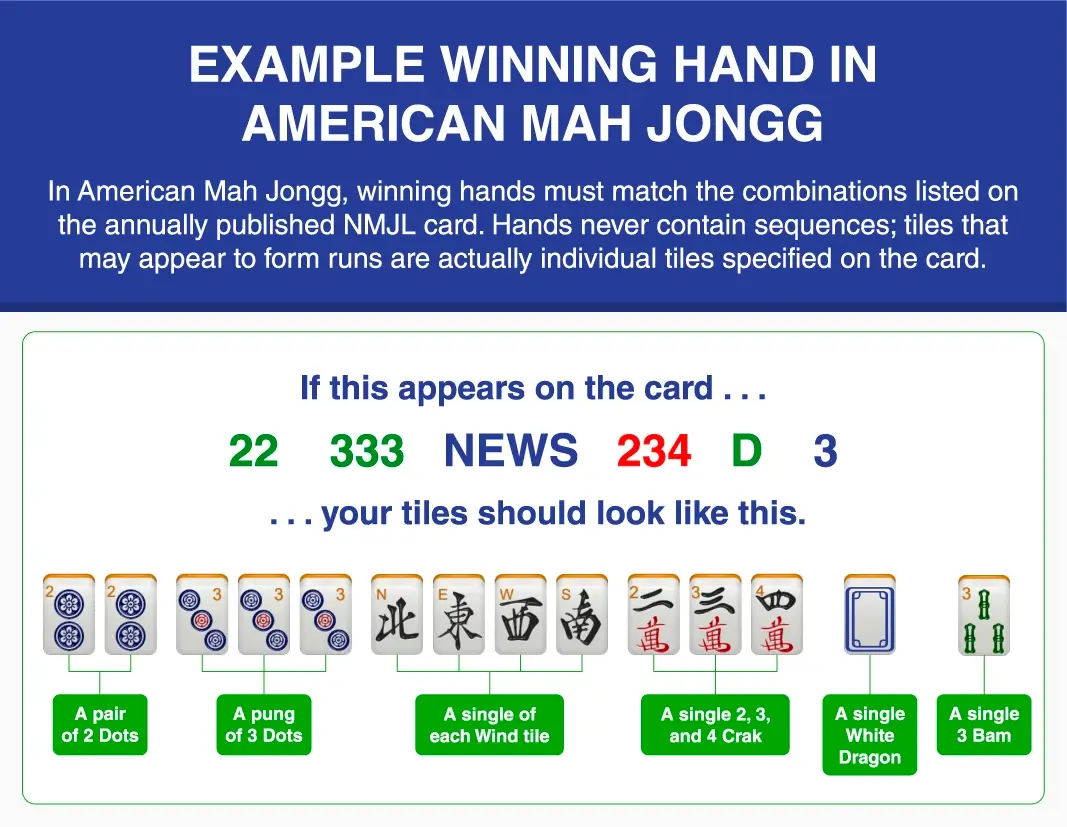
- NEWS: You need a single tile for each wind (North, East, West, and South).
- Four Winds: You need sets of each wind tile (for example: NNN, EEE, WWW, SSS).
Dragon Tiles
The Dragon tiles are honor tiles frequently collected as matching sets. The White Dragon is commonly nicknamed “Soap” in American Mah Jongg and may act as a zero in certain on the NMJL card. The Dragon tiles include:
- Red Dragon
- Green Dragon
- White Dragon
Like wind tiles, players typically say the color rather than the full tile name, such as “Red” instead of “Red Dragon.”
Flower Tiles
In some Mahjong variants, Flowers are treated as bonus tiles that score separately. To understand how that works, you can find it in our guide on Hong Kong Old Style Mahjong. In American Mah Jongg, however, Flower tiles are used only when a hand specifically calls for them on the NMJL card, typically represented by the letter “F.”
In American play, Flower tiles are interchangeable with one another, meaning any flower can substitute for another flower within a flower-based hand regardless of number. In addition, what would be considered season tiles are included as Flower tiles.
Flower tiles are not wildcards. They may only be used when a hand specifically calls for flowers and cannot substitute for suit tiles or honor tiles.
Jokers
Unlike any other tiles, Jokers are wildcards and can substitute for most tiles in sets of three or more identical tiles. However, jokers cannot be used to complete a pair or single tile requirement under NMJL rules.
Jokers are unique to American Mah Jongg and are one of the game’s most important strategic elements. Because many hands require large matching sets, such as kongs or quints, collecting Jokers can significantly increase your flexibility during gameplay. In fact, you can’t complete a quint without a Joker.
You can even swap a tile for another player’s Joker during gameplay. If an opponent reveals a kong of 3 Bams but one tile is a Joker, you can swap a 3 Bam from your rack for the Joker during your turn.
Mahjong Hand-Building Terms
Mahjong hands are built from structured groupings of tiles. On the NMJL card, every winning hand lists the exact combinations required, and these terms can help you make sense of how hands are formed.
- Tiles: Tiles are the individual game pieces used in Mah Jongg, including numbered suit tiles, honor tiles, flowers, and jokers, that get combined to build sets.
- Sets: A set is a group of matching tiles, such as a pung, kong, or quint that forms part of a valid Mah Jongg hand, but a pair or single tile required to complete a hand are not considered sets.
- Melds: A meld is a set that has been exposed on the rack after calling a discarded tile. Only pungs, kongs, and quints can be exposed unless you’re declaring Mah Jongg.
- Hand: A hand is the full collection of tiles a player holds and arranges on their rack while working toward one specific combination listed on the NMJL card.
- Ready hand: A ready hand is another way to describe a hand that is one tile away from winning.
- Winning hand: In American Mah Jongg, a winning hand consists of 14 tiles that match one of the exact combinations shown on the National Mah Jongg League card.
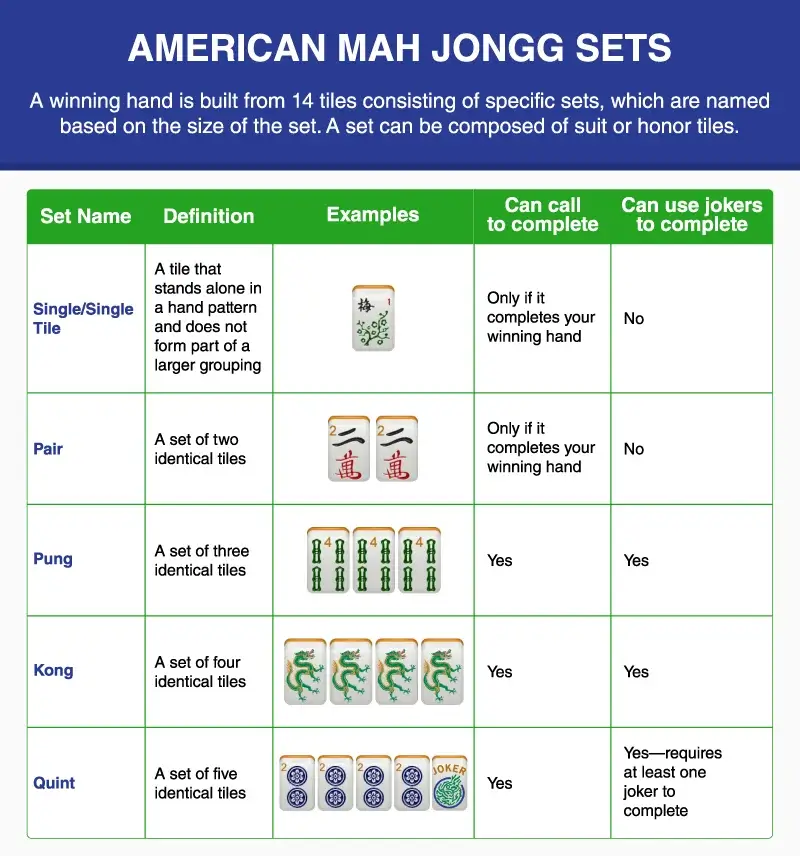
These terms refer to the different elements you may be required to build in a hand and how Jokers interact with each grouping.
- Single tile: A single tile is a tile that stands alone in a hand pattern and does not form part of a larger grouping. Some NMJL hands require specific single tiles rather than pairs or larger sets. Although tiles in a hand may seem to be a numerical sequence (e.g. 1, 2, 3 Bams), it actually refers to collecting single tiles of the same suit (e.g. one 1 Bam, one 2 Bam, and one 3 Bam). You can only call a single tile if it completes your entire hand, allowing you to declare Mah Jongg.
- Pair: A pair is a set of two identical tiles that complete part of a hand. Like singles, you can’t call a tile to complete a pair unless the pair will complete your entire hand so you can declare Mah Jongg, and Jokers cannot be used to complete a pair. Because of this restriction, completing your pair is often one of the most challenging parts of finishing a winning hand.
- Pung: A pung is a set of three identical tiles, such as three 5 Bams, and is sometimes called a triplet in other variations. You can call tiles to complete a pung during gameplay, and may include Jokers as substitutes.
- Chow: A chow is a sequence of three consecutive tiles in the same suit, such as 4, 5, 6 Dots. Chows are common in Chinese and Japanese Mahjong but rarely appear in official American Mah Jongg hands. Sets listed on the NMJL card require hands to rely on groups of identical tiles or sequences treated as single tiles.
- Kong: A kong is a set of four identical tiles. Since there are four identical tiles of each number in a Mahjong set, a kong uses every copy of that tile. Kongs may be formed by calling a discarded tile to complete the set, and Jokers may be used in kongs.
- Quint: A quint is a set of five identical tiles and is a distinctive feature of many American Mah Jongg hands on the NMJL card. Because a Mahjong set includes only four identical tiles, a quint must include at least one Joker.
Charleston Terms
The Charleston tile exchange is a tile-passing phase unique to American Mah Jongg that takes place after the deal and before regular gameplay begins. During this stage, players exchange unwanted tiles in a structured sequence to improve their starting hand. Many American-specific terms originate from this pre-game exchange.
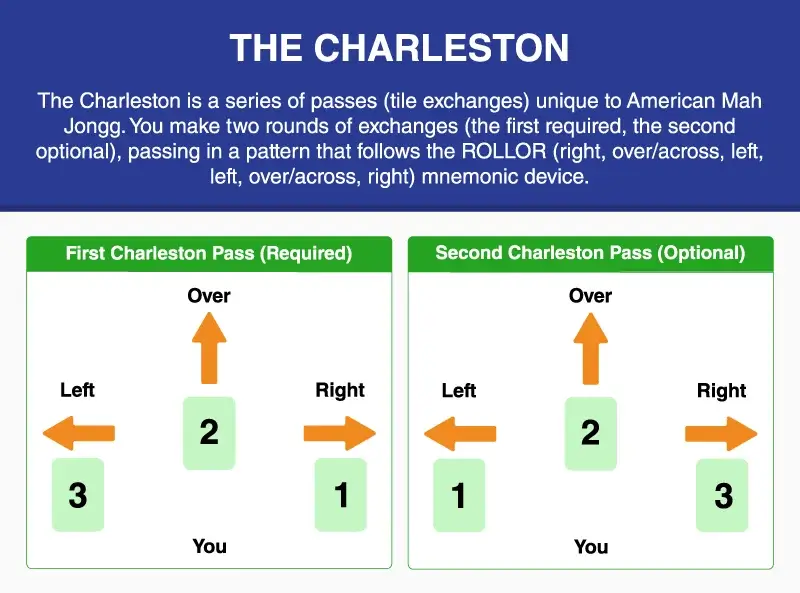
- Charleston: The Charleston is the structured series of tile exchanges that occurs at the beginning of a round. It allows players to refine their hand before gameplay. It consists of six total passes, with the first three passes required and the second round of three passes optional.
- ROLLOR: ROLLOR is a mnemonic some players use to remember the direction of passes during an entire Charleston sequence: right, over (across), left, left, over, right.
- Pass: A pass is the act of giving unwanted tiles to another player during the Charleston. Passes typically involve three tiles at a time.
- First Charleston: The first three passes—passing right, over, and then left—make up the first round of the Charleston and are often called the first Charleston. This series of exchanges is required.
- Second Charleston: The second round of three passes—passing left, over, and then right—are often referred to collectively as the second Charleston. This series of exchanges is optional (also referred to as the optional Charleston), and all players must agree to perform this round
- Right pass: A right pass is a pass of three tiles to the player seated on your right.
- Across pass: An across pass is a pass of three tiles to the player sitting directly across from you. It’s often referred to as the “over” pass, which follows the ROLLOR mnemonic device, as you’re reaching over the table.
- Left pass: A left pass is a pass of three tiles to the player seated on your left.
- Blind pass: A blind pass occurs when a player passes tiles without first looking at the tiles they have received. A blind pass can only occur on the third and sixth passes of the Charleston. If you have a strong hand that you don’t want to disrupt or want to conceal your strategy, you might do a blind pass. You can blindly pass one, two, or all three tiles passed to you.
- Courtesy pass: A courtesy pass is an optional exchange in which players may agree to pass up to three tiles with the player directly across from them. Both players must first agree to do the pass and then agree to the number of tiles to exchange.
Gameplay Terms
After tiles are dealt and players begin building sets, gameplay revolves around drawing, discarding, and occasionally claiming tiles (calling) from other players. These terms describe what happens during an active turn and how tiles move around the table.
- Draw/drawn tile: To draw is to take a tile from the wall at the beginning of your turn. The drawn tile is the new tile added to your hand before you decide which tile to discard.
- Discard/discarded tile: To discard is to place one unwanted tile face up in the center of the table at the end of your turn. A discarded tile becomes available for other players to call if it completes one of their sets.
- Discard pile: The discard pile is the area in the center of the table where all discarded tiles are placed face up. Watching the discard pile helps players track which tiles are no longer available.
- Call: To call is to claim another player’s discarded tile to complete a set. When a player calls, they interrupt the normal turn order to take the tile. Players can call tiles no matter whose turn it is. You can only call a single tile if it completes a set of three or more tiles. You can’t call tiles for a single or pair unless that tile completes your winning hand, allowing you to declare Mah Jongg.
- Exposure/exposed: An exposure occurs when a player reveals a completed set on their rack after calling a discarded tile. An exposed set remains visible to all players for the rest of the round and cannot be changed.
- Live tile: A live tile is the most recently discarded tile, which is still eligible to be called by another player.
- Dead tile: A dead tile is a discarded tile that can no longer be claimed once the next player has drawn from the wall.
- Joker exchange: A joker exchange or swap occurs when a player replaces a Joker in another player’s exposed set with the actual tile it represents, taking the joker into their own hand. This exchange is allowed only under NMJL rules and only in eligible sets.
- Next player: The next player is the person whose turn follows in counterclockwise order. Unless someone calls a discarded tile, the next player draws from the wall to continue gameplay.
Hand Status and Winning Terms
As gameplay progresses, a player’s hand moves closer to completion. These terms describe the status of a hand, whether tiles are concealed or exposed, and what happens when a player reaches a valid winning combination.
- Tenpai: Tenpai is a Japanese Mahjong term that describes a ready hand. While the term does not formally apply in American Mah Jongg, it is sometimes used in broader game discussions to mean one tile from completion.
- Concealed hand: A concealed hand is a hand in which all sets remain hidden on the rack and no tiles have been exposed by calling.
- Exposed hand: An exposed hand is a hand that includes one or more exposed sets formed by calling discarded tiles during gameplay.
- Natural hand: A natural hand is a completed winning hand that does not use any Jokers.
- Winning tile: A winning tile is the final tile that completes all required sets in a hand and allows a player to declare Mah Jongg.
- Mah Jongg (Mahjong): Mah Jongg is declared when a player completes a hand that exactly matches one of the combinations printed on the NMJL card. The declaration ends the round.
- Dead hand: A dead hand is a hand that can no longer legally match any combination on the NMJL card, even if the round continues.
- Washout: A washout occurs when the last tile is drawn from the wall and no player has declared Mah Jongg.
Terms from Other Mahjong Variants
If you’re learning to play Mahjong, you may come across terms that don’t appear on the NMJL card or at an American Mah Jongg table. That’s because different versions of the game, including Chinese and Japanese Mahjong, use additional vocabulary and scoring systems. Understanding which terms belong to American Mah Jongg and which do not can help prevent confusion when reading guides or watching gameplay from other regions. So use this list to help guide you:
- Riichi: Riichi is a declaration used in Japanese Mahjong when a player reaches a ready hand and commits to winning on a specific tile. This term is not used in American Mah Jongg, where players simply say they are “calling.”
- Tsumo: Tsumo is a Japanese term for winning by drawing your own final tile from the wall. In American Mah Jongg, players declare Mah Jongg regardless of whether the winning tile was drawn or called.
- Ron: Ron is a Japanese term for winning on another player’s discarded tile. American Mah Jongg does not use separate terminology to distinguish how the winning tile was obtained.
- Yaku: Yaku refers to specific scoring combinations required to win in Japanese Mahjong. Unlike American Mah Jongg, which relies entirely on the printed NMJL card, Japanese Mahjong requires at least one qualifying yaku to declare a win.
- Chun: Chun is the Chinese name for the Red Dragon tile. In American Mah Jongg, players refer to it simply as the Red Dragon.
- Simples: Simples is a Japanese scoring concept that refers to numbered tiles that are not terminals (1s or 9s) or honor tiles. This distinction does not apply in American Mah Jongg scoring.
- Meld (in Japanese Mahjong): While the term meld appears in multiple variants, in Japanese Mahjong it has formal scoring implications. In American Mah Jongg, “meld” is primarily a descriptive term for a completed and revealed set and is not tied to a point system.
Now that you understand the most important Mahjong terms, you’re ready to put that knowledge into action. The best way to make this vocabulary stick is to practice it in real gameplay. Head over to Mahjong 4 Friends and start playing Mahjong online to practice these terms at the table.