American Mah Jongg Hands: How to Build Winning Hands
Most people assume Mahjong has one standard way to build a winning hand. And if you're playing Chinese Mahjong or other traditional types of Mahjong, that's largely true: You're working toward a complete hand of four sets (chows, pungs, or kongs) and a pair. But American Mah Jongg works differently. In American Mahjong, you build one specific pattern from the annual card issued by the National Mah Jongg League (NMJL). These NMJL cards define every legal winning hand, and if your tiles don't match one exactly, you can't declare Mahjong.
That changes how you play Mah Jongg from the very first move. Instead of focusing on sets alone, you're reading your hand for patterns grouped on the card, looking for even, odd, or like numbers or groups of Wind or Dragon tiles. And because you can't complete a single tile or pair by calling a discarded tile, your decisions during the Charleston are critical. Additionally, the hand you choose impacts Mah Jongg scoring at the end of the game, so you want to select a hand you can win with.
In American Mahjong, success comes down to recognizing which of the official Mah Jongg hands your tiles can realistically become and adjusting your rack to complete the pattern before the end of the game. To do that, you have to learn how to read the NMJL card efficiently, spot viable patterns quickly, narrow your options, and use strategy to guide every pass, call, and discard.
Core Mah Jongg Hands
The NMJL card is organized into sections, but when you're actually trying to play Mah Jongg, it's more useful to think in terms of hand types or patterns as the game develops. Instead of scanning every line, you're asking, What kind of hand could this easily become? Then you're shaping decisions around that direction.
These sections help you understand how to read the patterns on the card and how to strategize to build them. You can use our guide on advanced Mah Jongg strategies to discover more on how to build an achievable hand. Remember: Because the card is copyrighted, the examples below are similar to what you might see on the card, but they don't represent exact valid, winning hands.
Pattern-Based Hands (Even, Odd, and Fixed Numbers)
These hands rely heavily on numbered tiles and follow clear, repeating structures across suits (Dots, Bams, Craks).
These include:
- 2468 (even numbers)
- 13579 (odd numbers)
- 369
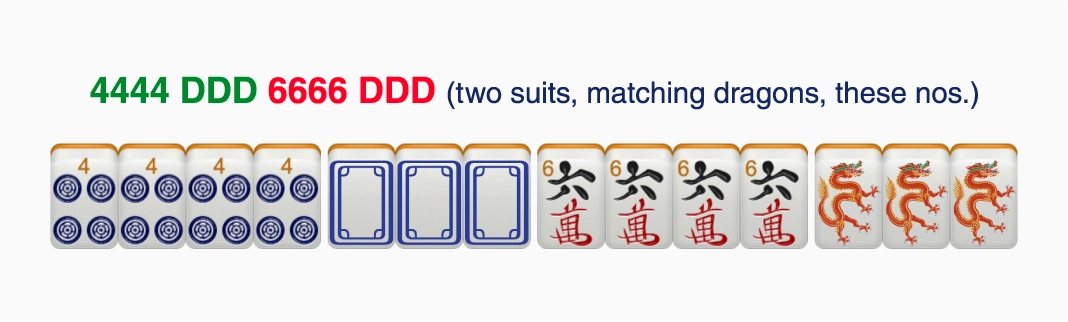
In this example, you must use
- Exact numbers as listed: For example, a kong of 4s and a kong of 6s are the exact numbers you must use for the suited sets. You can't replace them with any other number.
- Two different suits: Any combination of two different suits will satisfy this requirement. For example, a kong of 4 Dots and a kong of 6 Craks is one combination that works.
- Matching Dragons: The Dragon tiles must match the suits used, and you can use our guide on tile names to understand more about how tiles are connected and grouped, especially on the NMJL card. For example, a pung of White Dragons matches the Dots, and a pung of Red Dragons matches the Craks. If Bams were used, then Green Dragons would match.
Strategy: You'll recognize these hands early if your hand leans strongly even or odd or if you're seeing multiple copies of the same numbers forming natural groups. These are often the easiest Mah Jongg hands to spot, but they're not very forgiving. If your tiles don't keep reinforcing the pattern through the Charleston, it's usually better to pivot.
Like Numbers & Repetition Hands
These hands center on repeating the same number, often across different suits, and may involve larger groupings supported by Jokers.
These include:
- Any Like Numbers
- Quints (groups of five)
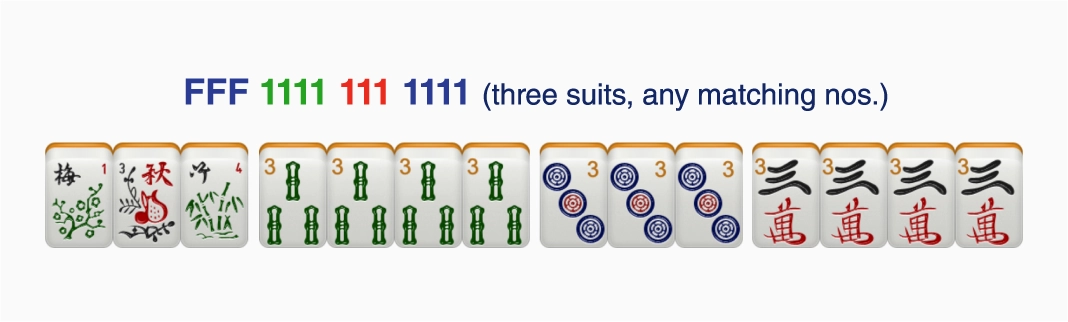
In this example, you must use
- Any matching numbers: Although 1s are printed, you can use any number, such as 3, as long as you use the same number across the hand.
- Three different suits: It doesn't matter which suits build the kongs and which one builds the pung as long as you use a different suit for each group. For example, you could build a kong of 3 Bams, pung of 3 Dots, and a kong of 3 Craks.
- A pung of Flowers: Because all Flower (and Season) tiles are interchangeable, you can use any three of those tiles to satisfy this hand requirement.
Strategy: These hands are flexible and common, but that also means more competition for the same winning tiles. You'll spot them early when you have pairs, triples, or multiple copies of the same number. Pay attention to what's being discarded, too, because these hands can stall quickly if key tiles disappear.
Consecutive Pattern Hands
These hands use sequential numbers, but they are not true runs. Each number is a single tile or pair in a fixed pattern, not a grouped sequence. So the hands can feel intuitive, especially if you're used to Chinese Mahjong, but they're easy to misread. For example, sequential numbers in the same suit, such as 4, 5, 6 Dots, don't refer to a run (like a chow in Chinese Mahjong). Instead, this means you need a single 4 Dot, single 5 Dot, and single 6 Dot. Because you can't use a Joker to complete a single or pair requirement or call tiles for singles or pairs unless you're declaring Mah Jongg, these hands are more difficult.
These include:
- Consecutive run
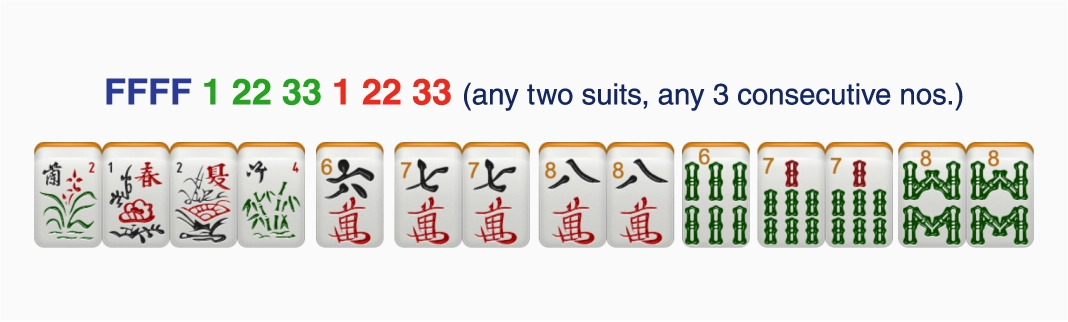
In this example, you must use
- Three consecutive numbers: The 1, 2, 3 designation is just showing that you need consecutive numbers. For example, 6, 7, and 8 will work for each run.
- Two different suits: Each run must be a separate suit. For example, you could build a single 6 Crak, pair of 7 Craks, and a pair of 8 Craks, and then build a single 6 Bam, pair of 7 Bams, and a pair of 8 Bams.
- A kong of Flowers: With interchangeable Flower (and Season) tiles, you just need 4 of any of those tiles for this hand, regardless of the image or number on the tile.
Strategy: You'll recognize these hands when your tiles naturally fall into number progressions like 4–5–6 or 6–7–8. Don't assume flexibility though. If you don't build the exact pattern or can't get the needed single tiles, you won't complete the hand easily because you can't call single tiles unless you're declaring Mahjong. So be ready to abandon it early.
Honor Tile Hands (Winds & Dragons)
These hands rely heavily or entirely on Wind tiles (North, East, West, South) and Dragon tiles (White Dragon, Green Dragon, Red Dragon), rather than numbered tiles.
These include:
- Winds - Dragons
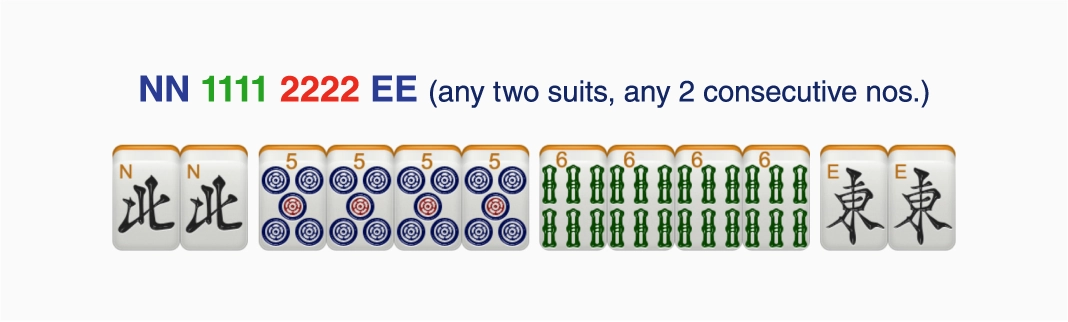
In this example, you must use
- Two consecutive numbers: The 1 and 2 shown are just examples. You could, for example, build this hand with a 5 and 6.
- Two different suits: Each number must be a separate suit. For example, you could build a kong of 5 Dots and a kong of 6 Bams.
- A pair of both North and East: Wind tiles aren't interchangeable, so the hand must have exactly two North and two East tiles.
Strategy: You'll recognize these hands when you have multiple Winds or Dragons, especially in pairs or groups. Use these as a pivot when your numbered tiles don't align. They're often less competitive and easier to complete if your hand supports them.
Constraint Hands (Singles, Pairs, and Special Hands)
These hands require singles and pairs with very specific tile combinations. These are some of the hardest winning combinations to complete: You can't use Jokers for singles or pairs, and you can't call a discarded tile to complete them unless it's your last tile. That means many of these hands are effectively decided during the first Charleston and second Charleston tile exchange, long before the end of the game.
These include:
- Singles and Pairs
- Year
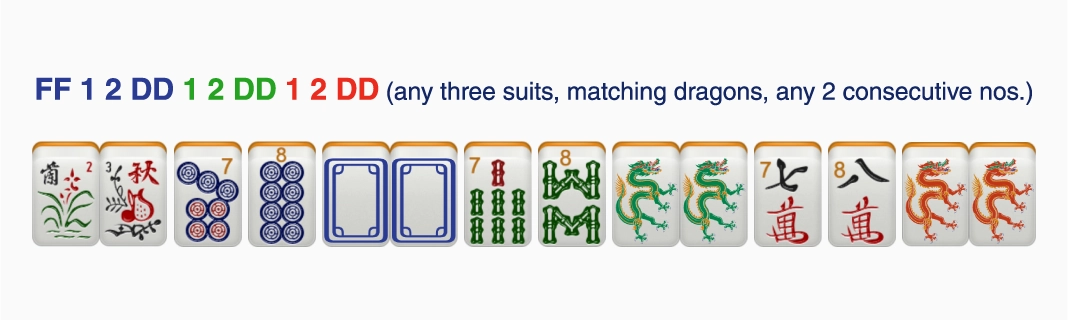
In this example, you must use
- Two consecutive numbers: Any two consecutive numbers must be used, for example, a 7 and 8.
- Three different suits: The same two consecutive numbers must be built in three suits. For example, you could use a single 7 Dot and 8 Dot, a single 7 Bam and 8 Bam, and a single 7 Crak and 8 Crak.
- Matching Dragons: Because three suits are being used, all Dragons must also be used to match. White Dragons match Dots, Green Dragons match Bams, and Red Dragons match Craks.
- A pair of Flowers: Use any two Flowers for this hand because these tiles are interchangeable.
Strategy: You'll recognize these hands early if you're holding multiple pairs or isolated tiles that match a pattern on the card. Protect pairs and commit early. You can't use Jokers or call a discarded tile for most of these, so if you don't build them during the Charleston, you won't complete them.
Tips for Reading the NMJL Card Efficiently
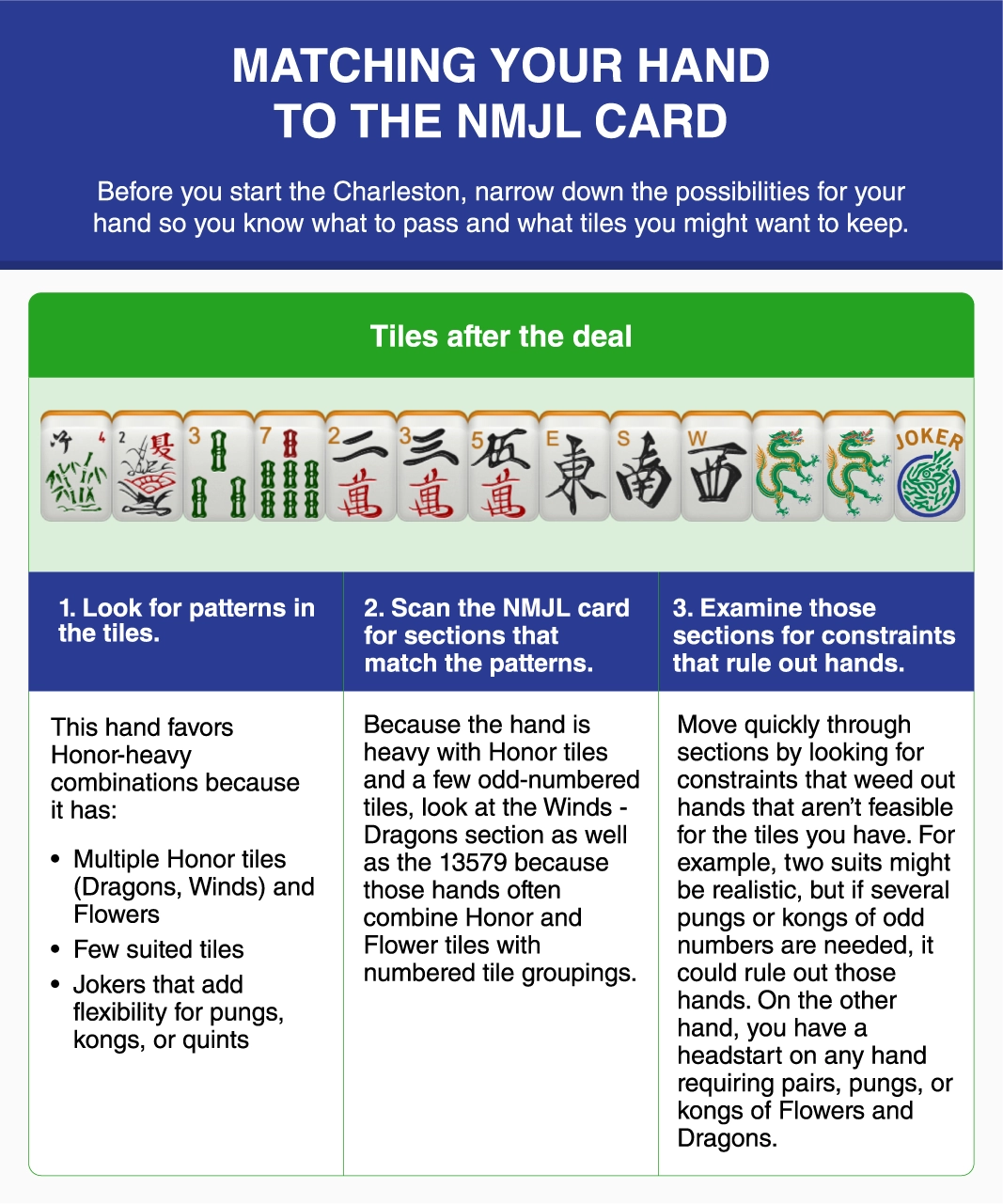
Reading through the NMJL card to select potential hands has to happen before you start the Charleston. This can feel daunting because of all the information and lines of hands the card contains. So follow these steps to do it strategically and quickly:
- Start with your own tiles, not the card. You don't need to memorize every line on the NMJL card. Just quickly connect your tiles to a small number of viable Mah Jongg hands. Take a quick read of your tiles by asking yourself these questions.
- Do your numbered tiles lean even or odd?
- Do you have pairs or like numbers?
- Are your tiles mostly in the same suit or spread across different suits?
- Do you have several Wind tiles or Dragon tiles?
- Use the patterns to narrow your focus to card sections. You should never be scanning the entire card—only the sections that match what you already have.
- Work through each potential hand quickly. Keep in mind whether the hand you're looking at is realistic based on your tiles and what you've already seen discarded. If it's not realistic based on the following tips, move on immediately.
- Check the suit requirement first (same suit vs mixed suits).
- Look at how many singles or pairs are required.
- Note whether the hand must be played as a concealed hand or can be exposed.
- Identify the key tiles you'll need to complete the hand, including your likely winning tile.
As you read through the card, remember:
- The hand will specify whether you need those exact numbers or can use any numbers. You might wonder whether the exact numbers listed in a hand must be used. The card will explicitly point out if you can use "any like numbers" or "any consecutive numbers" or something similar to make it clear what is required.
- A zero (0) always refers to a White Dragon. You'll see zeroes mostly in hands referring to years (2026). Because there is no zero tile, you must use the White Dragon.
- Runs are actually singles. If you see a consecutive number run (4–5–6, for example), those are single tiles: a single 4, single 5, and single 6. You can't use Jokers to complete these, and you can only call tiles to complete for a single if you're declaring Mahjong.
- Jokers can only be used in sets of three tiles or more. You might be tempted to select a hand because you figure you can use a Joker to complete it, but Jokers can only be used for pungs, kongs, and quints.
Building and Pivoting Your Hand
After you read through the card, you need to start building your hand, and that all begins with the Charleston and continues throughout the game. So you have to stay alert to get the tiles you need or to pivot when you need to change course.
These sections take the guesswork out of building or changing your hand so that you build and adjust based on how the game progresses.
Step 1: Select Two Flexible Hand Options
After reading through the card and noting patterns in your hand, you should have a realistic idea of which winning hands you could build. For example, multiple 6s could support:
- 2468
- Like numbers
- Consecutive run
The idea is to choose hands with multiple completion paths. Favor hands that can be built in more than one way—across different suits or with interchangeable groupings—so you're not dependent on one exact set of tiles showing up.
One of the biggest mistakes, especially for a beginner, is locking into a single hand too early. If you find it difficult to pick just two options, narrow to three, but no more than three. Keeping options open gives your hand flexibility, but having too many options hinders decision making, especially during the Charleston.
Step 2: Use the Charleston to Shape Your Hand
The Charleston tile exchange gives you an opportunity to enhance your hand into something more concrete. This is the time to let incoming tiles confirm your direction and validate whether your hand is feasible. Because you've picked two options already, you can use the tile exchange to selectively pass tiles you know you don't need for your hand. Then look for what you will need to strengthen your hand.
- During the first Charleston, pass isolated or weak tiles, but keep pairs and tiles that could fit multiple Mah Jongg hands.
- If the optional second Charleston takes place, start narrowing your direction by looking for reinforcement. Check to see if incoming tiles are supporting one pattern more than others. You might notice a pattern by what you're not seeing get passed, too!
By the end of the Charleston, even if only the first round is completed, you should be focused on just one or two realistic winning combinations.
Step 3: Protect the Hardest Tiles to Replace
The hardest parts of any Mah Jongg hand to complete are almost always single tiles and pairs. You can't substitute a Joker for them, and you typically can't call a discarded tile to complete them unless it's your last tile for Mahjong. Sets are relatively manageable. You can easily build pungs or kongs and rely on Jokers and calling tiles to fill gaps in those groupings. But singles and pairs don't give you that flexibility.
So don't break pairs or toss a single casually if they're needed for one of your two hand options. A pair isn't just another grouping—it's a constraint you'll have to solve by drawing, which means you have fewer options available. And a single tile can quietly become the piece that stalls an otherwise strong hand at the end of the game. So discard these only if you're abandoning that hand option.
Step 4: Adjust Based on What You See
You will often adjust to just one hand option early in the game based on what you're drawing or calling. However, because what looked viable at one stage of the game can change quickly, continually reassess whether your current hand still makes sense. During gameplay, you'll get a sense of what options are still viable or not, but you have to look at what all the players are discarding and revealing as well as what you need in your rack.
As the game progresses, adjust and make informed pivots by doing the following:
- Watch every discard. As tiles are discarded, mentally eliminate hands that rely heavily on those tiles so you don't chase combinations that are no longer possible.
- Track which tiles are already out of play. Exposed sets remove possibilities from your hand. So keep an eye on those sets and how that impacts the hand you want to build.
- Keep your hand structurally balanced as long as possible. Avoid overloading on one type of tile (like all singles or scattered numbers) unless you're fully committed; balanced hands give you more ways to pivot.
- Notice what tiles haven't been revealed. Tiles that are conspicuously absent from the discards and exposed sets are tiles other players must be using to build their hand. So don't pivot to any hands that rely on those tiles.
If key tiles for your hand are repeatedly discarded, your hand may no longer be viable, requiring you to pivot before it's too late.
Build Your Winning Hand with Confidence
At its core, Mah Jongg is about turning a shifting set of tiles into a clear path to a winning hand. And you can do that by reading your rack, narrowing your options, and making steady, informed decisions as the game unfolds.
The best way to build that instinct is through repetition. The more you play and practice, the better equipped you'll be to strategize and pivot and build a winning hand quickly and confidently. Whether you play on a Mahjong app, in person at a table, or choose to play Mah Jongg online, each game sharpens your ability to spot patterns, adjust your strategy, and recognize when a hand is truly within reach