Types of Mahjong: 7 Popular Variations Explained & Compared
Mahjong isn’t one single game. Although the tiles look familiar from one version to the next, the rules and scoring systems can change the pace and strategy of the game. Just ask any three Mahjong players where they learned, and you might get three entirely different answers. One player may have picked up American Mah Jongg from a weekly community group while another plays Riichi Mahjong online against global competitors. Still someone may say they grew up playing Filipino or Chinese Mahjong with their family.
Whether you’ve only played online, stuck to playing just one single version, or never played at all, you’ll be relieved to know that, if you want to play Mahjong, you don’t have to learn every variation. Most players settle into one type of Mahjong, and which variation you stick with ultimately comes down to which form of gameplay and scoring you like best.
The Most Common Types of Mahjong Games at a Glance
American Mah Jongg’s popularity has surged through local clubs and community groups. Competitive players often gravitate toward Riichi Mahjong or Chinese Official Mahjong (MCR), while regional variations continue to develop their own loyal followings. Wright-Patterson Mahjong, for example, grew out of American Mah Jongg and developed its own annual card and style of play.
The chart below highlights some of the most popular Mahjong variations and what makes each one unique, although many other regional variants exist around the world.
| Mahjong Variation | Objective | Learning Curve | Best for | What Makes It Unique |
|---|---|---|---|---|
| Hong Kong Mahjong (Old Style) | Build a complete winning hand of four sets and one pair while meeting the minimum fan requirement. | Easy to Moderate | Players seeking an approachable traditional Mahjong experience | Traditional gameplay with a relatively simple fan-based scoring system |
| Chinese/ British Mahjong | Build a winning hand by creating four sets and one pair and meeting the scoring requirements of the rule set being played. | Moderate | Players who want to learn classic Mahjong fundamentals | Flexible hand building without a card or highly structured scoring requirements |
| American Mah Jongg | Build one of the specific, 14-tile winning hands listed on the annual NMJL card. | Moderate | Players who enjoy puzzles, pattern recognition, and social play | Uses an annual NMJL card, Jokers, and the Charleston tile exchange |
| Filipino Mahjong | Build a 17-tile winning hand using traditional Mahjong combinations while maximizing scoring opportunities throughout the game. | Moderate | Players who want traditional yet fast-paced and aggressive gameplay | Flowers, Seasons, Winds, and Dragons function as bonus tiles rather than hand-building tiles. |
| Panama Rules Mahjong | Build a winning hand by creating four sets and one pair and meeting the scoring requirements of the rule set being played. | Moderate | Players looking for a little flexibility for hand building up front but with a preference for traditional rules | Traditional Mahjong gameplay with limited chows and the addition of a three-pass Charleston |
| Chinese Official Mahjong (MCR) | Build a winning hand of four melds and a pair and reach the 8-fan minimum established by Mahjong Competition Rules (MCR). | Difficult | Tournament-minded players who enjoy detailed scoring systems | Requires players to meet a minimum fan threshold before declaring a win |
| Riichi (Japanese) Mahjong | Build a winning hand from four sets and a pair and at least one scoring condition known as a yaku. | Difficult | Competitive players who enjoy deep strategy | Winning hands must satisfy specific scoring patterns called yaku, and players can declare Riichi. |
A Note on Mahjong Solitaire
If you searched for "Mahjong" and landed on a single-player tile-matching game, that's Mahjong Solitaire — a different game entirely. Rather than building a hand of sets and a pair against other players, you clear a layered layout by matching identical free tiles in pairs. It uses the familiar Mahjong tiles but isn't one of the four-player variations above. If you enjoy the tiles but want a quick solo puzzle, it's worth a try.
7 Mahjong Variations Explained
Most Mahjong games use the same basic tiles, but the history of Mahjong shows that it changed and developed throughout time and regions. So the similarities begin to fade as soon as your tiles have been dealt. Some variations focus on traditional hand building and scoring, while others introduce unique mechanics, varied scoring systems, or even entirely different objectives. For example, in one version, Flower tiles may be a required part of your hand, but in another version they score as a bonus.
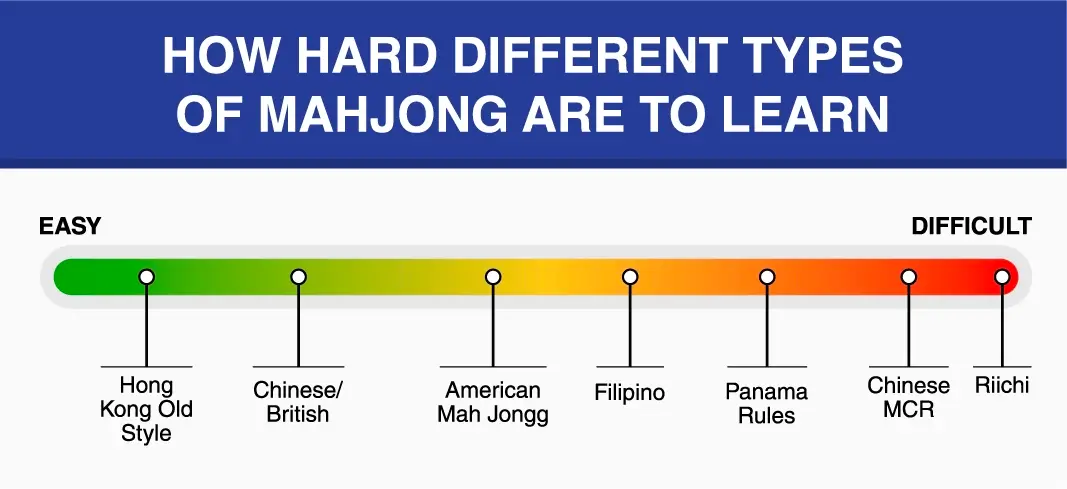
The variations below are arranged from the most approachable for new players to the most challenging. Keep in mind that "easy" doesn’t mean simple. Every version of Mahjong rewards experience and strategy. Instead, the learning curve reflects how quickly most new players can understand the rules and scoring and begin playing confidently.
1. Hong Kong Mahjong (Old Style)
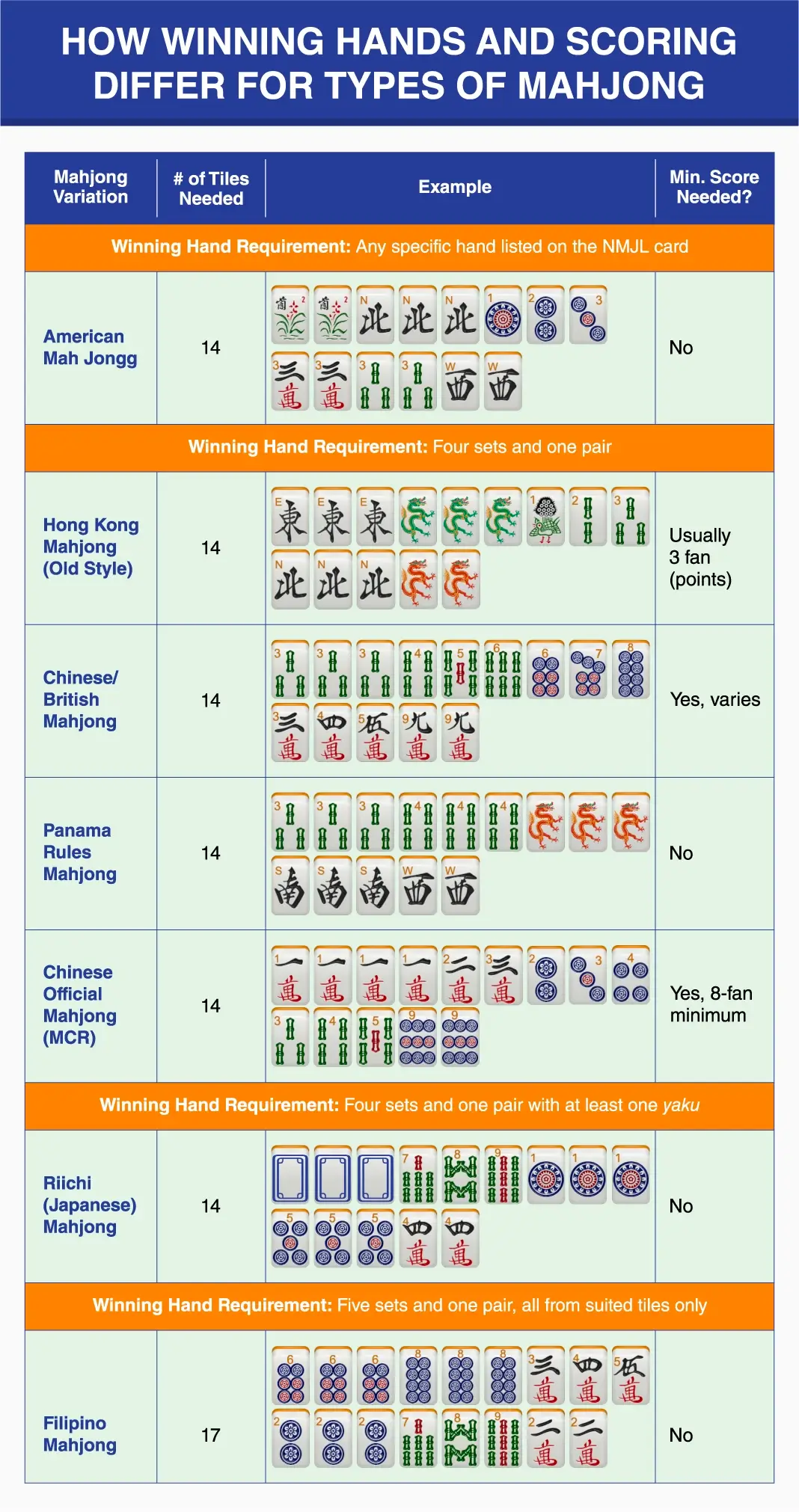
- Objective: Build a winning hand of four sets and one pair while meeting the minimum fan requirement.
- Best for: Players who want a traditional Mahjong experience with straightforward scoring and fast gameplay
- Learning curve: Easy to moderate
Hong Kong Mahjong (Old Style) uses 144 tiles and keeps the traditional Mahjong structure of building chows, pungs, or kongs with a pair but avoids some of the scoring complexity found in tournament-focused variants like Chinese Official Mahjong (MCR).
The key challenge isn’t simply completing a hand. Players also need enough fan, which are points earned through specific combinations, patterns, and bonuses. A player may finish a hand only to discover it doesn’t reach the minimum scoring threshold needed to win; these are called a chicken hand. In many games, including Mahjong 4 Friends, the minimum is three fan, though local clubs and online platforms sometimes use different requirements.
Compared to MCR, the list of scoring patterns is much shorter, making it easier for new players to learn what is valuable and what isn’t. After a few rounds, most players begin recognizing the combinations that appear frequently and can start making strategic decisions about whether to pursue a quick win or hold out for a higher-scoring hand.
Hong Kong Mahjong earns an easy-to-moderate learning curve because players can focus on learning a relatively small number of scoring patterns while still experiencing traditional Mahjong gameplay. At the same time, experienced players still have plenty of room to develop advanced strategies around risk, timing, and hand value. You can find a breakdown of the rules, scoring, and strategies for this version in our guide on Hong Kong Old Style Mahjong.
2. Chinese/British Mahjong
- Objective: Build a winning hand by creating four sets and one pair and meeting the scoring requirements of the rule set being played.
- Best for: Players who want to learn traditional Mahjong and develop flexible hand-building skills
- Learning curve: Moderate
For many players outside of Asia, Chinese/British Mahjong is what they picture when they hear the word "Mahjong." Chinese and British Mahjong share many of the same traditional hand-building concepts, although scoring systems and table rules can vary between organizations and regions. For the purposes of this guide, they are grouped together because they provide a similar introduction to traditional Mahjong fundamentals.
The game uses 144 tiles and revolves around familiar building blocks, such as chows, pungs, kongs, and a pair. The scoring can take some time to learn, but most newcomers, especially those familiar with set-building card games like Rummy or Gin, pick up the basic flow of the game fairly quickly.
Once you understand how combinations are formed and what constitutes a winning hand, you can start playing while gradually learning the finer points of scoring and strategy. The learning curve lands in the middle because players need to understand both hand building and scoring, but they don’t have to memorize the extensive scoring systems found in tournament-focused variants.
Many other Mahjong variants trace their roots back to this traditional style of play, and if you’re used to American Mah Jongg, you can get an even closer look at how Chinese and American Mah Jongg differ for gameplay.
3. American Mah Jongg
- Objective: Build one of the specific, 14-tile winning hands listed on the annual National Mah Jongg League (NMJL) card.
- Best for: Players who enjoy pattern recognition, strategic planning, and organized social play
- Learning curve: Moderate
Although American Mah Jongg evolved from earlier Chinese versions of the game, it has its own distinctive elements that truly make it look and feel different when you play. The biggest difference is the NMJL card, which provides a list of legal winning hands that changes every year. Instead of building any valid scoring combination, players must complete one exact pattern from the card. Reading the card and matching your rack of tiles to a valid winning Mah Jongg hand is what makes this game a more moderate version to learn.
American Mah Jongg not only uses slightly different tile names (Dots, Bams, and Craks), but it also introduces new features unfamiliar to many other versions. Before gameplay begins, players participate in the Charleston tile exchange designed to improve their starting hands. The game also uses Jokers, which can substitute for tiles in sets that require three or more tiles, creating more strategic opportunities. Because this version adds eight Jokers, you use 152 tiles to play.
Playing American Mah Jongg can feel more like a puzzle than a traditional set-building game. Success often depends on recognizing which hands are realistic, adjusting your hand based on the Charleston and discards throughout the game, and knowing when to commit to a particular pattern. Those layers of decision-making help explain why American Mah Jongg remains one of the most popular Mahjong variations in the United States.
4. Filipino Mahjong
- Objective: Build a 17-suited-tile winning hand of five melds and a pair while maximizing scoring opportunities throughout the game.
- Best for: Players who enjoy faster-paced traditional Mahjong and more aggressive gameplay
- Learning curve: Moderate
Filipino Mahjong uses 144 tiles and requires five melds and a pair, but it has some added constraints not found in other versions. You have to complete a winning hand only from suited tiles (Dots, Characters, and Bamboo). All other tiles, including Flowers, Seasons, Winds, and Dragons, become bonus tiles that are scored separately. In addition, you can’t call tiles or expose melds in this version.
That added scoring layer changes how players evaluate tiles during the game. A tile that might build a set in another Mahjong variant could become a valuable bonus in Filipino Mahjong. As a result, players must think about both completing their hand and maximizing scoring opportunities.
The learning curve falls in the moderate range because the core mechanics remain familiar to anyone who has played traditional Mahjong. The adjustment comes from learning how bonus tiles affect scoring and strategy, particularly if you’re accustomed to variants where Winds and Dragons are used primarily within the hand itself.
5. Panama Rules
- Objective: Build a winning hand of four sets and a pair.
- Best for: Players who like having a chance to use the Charleston to better their hand but also want rules more like Chinese Mahjong
- Learning curve: Moderate
Panama Rules Mahjong is a regional variation that uses 144 tiles and retains the familiar foundation of traditional Mahjong as well as a base-point and multiplier scoring system. But the addition of a single three-pass Charleston creates a distinct playing experience. A winning hand includes four sets and a pair, and sets can be pungs and kongs, with only one chow allowed.
Although it’s not as highly structured in format as MCR or Riichi, Panama Rules has an interesting dynamic. The Charleston gives players an opportunity to improve their starting hands, but once play begins, the one-chow limitation can make hand development more focused and strategic.
Players who already understand basic Mahjong mechanics can usually adapt quickly, which is why the learning curve is moderate, but learning the scoring nuances and regional conventions may take some additional practice. For many players, that blend of familiar gameplay and unique strategy is what makes Panama Rules Mahjong especially enjoyable.
6. Chinese Official Mahjong (MCR)
- Objective: Build a winning hand of four sets and a pair and reach the 8-fan minimum established by Mahjong Competition Rules (MCR).
- Best for: Players who enjoy complex strategy, tournament play, and mastering detailed scoring systems
- Learning curve: Difficult
Chinese Official Mahjong, often called MCR (Mahjong Competition Rules), was developed as a standardized tournament format designed to make competitive Mahjong more consistent across clubs, leagues, and international events. While it shares the same roots as other traditional Mahjong variants and uses 144 tiles, MCR places much greater emphasis on scoring patterns and hand valuation.
The biggest adjustment for new players is that completing a hand isn’t always enough to win. Under MCR rules, a hand must also meet a minimum fan requirement, which means players need to think about scoring opportunities from the very beginning of the game. A player may technically have a complete Mahjong hand but still be unable to declare victory because the hand doesn’t generate enough fan.
This focus on scoring creates a deeper layer of strategy than many casual Mahjong variants. Players aren’t simply trying to complete sets and a pair because they’re actively pursuing specific scoring combinations while balancing risk, tile availability, and defensive play.
The learning curve is considered difficult because players must not only understand the basic mechanics of Mahjong but also learn and apply a large collection of scoring patterns and point values. While that complexity can feel overwhelming at first, it is also one of the reasons MCR has become the preferred format for many serious Mahjong competitors around the world.
7. Riichi (Japanese) Mahjong
- Objective: Build a winning hand from four sets and a pair and at least one scoring condition known as a yaku.
- Best for: Competitive players who enjoy deep strategy and complex scoring systems
- Learning curve: Difficult
Japanese Riichi Mahjong has developed one of the most passionate player communities in the world, particularly online. At first glance, the game looks similar to Chinese Mahjong, but the scoring system adds an entirely different layer of strategy. This version also uses just 136 tiles because you play without Flower and Season tiles.
In Riichi Mahjong, completing a hand isn’t always enough to win. Players must also satisfy specific scoring patterns called yaku. This means a hand can be technically complete while still being invalid for scoring purposes. As a result, players must constantly balance hand development, scoring potential, risk, and defensive play, which is why this version’s learning curve earns a difficult rating.
The game’s namesake mechanic, Riichi, allows players to declare that they are one tile away from winning. That announcement creates new scoring opportunities but also reveals information to opponents.
How to Choose the Best Mahjong Type for You
With so many Mahjong variations available, the best choice often comes down to what kind of experience you’re looking for. Some players enjoy learning detailed scoring systems and tournament-style strategy, while others prefer a more social game or a ruleset that’s easier to learn, and this table breaks it down for you.
| If you want . . . | Try . . . |
|---|---|
| The easiest traditional starting point | Hong Kong Old Style Mahjong |
| Traditional Mahjong fundamentals | Chinese/British Mahjong |
| A puzzle-like experience | American Mah Jongg |
| Regional twists on classic gameplay | Filipino or Panama Rules Mahjong |
| Tournament-style strategy | Chinese Official Mahjong (MCR) |
| Deep competitive play | Riichi Mahjong |
No matter what variation you decide on, you won’t make a wrong choice. Every type of Mahjong offers its own strategic challenges and fun experience to play online or in person with a group. To find a good starting place, consider which variation fits you best using this list:
- If you’re new to Mahjong and want a traditional experience, Hong Kong Mahjong is often one of the easiest places to start. The rules are approachable, the scoring system is manageable, and you’ll learn many of the concepts that appear in other traditional Mahjong variants.
- If you’re interested in learning the foundations of traditional Mahjong and developing flexible hand-building skills, Chinese/British Mahjong is a strong choice. Because players aren’t tied to a specific hand card, you’ll learn how to adapt your strategy as the game develops.
- If you enjoy puzzles, pattern recognition, and organized group play, American Mah Jongg may be the best fit. The NMJL card, Charleston, and Joker tiles create a very different experience from traditional Mahjong and reward long-term planning.
- If you enjoy competition and complex strategy, try Riichi Mahjong or Chinese Official Mahjong (MCR). Both require a deeper understanding of scoring and hand valuation, making them rewarding options for players who enjoy mastering intricate systems.
- If you’re looking for something a little different, regional variants such as Filipino Mahjong and Panama Rules Mahjong offer unique twists on traditional gameplay while still preserving many of the core elements that make Mahjong enjoyable.
Find Your Favorite Type of Mahjong to Play
One of the reasons Mahjong has remained popular for generations is that no single version defines the game. Players have adapted the rules, scoring systems, and strategies to create experiences that reflect their own preferences and traditions.
Whether you’re drawn to the approachable scoring of Hong Kong Mahjong, the flexibility of Chinese/British Mahjong, the pattern-based challenge of American Mah Jongg, or the tournament depth of Riichi and MCR, every variation offers a different way to enjoy the same timeless game.
The best way to discover your favorite is to play Mahjong online. After you learn the fundamentals of one variation, you’ll quickly begin to recognize the concepts that connect them all, making it easier to explore new rulesets, new strategies, and new ways to experience Mahjong.