History of Mahjong: From Ancient China to Today
Mahjong’s tiles, terminology, and basic structure grew out of centuries of Chinese gaming culture, and by the late-19th century, the game we recognize as Mahjong had emerged. But Mahjong didn’t simply appear one day as the finished game we know now. While rooted in China, it’s also a game rooted in change.
The history of Mahjong reaches backward through earlier Chinese card and gambling games, including games played with money-suited cards whose designs can still be recognized on Mahjong tiles today. But it didn’t just evolve as a different way to play a card game. Over time, older elements were combined with new ways of playing, and cards gave way to tiles as different sets and different rules developed. By the late Qing period, these changes had produced a distinctly new Chinese game: Mahjong.
Mahjong continued to develop and change both within and outside of China, including when Western players encountered it in Shanghai and when Joseph P. Babcock modified it for an American audience. The game has proved to be remarkably adaptable. That makes the history of Mahjong less like the story of an invention frozen in time and more like a prolific family tree with roots planted firmly in China.
How China’s Gaming Culture Gave Rise to Mahjong
Mahjong surfaced as a recognizable game in 19th-century China, but it did not emerge in isolation. Chinese players had been playing card and gambling games for centuries, and some of the building blocks of Mahjong can be traced through that much older gaming tradition. Elements of older games—suits, symbols, and ways of playing—were adapted and recombined over time until something recognizably new emerged.
The Connection of Mahjong Suits to Money Suits
One of the clearest connections between Mahjong and earlier Chinese games is found in the three numbered Mahjong suits. Circles, Bamboo, and Characters (whose tile names in American Mah Jongg are Dots, Bams, and Craks) descend from the money suits used on older Chinese playing cards.
Historian Annelise Heinz describes the direct link to today’s numbered tile suits.
- One suit represented coins, so Mahjong's Circles originated as stylized depictions of Chinese coins.
- A second suit contained images of long strings of coins. Because traditional Chinese cash coins had holes through their centers so that they could be strung together, these images of long strings evolved into the rods now recognized as Bamboo.
- A third suit represented much larger amounts of coins counted in myriads or units of ten thousand. And the Character tile suit still commonly includes (wàn), the Chinese character for ten thousand.
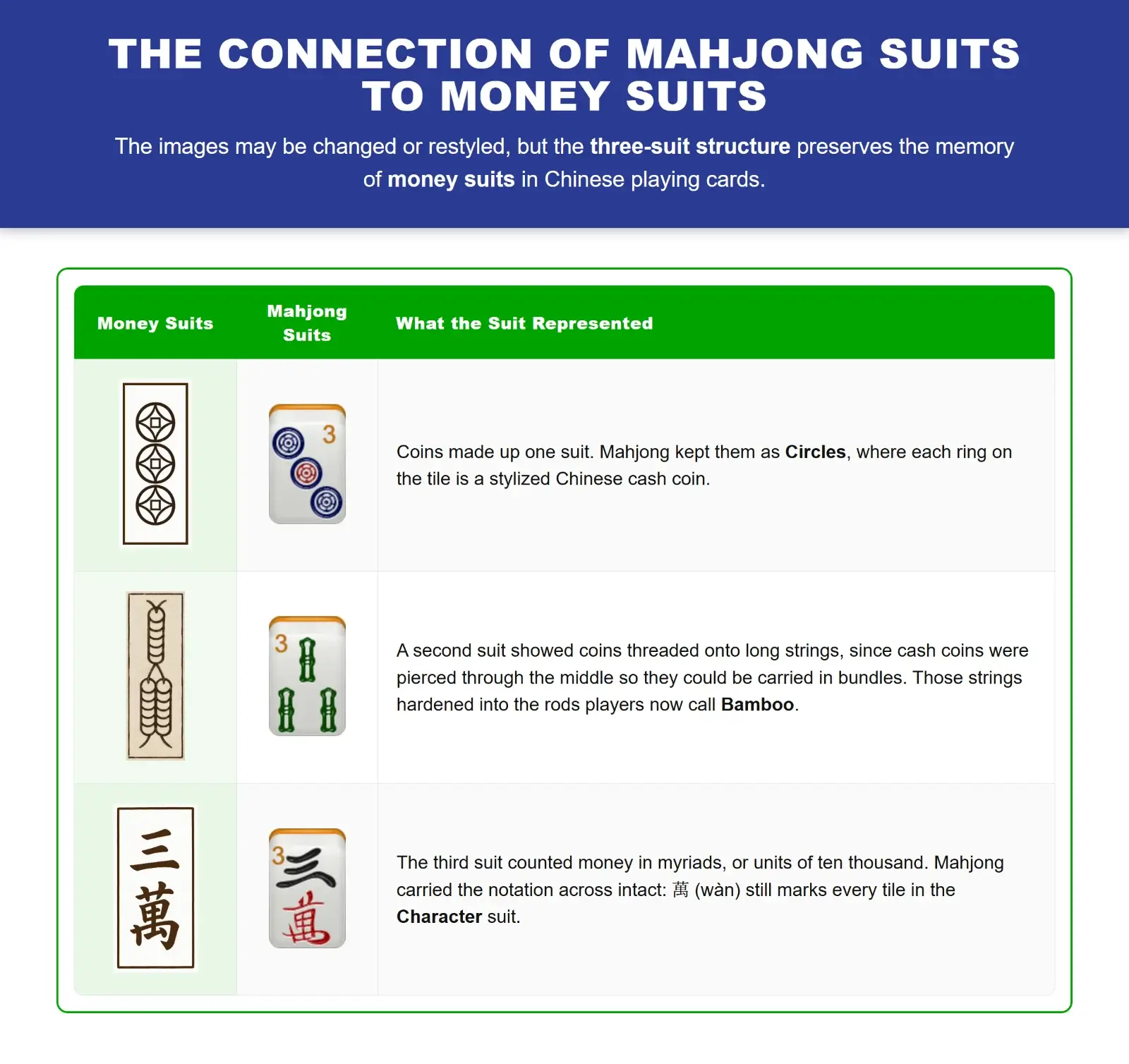
Early Mahjong-like sets collected in China used suit names closely related to the money suits found on playing cards. Researchers Michael Stanwick and Hongbing Xu have compared records of these early tiles with older card decks and found the same basic progression: Cash, Strings, and Myriads. So when a modern player looks at a Mahjong hand, part of the game's much older ancestry is sitting in plain sight. The images may even be changed or restyled, but the three-suit structure preserves the memory of an earlier Chinese monetary system.
Mahjong’s Connection to Madiao
Madiao was a Chinese card game popular during the late Ming period, centuries before recognizable Mahjong appeared. It’s worth a special mention because scholars, like historians Hsi-yüan Chen and Maggie Greene, who study Chinese gaming history consistently place it among Mahjong's forerunners.
But Madiao wasn’t just Mahjong played with cards. Although it used money-suited cards, its rules were different, and there is a considerable historical gap between the height of Madiao's popularity and Mahjong's emergence during the late Qing period. There were other games and developments in between.
Early Mahjong Is Recognized but Not Standardized in China
During the late Qing and Republican periods, Mahjong was still evolving in many ways, from where it was played to how. Chinese players inherited an existing vocabulary of suits and symbols from older games, combined it with changing forms of play, and gradually produced a game distinct enough to have an identity of its own. While it’s difficult to identify a single moment when older Chinese card and tile games suddenly became "Mahjong," by the late 19th century, you start to pick up a trail. However, the game and all its elements continued to evolve.
- Tiles sets: Some of the earliest known Mahjong-like tile sets were collected in China during the 1860s and 1870s. Two sets collected by George Glover date to roughly 1872 to 1873, while another documented by German diplomat Karl Himly was collected sometime between the late 1860s and mid-1870s. These sets contain features a modern Mahjong player would immediately recognize, including three numbered suits running from one through nine. But they aren't identical to every modern Mahjong set. The contents and terminology of early sets vary. Some features that later became standard were still developing, while other early tiles eventually disappeared.
- Variations: As it moved between places and groups of players, Mahjong variations developed. Players generally learned the game from other players, which allowed local practices to develop alongside the basic structure they shared. When Joseph P. Babcock published his Red Book of Rules in the early 1920s, he explained that Chinese players typically learned Mahjong as children rather than from written instructions. As a result, he wrote, different parts of China had developed their own variations and there was no single standardized Chinese method of play.
- Where it was played and by whom: Maggie Greene’s research notes Mahjong's place in Chinese society changed from a game criticized by some of the well educated to a fixture of upper-middle-class parlors. Its gender associations changed as well, as Mahjong moved from being represented largely as a male activity to one women were increasingly involved with.
- The name of the game: Even the game's name evolved. Some of the earliest records refer to the developing game by names meaning “Sparrow.” A set collected in the early 1870s was documented in 1875 with a term for house sparrow, and while some hypothesize that the tiles clacking were like the chattering of sparrows, there’s no clear evidence why it went by that name. As Mahjong dispersed, pronunciations and written forms varied by region. The form májiàng eventually became common in Mandarin, while Joseph P. Babcock later turned a pronunciation he encountered in China into the name “Mah-Jongg” for the version he marketed to Western players.
Shanghai Put Mahjong on the Map
By the turn of the 20th century, Shanghai had become especially important to Mahjong's next transformation. Mahjong was already being played throughout Chinese urban centers, but Shanghai was an unusually international city. Chinese merchants and professionals, Western-educated Chinese residents, foreign businessmen, expatriates, travelers, and others moved through overlapping social worlds there.
Mahjong moved through them, too. Heinz's research shows that Chinese intermediaries helped introduce the game to American businessmen and travelers in Shanghai. It was played within Chinese society and increasingly in social spaces where Chinese and foreign players encountered one another.
A game that had already changed as it traveled through China was about to cross another boundary. Foreign players could enjoy Mahjong, but they couldn't necessarily read the characters on the tiles, learn the game through the same social networks, or navigate regional variations as easily as Chinese players could. But Joseph P. Babcock had an answer, an answer that sent Mahjong into another evolution of change.
How Mahjong Changed for Western Players
Joseph P. Babcock, a businessman that was introduced to the game while living in China, didn’t invent Mahjong or single-handedly bring it to America. He helped it reach a new group of players, and the game was altered to make it work for them.
Babcock's motives weren't purely academic. He was a businessman who saw commercial potential in making Mahjong a game Western buyers had access to. Simplifying the rules, adding readable indexes to the Mahjong tiles, and packaging the game with an English rule book made Mahjong easier to learn and much easier to market and sell.
When Babcock began publishing his Red Book of Rules in 1920, he was quite explicit that he had created his own version of the Chinese game. So he selected among the variations he had encountered in China, simplified the rules, and attempted to standardize them.
He also changed the Mahjong tiles themselves. Beginning in 1920, Babcock added small Arabic numerals and Western letters to the tiles so players who could not read Chinese could identify the suits and Winds. So you needed no previous connection to Chinese Mahjong to play his version.
America Goes Crazy for Mahjong
In the early 1920s, the Mahjong craze in America exploded. Retailers sold Mahjong sets, department stores offered lessons, and newspapers and magazines followed the new fashion. Mahjong appeared in plays, songs, photographs, parties, and even a ballet. What had been a Chinese game was becoming an American consumer phenomenon, and commercialization changed Mahjong’s cultural identity in the West.
American marketers presented Mahjong as mysterious, exotic, and far more ancient than it actually was. An Abercrombie & Fitch advertisement from April 1922 called Mahjong the “new game of fashion” while simultaneously claiming that its history stretched back to Confucius. The store advertised complete Mahjong sets imported from China with English instructions.
The Confucius origin story, however, wasn't history. It was marketing. Historian Annelise Heinz has traced how American promoters created an origin myth in which Mahjong had supposedly been played for thousands of years in the ancient Chinese court. That story made the game seem more exotic, prestigious, and authentically Chinese to American buyers, even as it separated the fashionable game from the contemporary Chinese people living in the United States.
Jewish American Women Help Create a New Mahjong
After the national Mahjong craze faded, the game continued in pockets of American society. One of the most important was among Jewish American women. By the 1930s, American Mah Jongg had accumulated competing rules and combinations. Groups could effectively be playing different versions of the game, which was a familiar problem in Mahjong's history.
In 1937, players in New York organized the National Mah Jongg League (NMJL) in an effort to standardize American play. Historian Annelise Heinz describes nearly 400 women gathering at Manhattan's Essex House that fall to debate rules and unify a game they felt had become fractured. Many, though not all, of the women were Jewish.
One of the defining features of this version became the League's card of approved American Mah Jongg winning hands. Instead of preserving one permanent set of combinations, the NMJL issues a card of new hands each year, requiring players to adjust their strategies and learn the new card. Other differences accumulated as American Mah Jongg developed, including Jokers, racks, the Charleston, and distinctive rules governing winning hands. Together, those changes eventually made American Mah Jongg recognizably different from the Chinese game from which it descended.
This version spread rapidly through women’s groups, especially networks of Jewish women. During the Depression, World War II, and the postwar years, Mahjong groups provided regular opportunities for friendship and recreation. As Jewish families moved into new suburban communities, weekly games could help women build and maintain social networks.
Mahjong Kept Evolving Throughout the World
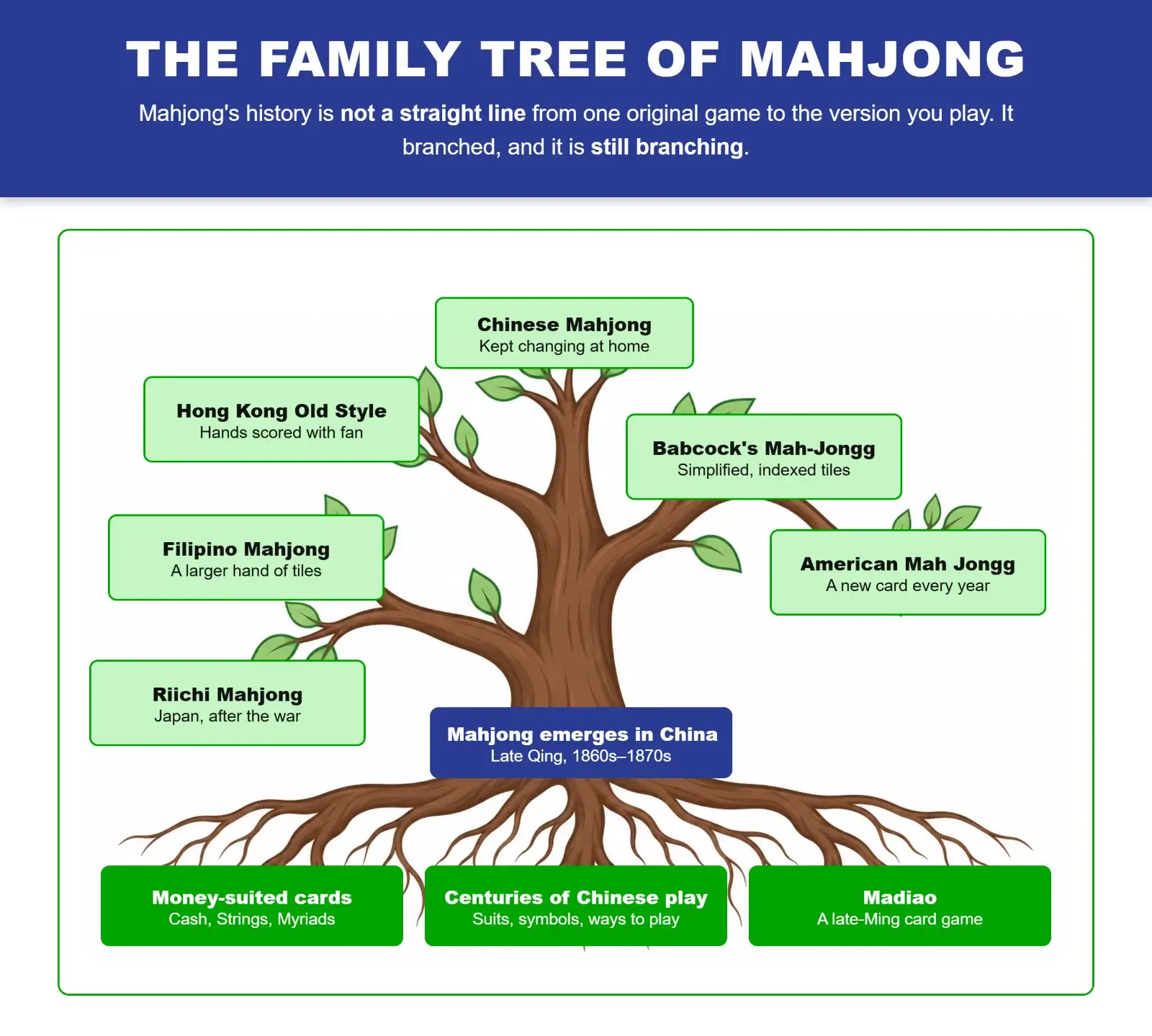
While American Mah Jongg changes each year with new hands, the Chinese game traveled into other countries, and players adapted it to their own gaming cultures.
- Riichi Mahjong: Mahjong reached Japan in the early 20th century and grew rapidly in popularity during the decades that followed. As in the United States, Japanese players did not simply preserve one Chinese ruleset unchanged. They initially simplified some aspects of Chinese play, then accumulated new rules and scoring conventions. After World War II, one particularly important feature spread widely: Riichi, a declaration made when a player's concealed hand is one tile away from winning. Other features, including Dora bonus tiles and distinctive scoring rules, also became part of the developing Japanese game.
- Hong Kong Old Style: In this Mahjong variation, the game retains the familiar structure of drawing and discarding tiles to create chows, pungs, kongs, and a pair, with winning hands scored using Fan. But despite its name, “Old Style” doesn't mean the rules have remained unchanged since nineteenth-century China. Hong Kong Mahjong itself developed through different periods of rule changes and simplification.
- Filipino Mahjong: Mahjong also became deeply established in the Philippines, where Filipino Mahjong developed its own style of play. The underlying family resemblance remains obvious—players still draw and discard familiar Dots, Bams, Characters, Winds, Dragons, and Bonus Tiles—but Filipino rules can differ substantially from Hong Kong, Chinese, American, or Japanese play. Filipino Mahjong commonly uses a larger hand of tiles, and rules governing Flowers, Winds, Dragons, and Jokers can vary from one table or region to another.
Mahjong continues to evolve and reach new players every day, but no matter what version of Mahjong you play, you’ll see familiar elements that remind you of Mahjong’s roots. Mahjong's history isn't a straight line from an “original” game to the one people play today. It's a family tree, and people are still adding branches. If you want to play American Mah Jongg or try other variations of the game, you can play for free at Mahjong 4 Friends.