American vs. Chinese Mahjong: 11 Key Differences
The history of Mahjong tells us that American Mah Jongg and Chinese Mahjong may share some basic roots and even many of the same tiles. But the way you play each game is quite different. American Mah Jongg is a pattern-based game where players build a specific, 14-tile winning hand listed on the National Mah Jongg League (NMJL) card. Chinese Mahjong (Chinese/British) is a more flexible version where you build a winning hand of four sets (chows, pungs, or kongs) and a pair.
The differences go beyond the NMJL card, however. Chinese Mahjong uses 144 tiles, but American Mah Jongg uses 152 because it includes Joker tiles. American Mah Jongg also introduces the Charleston, racks and pushers (to push tiles forward to create the wall), and other gameplay elements you won't find in traditional Chinese Mahjong. These differences affect everything from how you build hands to what Mahjong strategies you need to use.
The table below gives you a quick look at the differences between these two types of Mahjong, and the sections in this post breaks them down in detail so you know how to adjust gameplay and strategy whenever you play Mahjong.
| Feature | American Mah Jongg | Chinese Mahjong |
|---|---|---|
| Winning hand | Exact hand from NMJL card | Four sets and a pair |
| Hand building | Pattern-based | Flexible |
| Annual card | Yes | No |
| Number of tiles | 152 | 144 |
| Jokers | Yes | No |
| Flowers and Seasons | Interchangeable | Different |
| Charleston | Yes | No |
| Chows/sequences | No | Yes |
| Quints | Yes | No |
| Calling discards | For pungs, kongs, quints or Mahjong | For chows, pungs, kongs, or Mahjong |
| Hand scoring | Listed on the card | Depends on elements built in the hand |
1. Winning Hands: American Mah Jongg Uses the NMJL Card
In American Mah Jongg, you must complete one of the exact 14-tile combinations printed on the annual NMJL card, but with Chinese Mahjong, you generally work toward a hand made up of four sets and one pair. This is one of the biggest differences between these two versions.
Published annually, the NMJL card changes the legal winning hands from year to year. You can't simply collect four sets and a pair or combine parts of different hands on the card. Your completed hand must match one listed combination exactly.
That difference changes how you approach the entire game. American Mahjong players continually compare their tiles with the NMJL card and decide which winning hands remain possible. Chinese Mahjong players have more freedom to build combinations around the tiles they draw and claim.
2. Amount of Tiles: American Mah Jongg Uses 152 Instead of 144
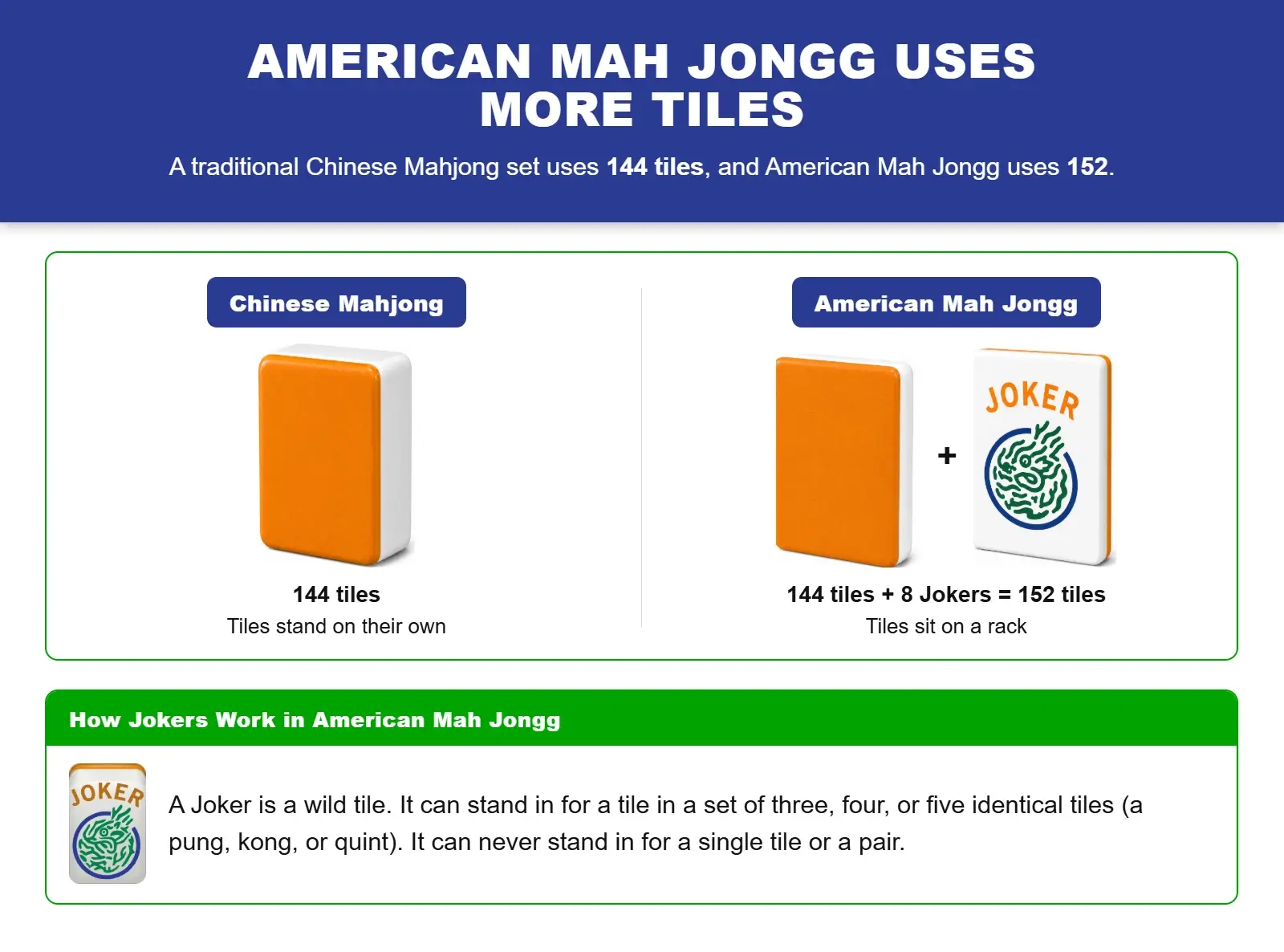
At first glance, American and Chinese Mahjong tile characters can look very similar, but complete tile counts are different. American Mah Jongg uses 152 tiles, and a traditional Chinese Mahjong set uses 144 tiles. The difference of 8 tiles comes from the American Mah Jongg game using Jokers, which act as wildcards, replacing a tile that would naturally fill a set of three tiles or more.
Traditional Chinese Mahjong doesn't use Joker tiles or other wild cards. You must complete your chows, pungs, kongs, and pair with the actual tiles required. Chinese tiles tend to be thicker as well, so you can stand them up without using a rack. But American Mah Jongg tiles are thinner and need a rack to hold them up.
Hand building in American Mah Jongg isn't flexible because you must follow the exact pattern on the NMJL card, but Joker tiles offer strategic flexibility. Jokers function as wild cards and follow specific Mah Jongg Joker rules that limit their use.
Jokers can't substitute for a tile used as a single or in a pair. That means they can't be used simply because consecutive numbers appear together on the NMJL card because those are actually considered single tiles, not sequences.
Jokers create another strategic opportunity because players can exchange tiles for exposed Jokers. If another player has an exposed set containing a Joker and you have the actual tile the Joker represents, you can exchange your tile for that Joker during your turn.
3. Tile Groups: Flowers and Seasons Are Grouped Differently
American and Chinese Mahjong use many of the same types of tiles, but they don't group or treat Flower and Season tiles the same way.
- American Mah Jongg treats Flowers and Seasons collectively as Flowers. All eight tiles are interchangeable, so when an NMJL card hand calls for a Flower, any of the eight Flower or Season tiles can fill that position.
- In Chinese Mahjong, Flowers and Seasons are distinct groups of Bonus tiles, with four Flowers and four Seasons. They don't become part of the sets in your hand. Instead, when you draw a Flower or Season, you expose it and draw a replacement tile.
Additionally, both versions contain the same Honor tiles (Wind and Dragon tiles) and use the same numbered suits, though the Mahjong terminology for each differs. This list shows you the Chinese and then the American Mahjong name for each suited tile.
- Bamboo/Bams
- Character/Craks
- Circles/Dots
4. Tile Sets: How Each Version Treats, Quints, Kongs, and Chows
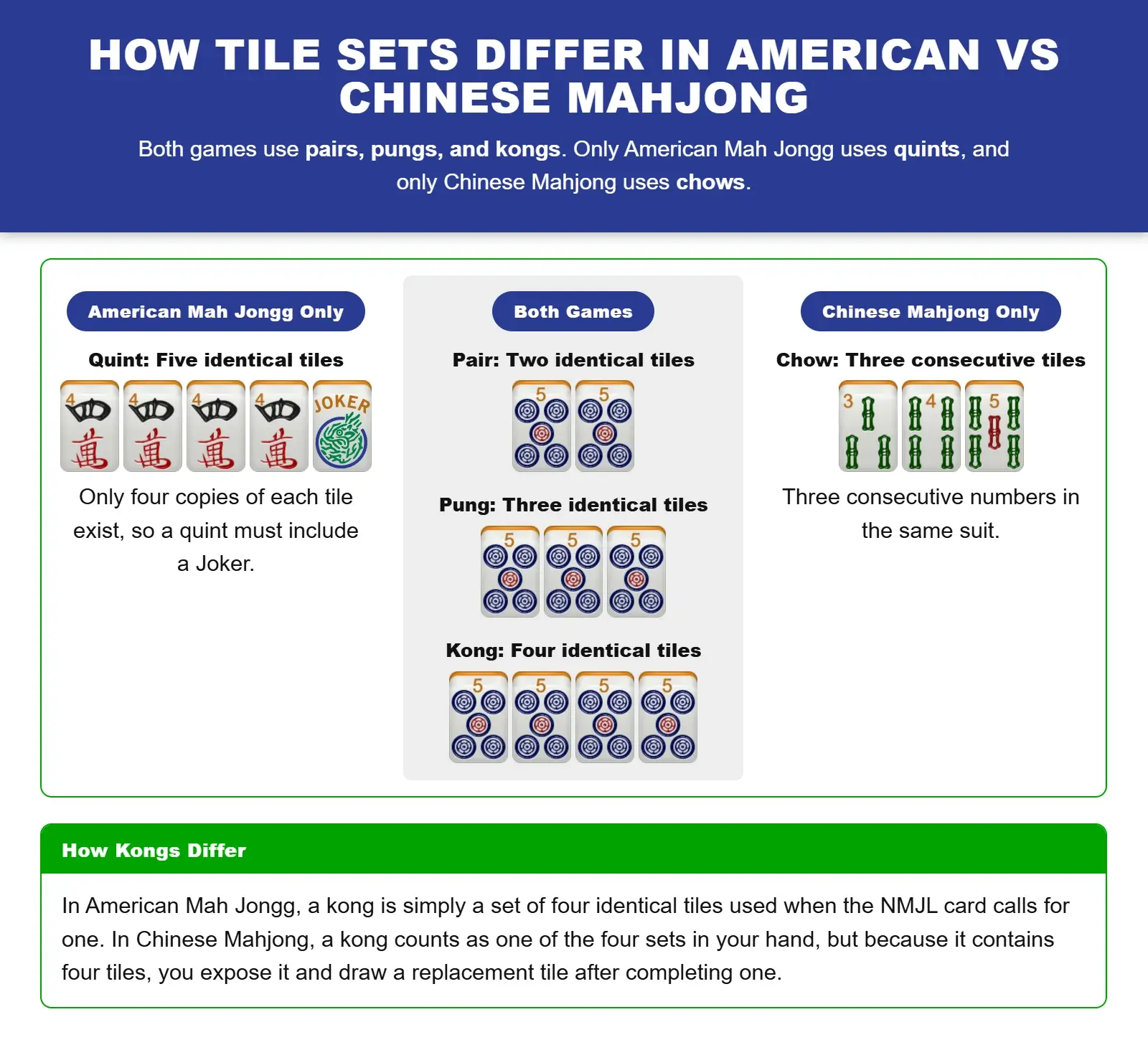
Both versions use three-tile sets (pungs), four-tile sets (kongs), and pairs. However, both versions have unique sets and treat kongs a bit differently. This list breaks down each difference.
- Kongs: In American Mah Jongg, a kong is simply a set of four identical tiles used when the NMJL card calls for one. In Chinese Mahjong, a kong has special gameplay rules. Because it contains four tiles but counts as one of the four sets in your hand, you draw a replacement tile after completing one and expose the kong.
- Quints: In American Mah Jongg, quints are five-tile sets. Because each tile only has four copies, a quint must use Joker. So this tile set doesn't exist in Chinese Mahjong.
- Chows: A chow is a sequence of three consecutive numbered tiles from the same suit, such as 3 Bamboo, 4 Bamboo, and 5 Bamboo. In Chinese Mahjong, chows can be used as one of the four sets needed to complete a standard winning hand. American Mah Jongg doesn't use chows or other sequential sets. Consecutive numbers may look like they appear in winning hands on the NMJL card, but they're treated as singles according to the exact pattern printed on the card rather than a three-tile sequence.
5. Tile Passing: American Mah Jongg Uses the Charleston
Before regular gameplay begins, American Mah Jongg players participate in Charleston structured tile exchange. During the Charleston, each player passes three tiles at a time following a prescribed pattern. The first Charleston includes three required passes: right, across, and left. If all players agree, a second Charleston follows that repeats the pattern backwards (left, over, right). Players sitting across from one another can also agree to a final courtesy pass.
The Charleston gives you an opportunity to improve your starting hand before regular drawing and discarding begins. As you compare your tiles with possible winning hands on the NMJL card, you can pass tiles that don't fit and keep tiles that preserve several possibilities.
Chinese Mahjong doesn't have this structured tile-passing phase. Once the Mahjong set is prepared, the tiles are dealt, and any Bonus tiles are handled, players move into regular gameplay.
6. Claiming Tiles (or Calling Them) Has More Options in Chinese Mahjong
Both American and Chinese Mahjong allow players to claim a discard, but the rules governing when and why you can take that tile aren't identical. Chinese Mahjong just has an additional option for calling tiles.
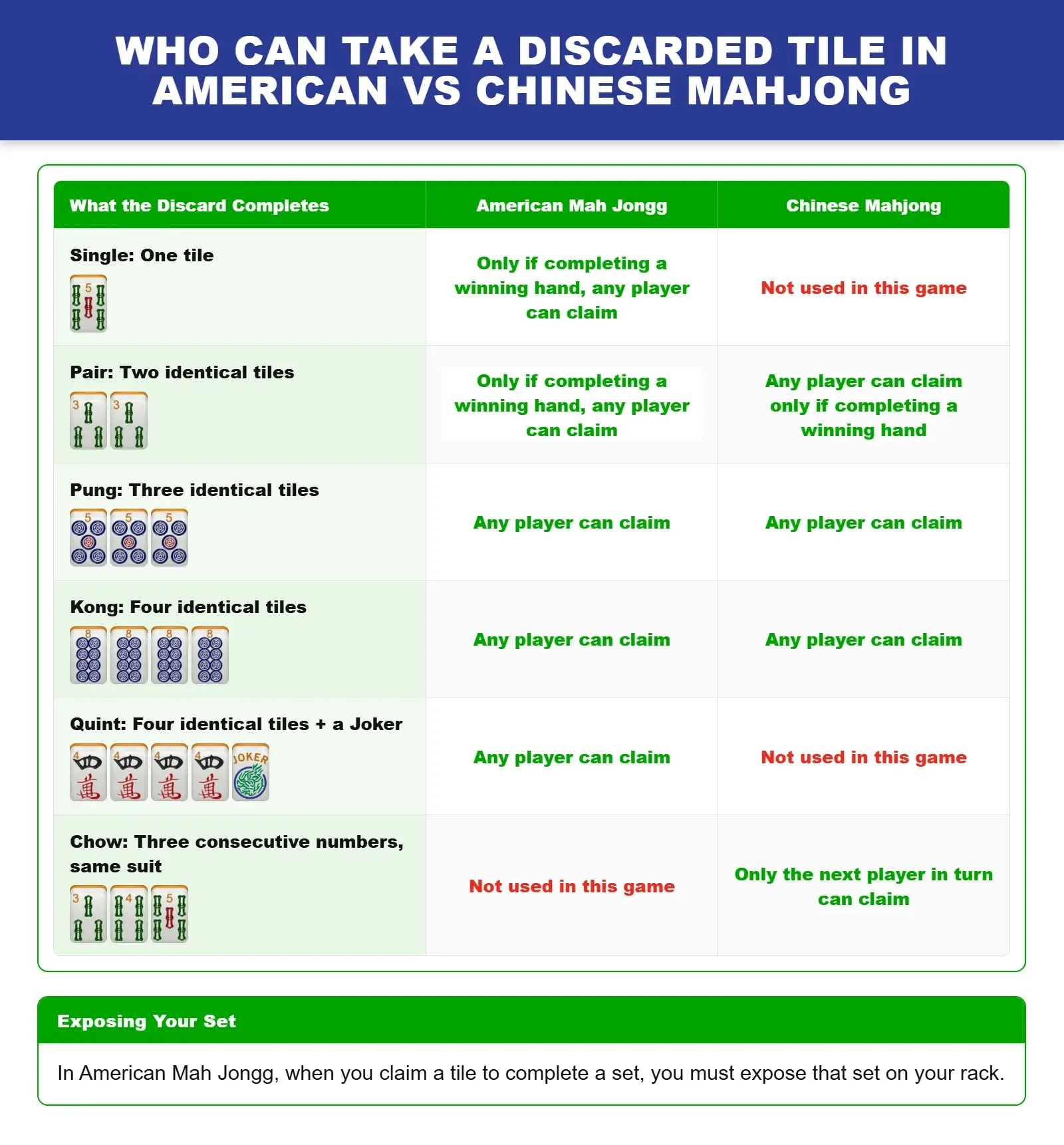
In American Mah Jongg, you can generally call a discarded tile when it completes an eligible set of three or more tiles, such as a pung, kong, or quint. You can also call a discard needed for a single or pair when that tile completes your entire winning hand. When you call a tile to complete a set, you have to expose that set on your rack.
Chinese Mahjong also allows players to claim discarded tiles for pungs and kongs, but chows add another possibility. Any player can claim an eligible discard for a pung or kong, while only the next player in turn can claim a discard to complete a chow. A player can also claim the appropriate discard when it completes a winning Mahjong hand.
7. Hand Building: Chinese Mahjong Has More Flexibility
Chinese Mahjong is more flexible when it comes to hand building because you have just one pattern to build: four sets and pair. But you decide what tiles and suits you use to complete the pattern. American Mahjong instead challenges you to remain flexible while working within the specific patterns allowed by the current NMJL card.
In American Mah Jongg, every win comes from the NMJL card. Early in the game, you might identify several possible winning hands that work with your tiles. As the game develops, you'll narrow those choices. If the tiles you need aren't appearing, you may need to switch to another hand before it's too late.
Chinese Mahjong doesn't restrict you to a list of predetermined winning hands. Instead, you continually evaluate how your tiles could become chows, pungs, kongs, and a pair. A tile that doesn't work with one possible combination may still become useful as the hand develops.
8. Scoring: American Mah Jongg Uses Straightforward Hand Scoring
Chinese Mahjong typically uses a scoring system that assigns value to different features of a winning hand. Depending on the rules being played, certain combinations, sets, Bonus tiles, or other scoring elements can increase a hand's point value. Because scoring rules vary among Chinese Mahjong variants, players need to agree on the scoring system they're using before beginning the game.
American Mah Jongg scoring is handled differently. Hands don't add up the value of individual sets or other elements within the hand. Instead, the NMJL card assigns a value to each complete winning hand. More difficult hands generally have a higher value, so the hand you choose determines what your Mah Jongg is worth if you win, and you can score additional bonus points for events like winning with a jokerless hand or drawing your winning tile.
This difference affects strategy in each game. In Chinese Mahjong, players may consider both whether a hand can win and how its individual scoring elements affect its value. In American Mah Jongg, you're working toward an exact NMJL card hand with a predetermined value rather than accumulating points from the combinations within it.
9. Strategy: Both Mahjong Types Require Different Strategies
American Mahjong strategy revolves heavily around the NMJL card. You need to recognize which winning hands fit your starting tiles, use the Charleston strategically, determine when to commit to a hand, and recognize when you still have enough flexibility to switch. Joker tiles add another strategic element, as does deciding whether exposing sets will reveal too much information about the hand you're building. You can use American Mah Jongg cheat sheets to keep the specific rules and strategies straight.
Chinese Mahjong strategy focuses more heavily on developing useful combinations from the available tiles. You're constantly evaluating opportunities to build chows, pungs, and kongs while keeping enough flexibility to respond to new draws and discards. Scoring can create additional strategic considerations in Chinese Mahjong.
10. Both Include Regional Variations
Another difference that's often overlooked is how both American and Chinese Mahjong are more like two different families of Mahjong that include unique but related offshoots. For example, the NMJL card is quite commonly used in American Mah Jongg circles. But the Marvelous card and Big Card are alternative cards that have their own hands and often unique bonuses in scoring.
Chinese Mahjong has several offshoots that operate more like actual variations because they use different rulesets or regional differences. Some of these include:
- Hong Kong Old Style: This version has a defined ruleset, and while it still requires four sets and a pair for a winning hand, the scoring differs from other variations.
- Chinese Official Mahjong (Mahjong Competition Rules; MCR): This competitive ruleset uses over 80 scoring patterns and an elaborate scoring system.
- Filipino Mahjong: Using traditional Chinese sets, you must build a 17-tile hand with Flowers, Seasons, Winds, and Dragons acting as bonus tiles.
- Panama Rules: This version has you building a hand like in Chinese Mahjong but you also get to use the Charleston tile exchange like in American Mah Jongg.
11. Learning Curve: Which Is Easier Depends on What Versions You Already Know
Neither American nor Chinese Mahjong is necessarily easier to learn. Instead, the learning curve comes from different parts of each tile-based game.
With American Mah Jongg, new players have to learn the basic rhythm of drawing, discarding, and calling tiles while also learning to read the NMJL card. Understanding the card's colors, abbreviations, American sets, winning hands, Joker restrictions, and Charleston can take practice.
Chinese Mahjong doesn't require you to interpret an annual card, and the basic goal of forming four sets and a pair can be relatively intuitive once you understand chows, pungs, and kongs. However, calling rules and the scoring system can add complexity, particularly because Chinese Mahjong isn't a single standardized game with one universal set of scoring rules.
Choose Your Favorite and Play on Mahjong 4 Friends
If you enjoy puzzles, pattern recognition, and working toward defined winning hands, American Mahjong may feel more intuitive. If you prefer flexible set building and adapting your strategy to the tiles you draw, Chinese Mahjong may feel more natural. No matter what you decide, you can enjoy playing both online at Mahjong 4 Friends.