How to Use Jokers in American Mah Jongg Jokers: Rules and Strategies
In American Mah Jongg, Jokers can help players complete groups of three or more identical tiles (pungs, kongs, and quints) that would otherwise take multiple turns to build. Because the goal of Mah Jongg is to build a 14-tile winning hand that matches a hand on the NMJL card, each Joker can move you one tile closer to declaring Mahjong.
But despite how powerful the Joker tile is, Joker rules are also one of the most confusing parts of learning how to play Mahjong. Many beginner mistakes happen because players try to use Jokers in pairs, singles, or runs that are not allowed under National Mah Jongg League (NMJL) rules. Joker swaps, exposures, and the rules surrounding Joker sets can also create confusion during gameplay.
Whether you’re playing Mah Jongg for the first time, reviewing NMJL rules before a competitive Mahj game night, or trying to improve your strategy with your regular Mahjong game group, understanding how Jokers work is essential for building a winning hand.
American Mah Jongg Joker Rules
Jokers, which are tiles used only in American Mah Jongg, can’t be played in just any set in any hand. The rules for using them are simple, but they shape your strategy from the very beginning of the game, from influencing how quickly you build your hand to going jokerless to maximize your Mah Jongg scoring. The sections below explain both the official rules and the nuances of using Jokers effectively during gameplay.
For quick reference while you play, download our free printable Mah Jongg Cheat Sheets, which include Joker rules and other essential gameplay guidelines.
Use 8 Jokers When Following Official NMJL Rules
Your Mahjong tile set typically contains more than eight Jokers, but the NMJL rules require that you play with only eight. However, for casual play, some house rules may allow two extra Jokers to be added to increase your luck, and others may add even more by including six blanks in addition to the two extra Jokers to double the number available. When playing with the blanks and two extra Jokers, you have to build walls 20 tiles long and 2 high to accommodate the extra tiles.
As a beginner, using extra Jokers may be helpful in creating winning hands faster, but it also means you have to engage with Joker rules nearly twice as often. And if you get used to more Jokers, you may not adjust well to traditional gameplay. More serious players and tournaments will only use eight.
No Jokers Can Be Passed in the Charleston
Jokers cannot be passed during the Charleston tile exchange. If you are dealt a Joker at the beginning of the Mah Jongg game, you must keep it in your rack rather than pass it to another player. Because Jokers are wild cards that can complete pungs, kongs, and quints, they are considered too valuable to circulate during the Charleston.
If you accidentally include a Joker in a Charleston pass, the Joker must usually be returned and replaced with another tile before gameplay continues. Some groups may have specific house rules for handling mistakes during the Charleston, but under official NMJL rules, Jokers are never eligible to be passed.
Use Jokers Only for Sets of Three or More Identical Tiles (Pungs, Kongs, and Quints)
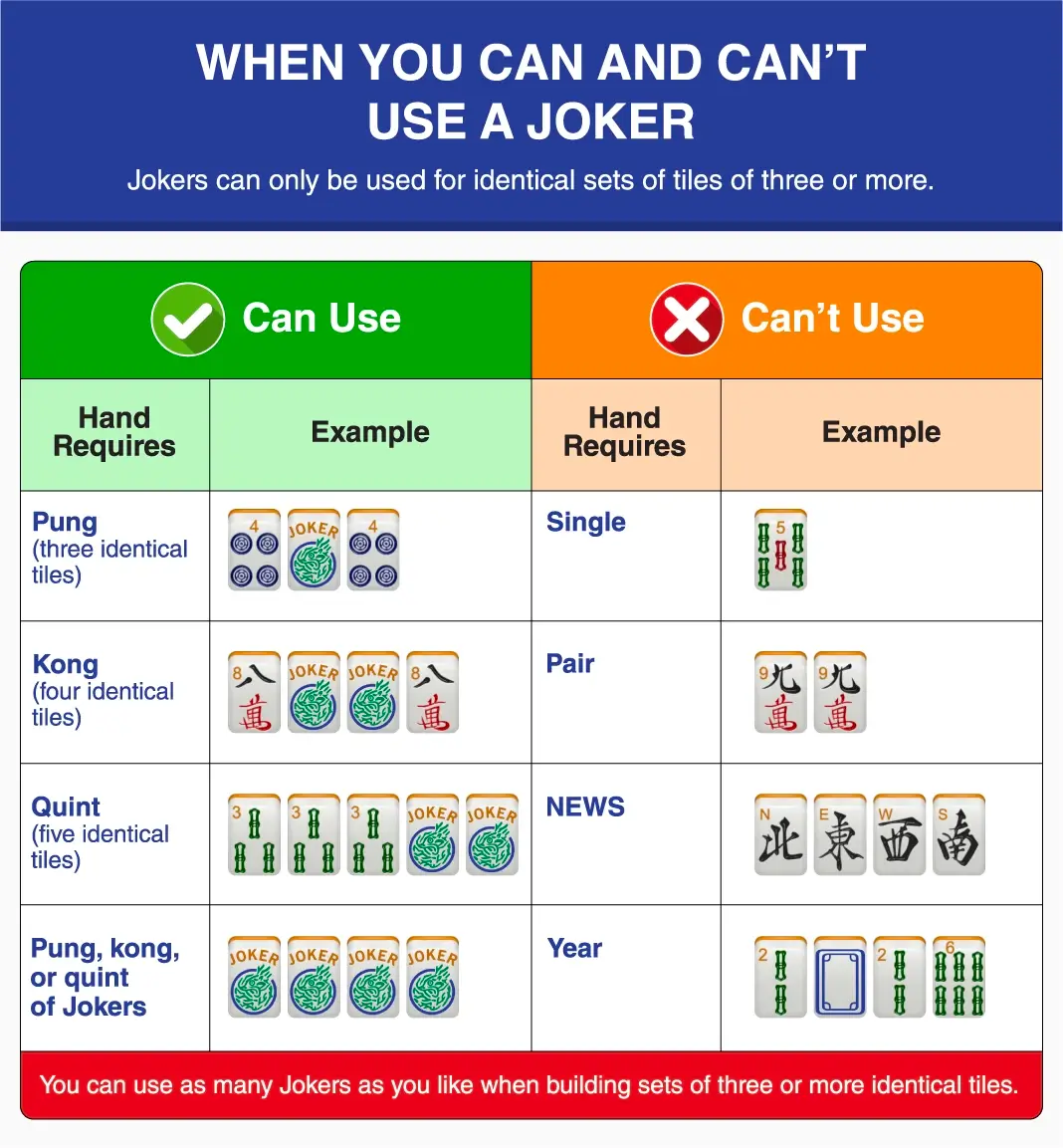
Jokers can only be used to replace tiles in sets of three or more identical tiles, which includes any pungs, kongs, and quints. Because quints require five of the same tile and only four of each tile is in a set, you must always use a Joker to complete a quint.
You can use as many Joker tiles as needed to complete a pung, kong, or quint. You can even complete the set using all Jokers, if necessary. For example, a pung of 4 Dots can be completed with Jokers in any of the following ways:
- 4 Dot, 4 Dot, Joker
- 4 Dot, Joker, Joker
- Joker, Joker, Joker
The table below offers some examples of how you can use Jokers in your Mah Jongg hand.
| Grouping | Meaning | Hand Requirement | Example |
|---|---|---|---|
| Pung | Three identical tiles | 222 | 2 Dot, Joker, 2 Dot |
| Kong | Four identical tiles | 8888 | 8 Crak, 8 Crak, Joker, 8 Crak |
| Quint | Five identical tiles | 55555 | 5 Bam, 5 Bam, 5 Bam, Joker, 5 Bam |
| Full Joker Grouping | A pung, kong, or quint made entirely of Joker tiles | 4444 | Joker, Joker, Joker, Joker, |
Jokers Cannot Be Used to Complete Singles or Pairs
Only groups of three or more identical tiles (pungs, kongs, or quints) can use Jokers, not single tiles or pairs of identical tiles. So you have to be careful with some Mah Jongg hand patterns that involve NEWS or year combinations (like 2026). For example,
- A hand requiring a single North, East, West, and South tile (NEWS) cannot use Jokers because each tile functions as an individual single. Likewise, a year hand requiring single tiles to form 2026 (where a White Dragon stands in for the zero) cannot use Jokers in those positions.
- A NEWS or year hand that requires groups like NNN EEE WW SSS or 222 000 2222 666 can use Jokers for any of the pungs, kongs, or quints of identical tiles.
This is one reason singles and pairs are especially valuable during the Charleston and early gameplay. And because players cannot call tiles to complete singles and pairs unless declaring Mahjong, building pairs and singles early is important.
The following table breaks down instances of when you can’t use a Joker—and why—when building your hand.
| Situation | Joker Rule | Hand Requirement | Example |
|---|---|---|---|
| Singles | Jokers can’t replace a single tile in a hand. | D | single Green Dragon |
| Pairs | Jokers can’t replace a tile in pairs. | 55 | 5 Dot, 5 Dot |
| NEWS | NEWS contains a single tile for North, East, West, and South, and Jokers can’t replace single tiles. | NEWS | North, East, West, South |
| Year Hands | Year combinations use single tiles to create the year, and Jokers can’t replace single tiles. | 2026 | 2 Bam, White Dragon (replaces a zero), 2 Bam, 6 Bam |
Jokers Must Be Exposed If They’re Part of a Meld
You don’t have to expose any Jokers you have racked (concealed in your rack) unless they are part of a meld, which is an exposed pung, kong, or quint (you can get familiar with more American Mah Jongg terms in our guide.) In American Mah Jongg, a concealed pung, kong, or quint and any Jokers used in the set stay concealed, too. But if you complete the set by calling a discarded tile from another player, the entire set must be exposed, including any Jokers within it, and that exposure is what turns it into a meld.
After a set is exposed, that grouping becomes locked into your final hand. Because exposures commit you more heavily to a specific hand, many experienced players try to stay concealed as long as possible before exposing Jokers in melds. Plus, exposing Jokers offers other players the opportunity to steal the Joker from you during a Joker swap. If you keep it in your hand and draw or claim the representative tile yourself, you can then use that Joker elsewhere in your hand.
Exposed Jokers May Be Swapped for the Representative Tile by Any Player
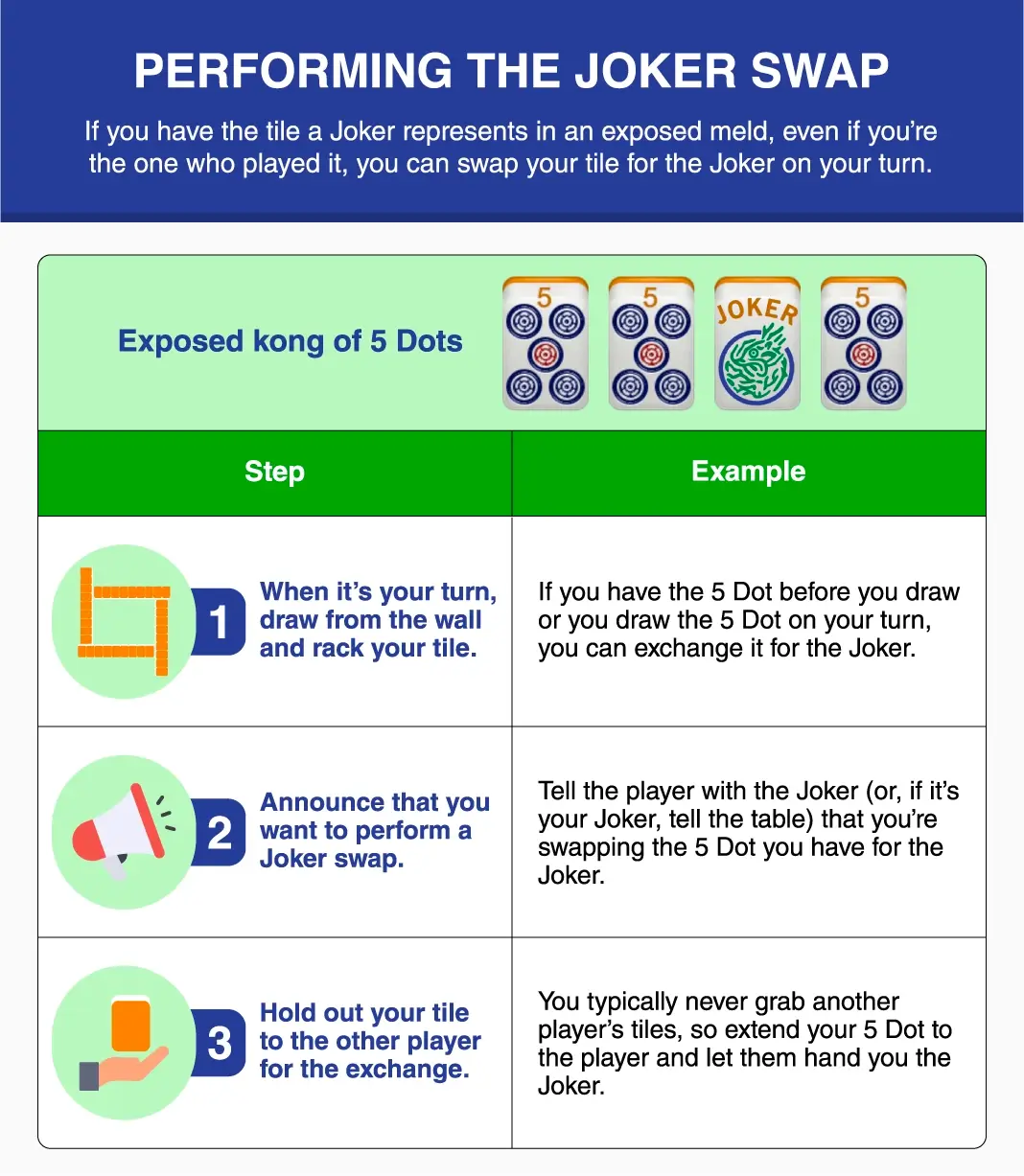
One of the most unique Joker rules in American Mah Jongg is the Joker swap (sometimes called a Joker exchange). If a player exposes a Joker in a meld, any player, including the one who exposed it, may exchange the actual tile for the exposed Joker during their turn.
Because Jokers are so flexible, reclaiming one through a Joker swap can dramatically improve your hand and open up new possibilities for completing pungs, kongs, or quints. So Joker swaps have several important rules, worth highlighting:
- Any player, including the one who exposed the Joker, can swap. The Joker is up for grabs to anyone who has the representative tile as long as it’s their turn. So even if you exposed the Joker and then on your next turn you draw the necessary tile, you can swap it for the Joker.
- The swap must happen during your turn. If multiple players could perform the same Joker swap, the player whose turn comes first gets the opportunity.
- You must already have or draw the representative tile. If a player misses the chance to swap and discards the representative tile instead, that tile cannot later be reclaimed from the discard pile for the swap.
- The exposed player cannot refuse the exchange. While a Joker is in your rack, you’re the only player that can use it, but after it is exposed, any player, including yourself
- Joker swaps also only apply to exposed Jokers. Concealed Jokers in another player’s rack cannot be exchanged because the other players cannot see or interact with concealed tiles.
For example, if Player 1 exposes a kong of 2 Bams with a Joker, (2 Bam, 2 Bam, Joker, 2 Bam) and Player 3 has a 2 Bam in their rack or draws one during gameplay, Player 3 can exchange the 2 Bam for the exposed Joker by following these steps:
- On their turn, the player draws from the wall and racks the drawn tile. You have to wait until your turn to do a Joker swap. So if two players have the 2 Bam, the next player to take their turn gets to do the Joker swap.
- They announce that they want to swap their Joker. The player informs the table that they want to swap their 2 Bam for the Joker in the kong of 2 Bams. Typically, the player wanting to swap politely asks the other player to perform the swap. Note, however, that the player with the exposed Joker cannot refuse to perform the swap.
- The player exchanges their 2 Bam with the Joker. The 2 Bam is now in the meld and the exposed Joker is now placed into their own rack to use elsewhere in their hand.
Discarded Jokers Are Dead Tiles
Jokers should almost never be discarded during a Mah Jongg game because discarded Jokers are considered dead tiles. Once a Joker is discarded, no player can call it, claim it, or use it to complete a hand. The discarded Joker simply remains in the discard pile for the rest of the game.
Because Jokers are wild cards that can substitute for tiles in pungs, kongs, and quints, discarding one usually means giving up one of the most flexible tiles in your rack without any chance of recovering it later.
In most games, players only discard Jokers when they have no legal way to use them in a nearly completed hand or they want to double their payout by not using Jokers in their hand (only applies when playing for money). Even then, many experienced players will try to hold a Joker as long as possible so that they don’t give another player a chance to use it.
Mah Jongg Joker Strategy Tips
While Jokers are powerful tiles, using them effectively requires balancing flexibility, timing, and hand development. These strategy tips can help you make better decisions during gameplay:
- Build singles and pairs early. Because Jokers cannot be used for singles or pairs, these are often the hardest parts of a hand to build, especially later in the game. During the Charleston and early gameplay, prioritize building or keeping valuable singles and pairs whenever possible.
- Watch the discards and revealed melds to decide where to use your Joker. Save Jokers for the most difficult set to complete naturally. You can get two pieces of information from revealed tiles to help you determine where to use your Joker. For example, if several 5 Bams have already been discarded or a pung of 5 Bams is revealed, using a Joker for the 5 Bam you need may make sense. However, you might also gain information by what you don’t see. For example, if no one is discarding 6 Dots at all, another player is likely collecting them, so that set may be a better use for your Joker.
- Track exposed Jokers throughout the game. Watching exposed Jokers helps you estimate how many remain in play since official NMJL rules only use eight Jokers total. If many Jokers are already exposed in melds around the table, some hands on the NMJL card may become much harder to complete.
- Keep racked Jokers flexible early in the game. It’s tempting to assign a Joker to a set immediately, but staying flexible can create stronger hands later. For example, if you have one 2 Crak and a Joker, you may feel tempted to call the next discarded 2 Crak to complete the pung. But exposing the meld also exposes your Joker and gives other players the opportunity to swap for it. Early in the game, it may be smarter to wait and try to complete the set naturally while keeping your Joker concealed for another use.
- Use exposed Jokers to read opponents’ hands. Exposed melds can reveal which suits, numbers, or hand patterns other players are pursuing. If you know the NMJL card well and notice a player exposing melds that match a pattern on the card, for example, you may want to avoid discarding tiles you think they could use.
- Don’t assume a Joker automatically improves your hand. Sometimes a Joker pushes players too aggressively into one section of the NMJL card when another hand is actually more achievable. Strong Mah Jongg strategy often comes from flexibility, not just from collecting Jokers.
Mastering Jokers in American Mah Jongg
While Jokers can help complete difficult pungs, kongs, and quints, strong Mah Jongg strategy still depends on reading the table, protecting singles and pairs, and staying flexible as the game develops. The more you play, the easier it becomes to recognize when to hold a Joker, when to expose one, and when to completely change your hand with a Joker swap.
Whether you’re playing Mahjong online or simply sharpening your skills for your next Mahj game night, understanding how to use Jokers effectively is an important step toward becoming a stronger American Mah Jongg player.