How to Set Up American Mah Jongg: Step-by-Step Guide
Setting up American Mah Jongg can look almost as complicated as playing it the first time. There are 152 tiles, four racks and pushers, dice, four NMJL cards, four walls to build, and a Charleston to complete before anyone makes the first discard. Fortunately, the setup follows the same sequence every time, so after you do it for a few games, it goes quickly and becomes more automatic.
In addition to the physical setup, the game has another layer worth understanding. The deal gives you your initial possibilities, and the Charleston gives you several opportunities to refine them. Knowing what’s happening during setup and why can make it easier to move from simply following the steps to making better decisions at the table.
If you’re completely new to the game, our beginner’s guide to American Mah Jongg covers the basics you’ll want to know before you play.American Mah Jongg Setup: Quick Reference
For returning players who just need a reminder, here’s a quick reference for how to set up Mah Jongg:
- Gather your supplies. Get your tiles, racks, pushers, dice, and NMJL cards.
- Determine East. Roll the dice to determine East.
- Shuffle tiles and build the wall. Shuffle the tiles and have each player build a wall 19 stacks long × 2 tiles high. Push each wall together to form a square.
- East breaks the wall. East rolls the dice and counts stacks from the right end of their wall.
- Deal the tiles. Starting at where the wall was broken, players take turns taking 4 tiles at a time, moving counter-clockwise. When everyone has 12, the dealer takes 2 more tiles, and the rest of the players take 1 so that East gets 14 tiles and everyone else gets 13.
- Complete the Charleston and any courtesy pass. The first Charleston, which is required, has players passing 3 tiles Right → Across → Left, and the second Charleston, which is optional, has players passing 3 tiles Left → Across → Right. For the courtesy pass, pass up to 3 tiles to the player across from you only if both players agree (done after the Charleston finishes).
- East makes the first discard. The extra tile East took during the deal means they don’t draw from the wall to start the game but only need to discard a tile.
Keep our printable Mah Jongg cheat sheets at the table if you want a visual reminder of the setup and Charleston while you play.
If you already play Chinese, Hong Kong, or Riichi mahjong, a few differences in American Mah Jongg setup are worth noting up front:
- American Mah Jongg uses 152 tiles rather than the 144-tile set you may be accustomed to because the American set adds 8 Jokers.
- There is no dead wall.
- Flowers don't trigger a replacement draw as they do in some other versions of Mahjong.
- Most noticeably, American Mah Jongg includes the Charleston, a tile-passing sequence that takes place after the deal and before normal play begins.
So even if building four walls looks familiar, don't assume the rest of the setup works exactly like the version you already know.
Steps to Set Up Mah Jongg
Setup can take 5 to 10 minutes the first few times you play as you get accustomed to the process. However, you’ll be able to finish it in just a few minutes after you get the hang of it. If you’re unfamiliar with some of the game’s terms, check out our Mah Jongg terminology guide as you set up.
Step 1: Gather Your American Mah Jongg Supplies
Start by making sure you have everything you need for a four-player game, which includes:
- A standard American Mah Jongg set that contains 152 tiles
- Four racks, preferably with pushers
- Two dice
- A current Mah Jongg card for each player, typically the annual card published by the National Mah Jongg League (NMJL)
A standard American Mah Jongg set contains 152 tiles with numbered suits (36 Bams, 36 Craks, 36 Dots), Honor tiles (16 Winds and 12 Dragons), and Bonus tiles (8 Flowers and 8 Jokers). If you’re still learning which tile is which, see our Mah Jongg tile names guide before you play. Knowing that someone means a White Dragon when they say “Soap” or means the same suit when they say “Bam” or “Bamboo,” for example, makes the conversation around the table much easier to follow.
Some American sets also come with blank tiles. These are extras or replacement tiles and aren't part of the standard 152 tiles used under NMJL rules. Like any wildcard in a game, Jokers have a special role. They can substitute for tiles in groups of three or more identical tiles, but they can't be used in singles or pairs. Because they are special, you can read up on the Joker rules if you’re not familiar with how these are used.
The National Mah Jongg League (NMJL) card shows the hands that can win that year. Those hands use different combinations of singles, pairs, pungs, kongs, and quints along with the numbered suits, Winds, Dragons, and Flowers. If reading the card is still unfamiliar, our guide to building winning Mah Jongg hands explains how those combinations work.
Importance at the table: Unlike other variations of Mahjong, American Mah Jongg uses predesigned winning hands. Your hand must match the exact 14-tile construction listed on a card. So you need to know what card your group is playing with and get familiar with those hands.
Step 2: Roll the Dice to Choose East
Before building the walls, determine who will be the dealer, also called East, by following these simple steps:
- Each player rolls the dice.
- The player with the highest total becomes East for the first game. You may also hear this position called the East seat.
East has a few extra responsibilities during setup. They roll the dice to break the wall and begin with 14 tiles rather than 13. That extra tile is important because East starts regular play by discarding rather than drawing.
After a game is completed, the East position passes to the player on the right, so the dealer position moves counter-clockwise around the table. That means everyone gets a chance to be East.
Difference from variations: In other versions of the game, East may get an increased scoring opportunity, but not so according to American Mah Jongg scoring rules. East simply breaks the wall and gets an extra tile because they must go first.
Step 3: Shuffle the Tiles and Build the Wall
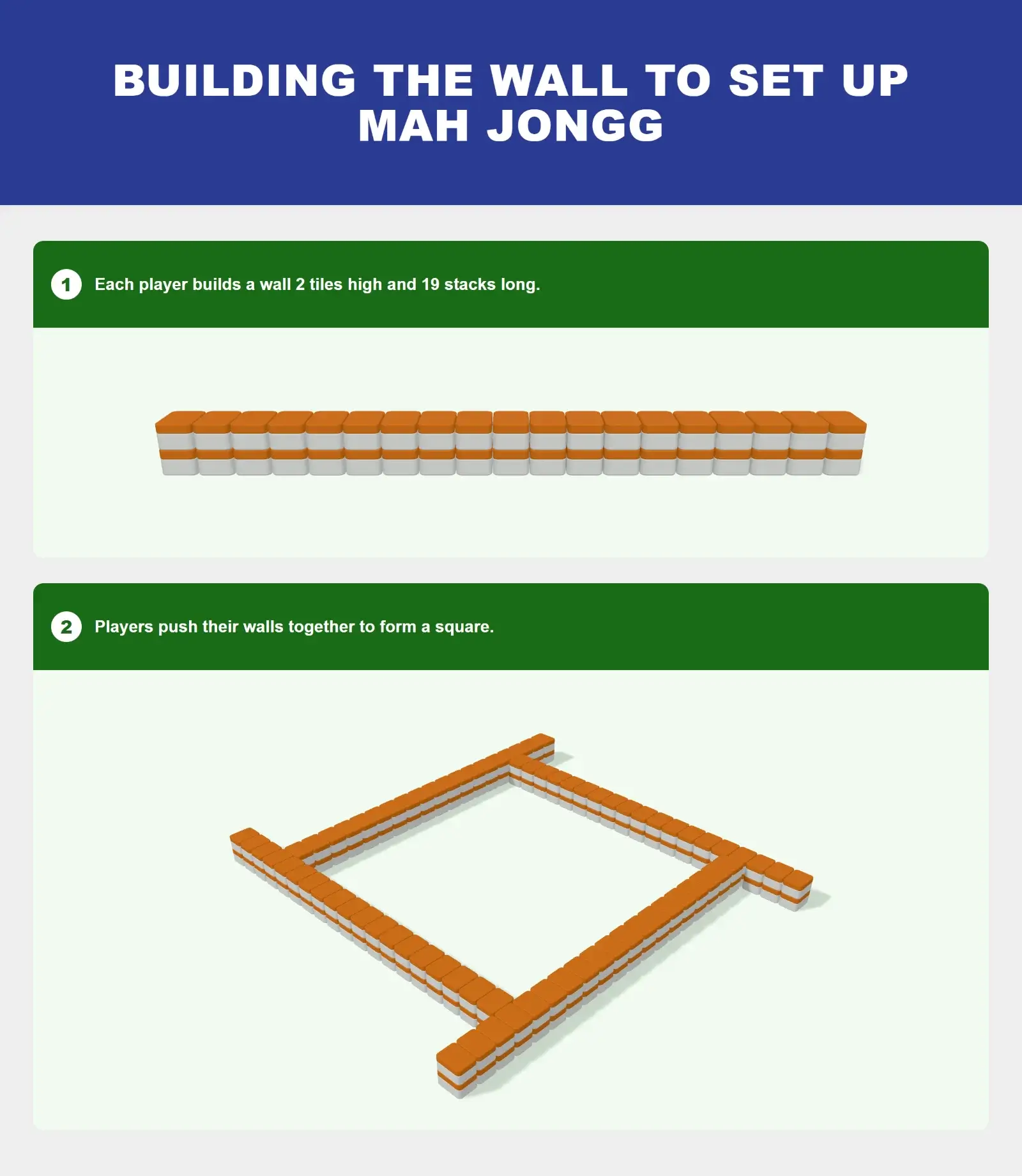
Turn all 152 tiles facedown in the center of the table and mix them thoroughly. Everyone can help shuffle as long as the faces of the tiles remain hidden. Then each player uses 38 tiles to build a wall in front of their rack that is 19 stacks long and 2 tiles high.
After all four players have finished building their walls, they use the pushers to move the walls together until they form a square in the center of the table. Your four walls now contain all 152 tiles.
Why this matters: Similar to shuffling a deck of cards and having a draw pile, the wall randomizes and physically organizes the tiles that will be dealt and drawn throughout the game. That uncertainty is part of the game, and it’s one reason good American Mah Jongg strategy depends on adapting to what becomes available rather than deciding too early that you must complete one particular hand.
Step 4: East Breaks the Wall
After the four walls are built, East determines where the deal will begin, following these steps:
- Roll the dice.
- Starting from the right end of East's wall and going inward, count stacks equal to the total shown on the dice. Remember that you're counting stacks of two tiles, not individual tiles. For example, if East rolls 7, count inward seven stacks from the right end of the wall.
- Make the break at that point. At that point, East pushes the wall apart, and that break establishes the starting point for taking tiles from the wall.
The physical orientation matters here: Begin taking tiles from the open end created at the break and continue away from the end you counted from. As the available section of one wall is exhausted, play continues into the adjoining wall.
Step 5: Deal the Tiles
Although it’s called dealing, everyone takes their starting tiles from the wall, beginning at the break and taking two stacks (4 tiles) at a time.
Starting with East and moving counter-clockwise, the deal is as follows:
- East takes two stacks (4 tiles).
- Each player, beginning with the player to East's right, takes 4 tiles.
- Repeat the process until every player has 12 tiles.
- After everyone has 12 tiles, East takes the first and third top tiles for two more tiles, which gives them 14, and all other players take 1 additional tile for 13 each.
Note: It may seem like a strange rule for the dealer (East) to take the first and third top tile, but East needs to discard first to begin the game. That means they need one more tile than the other players. If they simply took 1 tile, it would be the first top tile. Then if everyone took their last tile, East would have to take one last tile, which would end up being what was that third top tile. So it’s just quicker for East to take “1 and 3 for me” when they have the chance.
After everyone has the correct number, place your tiles on your rack facing you. This is your first opportunity to scan your tiles for possible pattern matches to the card, but keep in mind that your possibilities could change in the next step, the Charleston. The tiles you receive during those passes may strengthen one of the hands you're considering or point you toward another hand option.
Remember: There are two directions to keep straight during the deal. The players take their tiles in counter-clockwise order, but if the wall you're taking from runs out, the next wall to be served is the wall clockwise from it. That difference is easy to miss the first few times you set up a game.
Step 6: Complete the Charleston
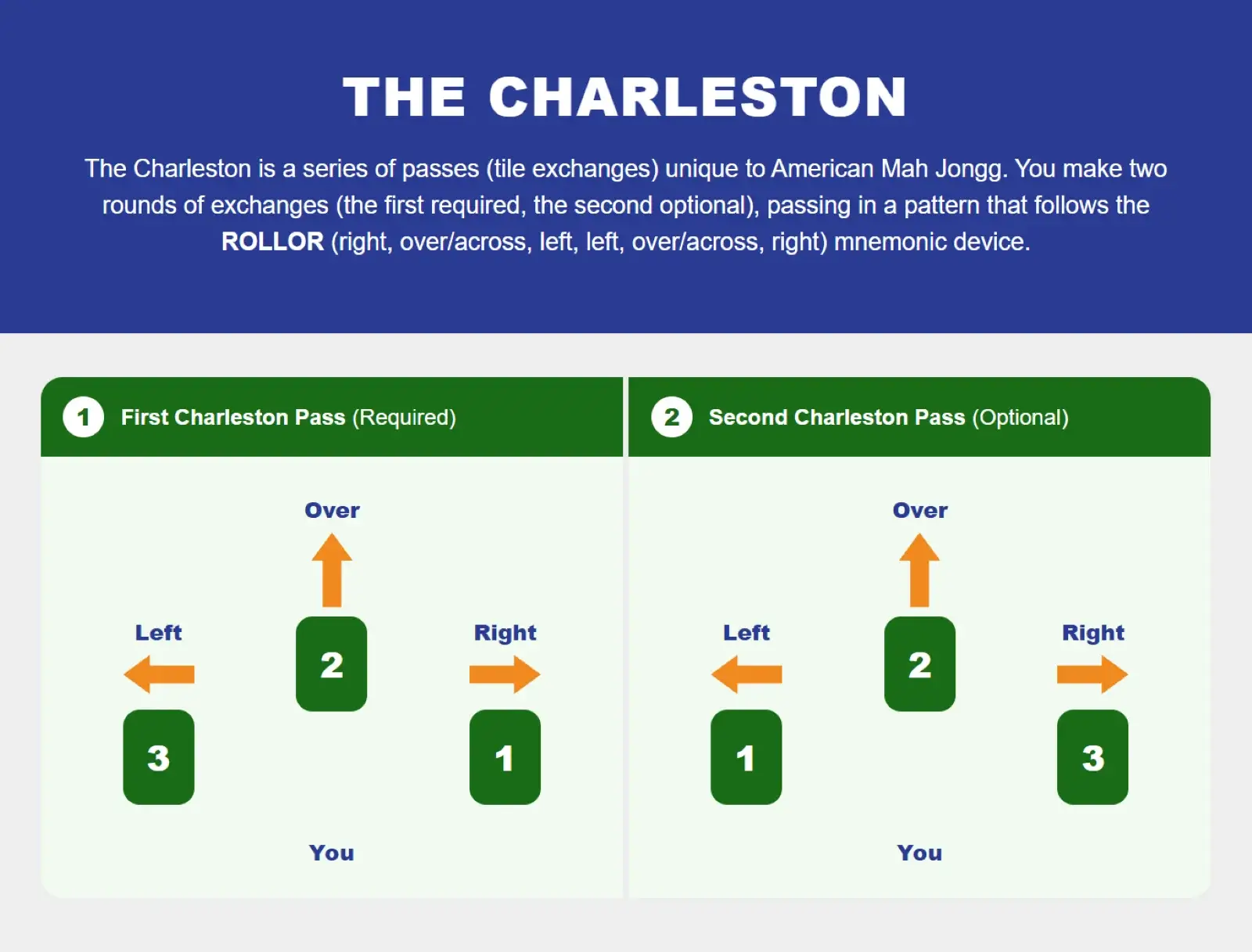
The Charleston is a defining feature of American Mah Jongg and a large part of your beginning strategy. It happens after the initial deal but before normal drawing and discarding begin. During the Charleston, players exchange three tiles at a time in a specific direction. The complete sequence of directions is right, over, left, left, over, right, remembered through the mnemonic device: ROLLOR.
This list breaks down those different parts of the process, but our complete guide to the Charleston can give you all the details if you’re new to the game:
- The first Charleston is required. Each player passes three tiles, right, over, and left. On the third pass, you have the option of making a blind pass: You pass the tiles that were just passed to you without looking at them. You can pass 1, 2, or all 3 tiles blindly.
- The second Charleston is optional. If all four players agree to continue with the optional second Charleston, they pass three tiles left, over, and right. A blind pass is also permitted on the final pass to the right.
- Once the Charleston has been completed, players sitting across from one another may agree to an optional courtesy pass. The two opposing players must agree both to make the pass and to the number of tiles they will exchange, from zero to three. Each pair of opposite players makes its own agreement.
The Charleston gives you a chance to get rid of tiles that don't fit your likely hands, while seeing whether the incoming tiles make one of your other possibilities stronger. But one rule is absolute: You cannot pass a Joker during the Charleston. You should also be cautious about passing useful singles and pairs too early, too. Because Jokers can't substitute in singles or pairs, those individual tiles may become particularly difficult to replace later.
Strategy note: The Charleston isn't simply a way to get rid of unwanted tiles. You're exchanging information and possibilities. You may be narrowing toward a possible hand while also noting what everyone else seems to not want in their racks. The Charleston gives you many opportunities to use advanced Mah Jongg strategies that help you build an achievable hand, observe information about other player’s possible hands, and determine when it’s best to stop the Charleston.
Step 7: East Makes the First Discard
After the Charleston and any courtesy passes are complete, setup is finished and regular gameplay begins with East making the first discard. Because East already has 14 tiles, they don’t draw from the wall. Instead, they choose one tile to discard, place it face up in the center of the table, and announce its name.
From there, play continues counter-clockwise. Players draw and discard as they work toward one of the winning hands on the current card. Depending on the situation, a player may also be able to claim another player's discard by calling the tile. Our guide on how to play American Mah Jongg details all you need to know to continue drawing, discarding, calling tiles, using Jokers, and completing a winning hand.
Set Up the Table or Play Mah Jongg Online
Setting up American Mah Jongg feels complicated primarily because several unfamiliar things happen before the first turn. But after you understand what each part is doing, the sequence becomes much easier to remember: Build the walls, establish the break, deal the tiles, use the Charleston to begin shaping your possibilities, and let East start the game.
And you don't need a physical table every time you want to practice. Mahjong 4 Friends lets you play American Mah Jongg online, giving you more opportunities to practice reading the card, recognizing tiles, evaluating possible hands, and making the strategic choices that begin as soon as the deal is complete.