Is Mahjong Hard to Learn? What Beginners Should Know
No, Mahjong isn’t especially hard to learn, but it can feel overwhelming when you first sit down to play. Between unfamiliar Mahjong tiles, new terminology, and rules that vary depending on the type of Mahjong you’re playing, Mahjong beginners often have several things to remember at once.
The good news is that you don’t need to master all of Mahjong before you can start playing. No matter what variation you play, the basic flow of drawing a tile, making a discard, and working toward a winning hand becomes familiar with practice. Strategy and scoring take longer to master, but they’re still not hard to learn.
The best way to learn how to play Mahjong is just by getting started. And this post helps you navigate the ins and outs of the game so you don’t run into any roadblocks when you play Mahjong online or at a table.
Where Beginners Get Stuck When Learning Mahjong
Beginners tend to get stuck at specific points where several unfamiliar concepts come together. Knowing where those sticking points are can make it easier to learn the game without feeling like you need to memorize everything at once.
The Mahjong Tiles May Seem Unfamiliar
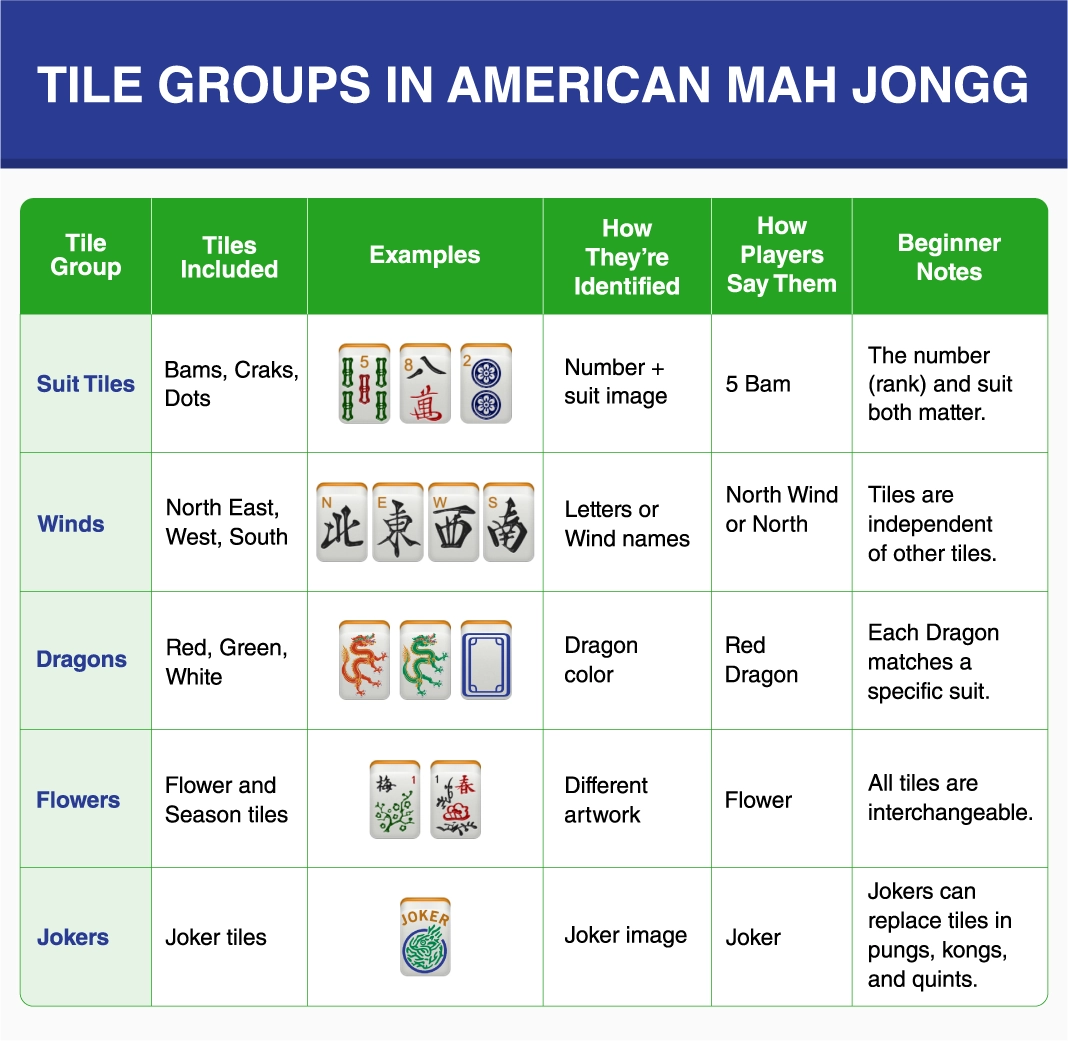
The Mahjong tiles can look intimidating at first, but they are organized into groups and patterns that quickly become recognizable. You’ll play with suited tiles (Dots, Bams, and Craks), Winds, Dragons, Flowers, Seasons, and, if you play American Mah Jongg, you’ll use Jokers. You don't need to look at a full set of Mahjong tiles and memorize every piece individually. Learning the basic Mah Jongg tile names and groups gives you a framework, and recognition gets faster as you play.
What this means for beginners: While there are many unfamiliar tiles and groups, you don't have to memorize each tile before you play. Learn the major groups first and let repeated play build recognition.
Mahjong Has Its Own Vocabulary
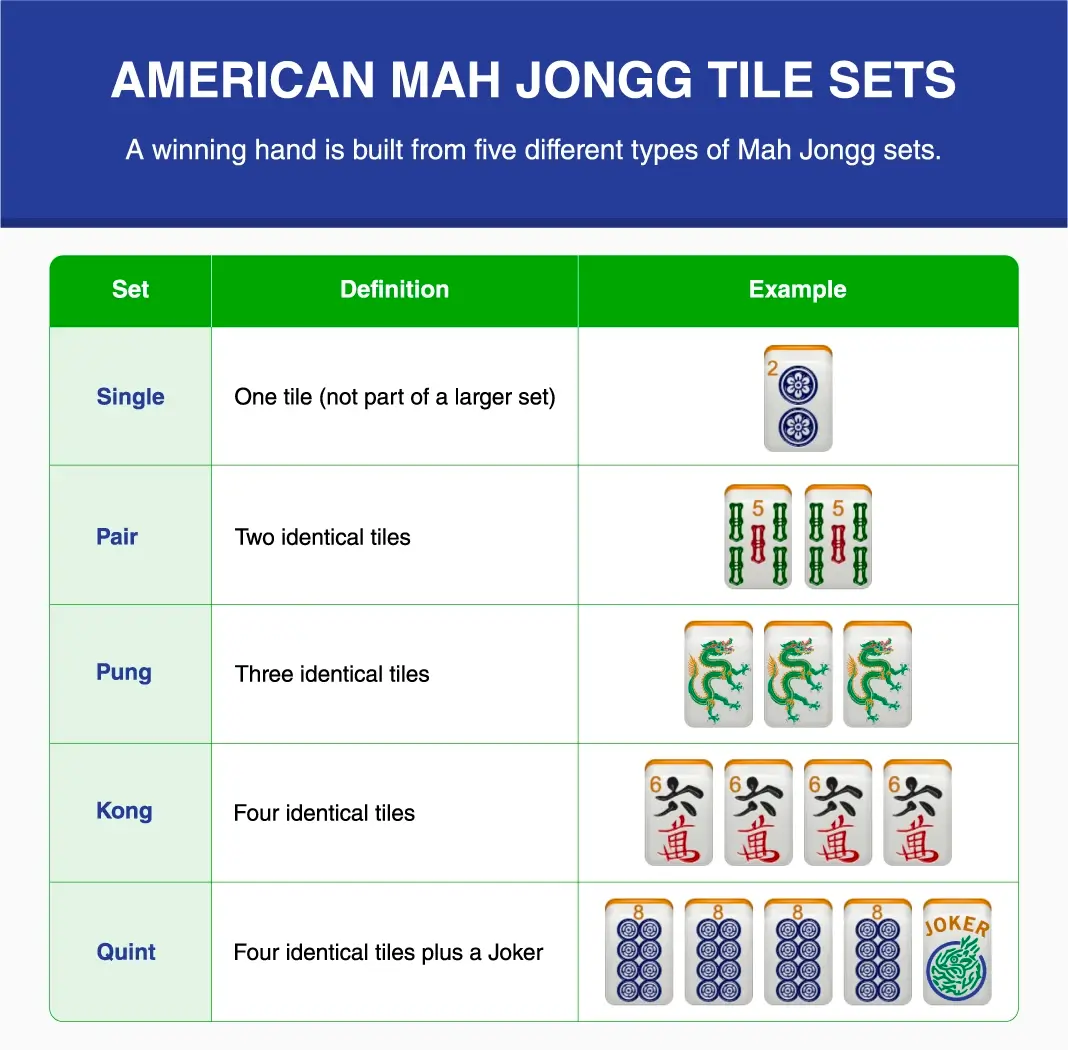
Mahjong terminology can make fairly simple actions sound more complicated than they are. A pair is simply two matching tiles, while terms such as pung (three identical tiles) and kong (four identical tiles) describe other groups of matching tiles. Depending on the version you're playing, you may also hear terms such as chow, exposure, the wall, Joker, and the Charleston. After you know the most common Mahjong terms, it's much easier to follow instructions and understand what's happening around the table.
What this means for beginners: You don't need to learn an entire Mahjong dictionary. Focus on the handful of terms you encounter during normal play for the variation you’re playing, and the vocabulary will become familiar through use.
Different Versions of Mahjong Have Different Rules
Part of the confusion around learning Mahjong comes from the fact that there isn't one universal set of rules. American Mah Jongg, Chinese Mahjong, Hong Kong Mahjong, Japanese Riichi, and other variations share some basic features but differ in how players build a winning hand, use special tiles, and calculate scoring.
In many traditional versions of Mahjong, for example, a standard winning hand consists of four sets and a pair. Those sets may include pungs, chows, or a kong. If you've played Rummy, Chinese Mahjong may feel familiar because both games involve drawing and discarding pieces while working toward combinations. Instead of collecting sets and runs of cards, you're building combinations of tiles, such as pungs and chows. American Mah Jongg works differently: Players build one of the specific winning combinations shown on the current National Mah Jongg League (NMJL) card.
Trying to learn rules from several variations at once can make Mahjong seem much harder than it is. Understanding the different types of Mahjong can help you identify which rules actually apply to the game you want to play.
What this means for beginners: Pick one variation and learn it first. You don't need to understand every form of Mahjong to sit down and play one of them.
The NMJL Card Has Its Own Learning Curve
The NMJL card is often one of the biggest challenges for new American Mah Jongg players because it determines which winning hands are valid. The National Mah Jongg League publishes a new card each year, and players use the combinations on that card rather than simply collecting any four sets and a pair.
At first, the card can look like meaningless rows of numbers, letters, colors, and abbreviations, but if you practice creating winning hands, it becomes easier. Then after you understand how American Mah Jongg hands work, you’ll be able to recognize patterns and match them to possible hands on your rack. You can even practice identifying winning hands on Mahjong 4 Friends to increase your efficiency at spotting them.
What this means for beginners: You don't need to memorize the NMJL card. The card stays in front of you while you play; the skill you're developing is learning how to read it and recognize which hands work with your tiles.
You May Not Know What to Keep or Discard
One of the biggest challenges for Mahjong beginners is figuring out which tiles to keep and which to let go. You may recognize the tiles and understand the basic rules but still struggle to see how the tiles in front of you could form a winning hand.
In American Mah Jongg, this starts during the Charleston, when you must decide which tiles to pass before regular play begins. Once play starts, you also need to consider which tiles fit the hands you're pursuing on the NMJL card, and the rules for Jokers add another consideration because they can substitute for certain tiles in a winning combination.
What this means for beginners: You don't need to know the best tile to keep or discard every time. Start by identifying the combinations you're working toward, and practice recognizing which tiles help you get there.
You Know What You Can Do but Not What You Should Do
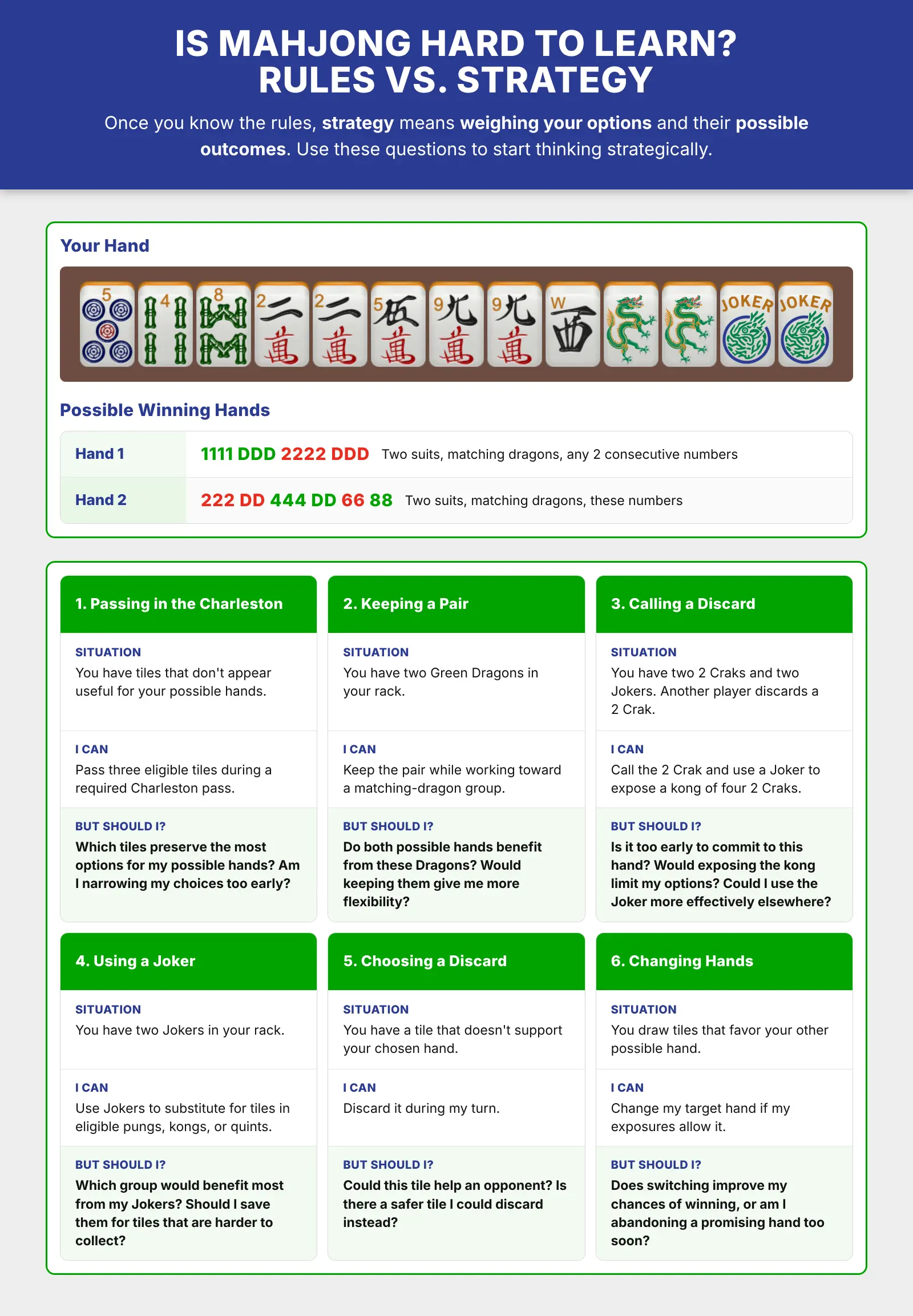
Learning how to play Mahjong is easier than learning how to make the best decision on every turn. After you understand the basic mechanics, the challenge shifts from remembering what you're allowed to do to deciding what you should do.
For example, in American Mah Jongg, you may know that you can call a discarded tile, but should you? You might have several possible hands on the NMJL card, but which one gives you the best chance of winning? And even if a discard doesn't help you, could it help an opponent?
In Chinese Mahjong, you face similar decisions about which combinations to pursue, whether to claim a discarded tile, and how your choices affect the possibilities available on future turns.
Those decisions become easier once basic actions, such as recognizing tiles, taking a turn, drawing, and making a discard, no longer require as much thought. American Mah Jongg strategy becomes much more useful once you're comfortable with the mechanics of the game.
What this means for beginners: You don't need to make the best strategic decision every time to enjoy Mahjong. First learn what moves are allowed and how to complete a winning hand. With practice, you'll get better at recognizing which moves are most advantageous. Strategy is a skill you develop over time, not a prerequisite for getting started.
Scoring Can Add Another Layer of Complexity
Mahjong scoring can be complicated because the scoring system depends on the version of Mahjong you're playing. Chinese and Hong Kong–style games may assign different values to particular combinations or winning hands, while American Mah Jongg uses the values printed on the NMJL card.
This is another area where trying to learn every possibility before playing can make Mahjong feel unnecessarily difficult. Scoring makes considerably more sense once you understand how a winning hand is constructed in your chosen variation.
What this means for beginners: Learn what makes a legal winning hand before worrying about every scoring possibility. Scoring can come after you're comfortable building and recognizing valid hands.
The First Few Games Require You to Think About Everything at Once
The first few games of Mahjong are often the hardest because none of the individual actions have become automatic yet. You may be recognizing Mahjong tiles, checking the NMJL card, remembering whose turn it is, watching other players' discards, deciding what to keep, and figuring out what to discard all at the same time.
Even before you start to actually play, setting up a Mahjong game can add to that feeling. From building and breaking the wall to getting your tiles into the rack, the set up can be a whirl of activity that looks foreign. But with repetition, many of those tasks stop requiring conscious thought. That frees up your attention for the decisions that make Mahjong interesting.
What this means for beginners: Don't judge how difficult Mahjong is by your first game. Much of what feels hard initially isn't conceptual difficulty. It's simply the mental load of doing several unfamiliar things at once. Our guide to American Mah Jongg for beginners breaks the game into the same steps you'll encounter at the table, so you can learn the mechanics in context rather than trying to absorb everything at once.
7 Steps That Make Learning Mahjong Easier
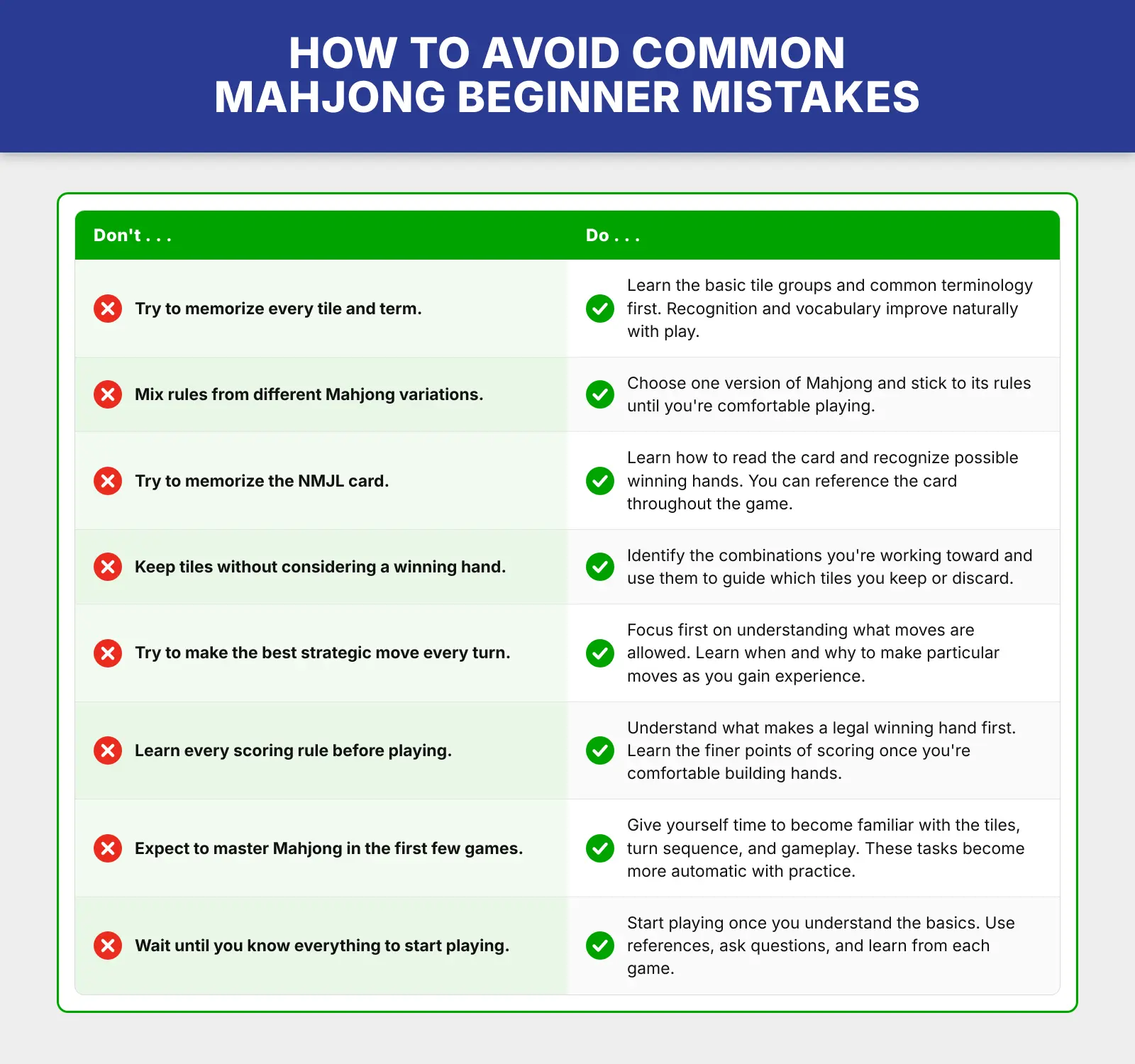
The easiest way to learn Mahjong is to break the game into manageable pieces and start playing before you try to master every rule. You don't need to memorize the tiles, scoring system, winning combinations, and advanced strategy before your first game. Learn what you need for the version you're playing, keep a reference handy, and add more skills as the basics become automatic.
1. Choose One Version of Mahjong to Learn First
Learning one version of Mahjong at a time makes the game much easier because you aren't trying to keep different rules and winning hands straight. American Mah Jongg, Chinese Mahjong, Hong Kong Mahjong, Japanese Riichi, and other versions share many gameplay concepts, but they aren't interchangeable.
American Mah Jongg isn't necessarily harder than Chinese Mahjong; the two games simply put the learning curve in different places. American Mah Jongg gives you the allowable winning combinations on the NMJL card, so you don't have to memorize them. However, you do need to learn how to interpret the card and choose among those possibilities. The Charleston and Jokers add rules that don't exist in traditional Chinese play.
Chinese Mahjong doesn't use a card of predetermined hands. Instead, players build combinations such as chows, pungs, kongs, and a pair. That may feel more intuitive to someone familiar with Rummy and other set-building games, while scoring and strategic tile decisions add complexity as you improve.
There are enough differences between American Mah Jongg and Chinese Mahjong that learning one doesn't mean you'll automatically know how to play the other.
Make it easier: Pick the version your friends play or the one you're most interested in and stick with that rule set while you're learning. You can always learn another form of Mahjong later.
2. Don't Try to Memorize Everything
You don't need to memorize Mahjong to play Mahjong. Beginners often make the game harder by thinking they need to know every tile, term, rule, and exception before they can sit down at the table.
Use references while you're learning. The printable American Mah Jongg cheat sheets, for example, organize tile groups, setup, the Charleston, NMJL card basics, hand selection, and gameplay in the order you'll encounter them during a game.
The same principle applies to the NMJL card. It stays in front of you while you play because you aren't expected to memorize all of its winning combinations.
Make it easier: Keep the information you need within reach rather than trying to hold everything in your head. Repetition will eventually turn many of those lookups into things you know automatically.
3. Start Playing Before You Feel Completely Ready
Playing Mahjong is one of the fastest ways to make the rules make sense because it puts unfamiliar concepts into context. Reading about the wall, racks, discards, Jokers, a kong, or the Charleston is useful, but seeing those things happen during a game makes them much easier to remember.
Expect to ask questions during your first game. You may need reminders about tile names, whose turn it is, whether you can call a discard, or what constitutes a winning hand. That's part of learning rather than a sign that you haven't learned enough to play.
After several games, you'll begin recognizing Mahjong tiles more quickly and spend less time thinking about the basic turn sequence. Actions that initially required concentration start becoming automatic.
Make it easier: Don't wait until you know every rule to play your first game. Learn enough to follow what's happening, then let actual gameplay reinforce what you've learned.
4. Teach Yourself with a Combination of Instructions and Practice
You can teach yourself Mahjong without taking a class or having an instructor at the table. Clear instructions can teach you the rules, but actual play provides the context that makes those rules easier to understand and remember.
The two work best together. Read enough to understand the next part of the game, play until it makes sense, and return to more detailed explanations when you're ready for them. That approach is often less overwhelming than trying to learn the entire game before you play it.
Make it easier: Think of learning Mahjong as a cycle—learn a little, play a little, then learn more—rather than a course you have to complete before you're allowed to sit down at the table.
5. Practice Without the Pressure of Keeping Up with Other Players
Practicing on your own can make learning Mahjong easier because you can concentrate on your decisions instead of worrying about slowing down a table of four players. This is especially helpful when you're still learning to read the NMJL card or deciding which tile to discard.
Mahjong 4 Friends lets you play Mahjong online against bots, so you can practice the mechanics of the game before—or between—games with other people. Instructional prompts can help guide gameplay, and American Mah Jongg players can use the Suggested Hands to help identify possibilities from the NMJL card.
As you become more comfortable, you can rely less on those learning aids and make more of the decisions yourself.
Make it easier: Give yourself opportunities to practice where making a mistake, looking something up, or taking extra time doesn't matter.
6. Learn Strategy After the Mechanics Start Feeling Natural
Strategy becomes much easier to learn once you aren't using all your attention to remember the basic rules. There's a big difference between knowing how to play Mahjong and knowing which decision gives you the best chance of winning.
At first, you may simply be asking, “Can I call that tile?” or “What am I allowed to discard?” With experience, those questions change: Which hand should I pursue? Should I keep this tile? Is it time to switch hands? What might another player be building? Could this discard help an opponent?
That's the point when American Mah Jongg strategy becomes more useful. With continued play, you may find yourself thinking several moves ahead and incorporating advanced Mah Jongg strategies.
Make it easier: Don't expect yourself to make expert strategic decisions while you're still learning the mechanics. First learn how to play; then work on playing well.
7. Measure Your Progress in Games, Not Hours
There's no single amount of time it takes to learn Mahjong because learning the rules, becoming comfortable, and developing strategy happen at different rates. Instead of expecting to “know Mahjong” after a certain number of minutes or lessons, pay attention to what becomes easier each time you play.
During your first game, expect to ask questions and look things up. After several games, tile recognition and gameplay should start requiring less thought. With continued practice, you'll spend less attention on the rules and more on the decisions you're making.
Eventually, instead of asking, “Can I do this?” you'll find yourself asking, “Is this the best thing to do?”
Make it easier: Don't use your first game as the test of whether Mahjong is difficult. Look for progress in what you no longer have to think about from one game to the next.
Make Practicing Mahjong Easy with Mahjong 4 Friends
Mahjong isn't particularly hard to begin playing, but it takes time and practice to play well. Your first few games may feel challenging because you're learning tiles, terminology, rules, and strategy all at once, but the game itself isn’t impossibly complicated.
The best way to become confident is to play Mahjong online. Doing so relieves the pressure of having to keep up a pace you’re not comfortable with when playing at a table. As you become more confident, you can rely less on those learning aids and make more of the decisions yourself. The goal isn't to know everything before your first game. It's to know enough to play your first game—and learn from there.